

More news on this day
Air travel across the Middle East is being sharply curtailed as major U.S. and European airlines cancel or reroute flights to Dubai, Riyadh and other key Gulf hubs in response to the rapidly escalating conflict involving the United States, Israel and Iran.
Get the latest news straight to your inbox!
What Is Happening to Flights in the Region?
Since late February 2026, when joint U.S. and Israeli strikes on Iranian military sites triggered a broader regional war, airspace closures and missile attacks have repeatedly disrupted some of the world’s busiest aviation corridors. Publicly available flight-tracking data and aviation advisories show that airspace over Iran, Iraq, Israel, Syria, parts of the Gulf, and sections of the eastern Mediterranean has been intermittently shut, forcing commercial traffic to thin out dramatically or avoid the region altogether.
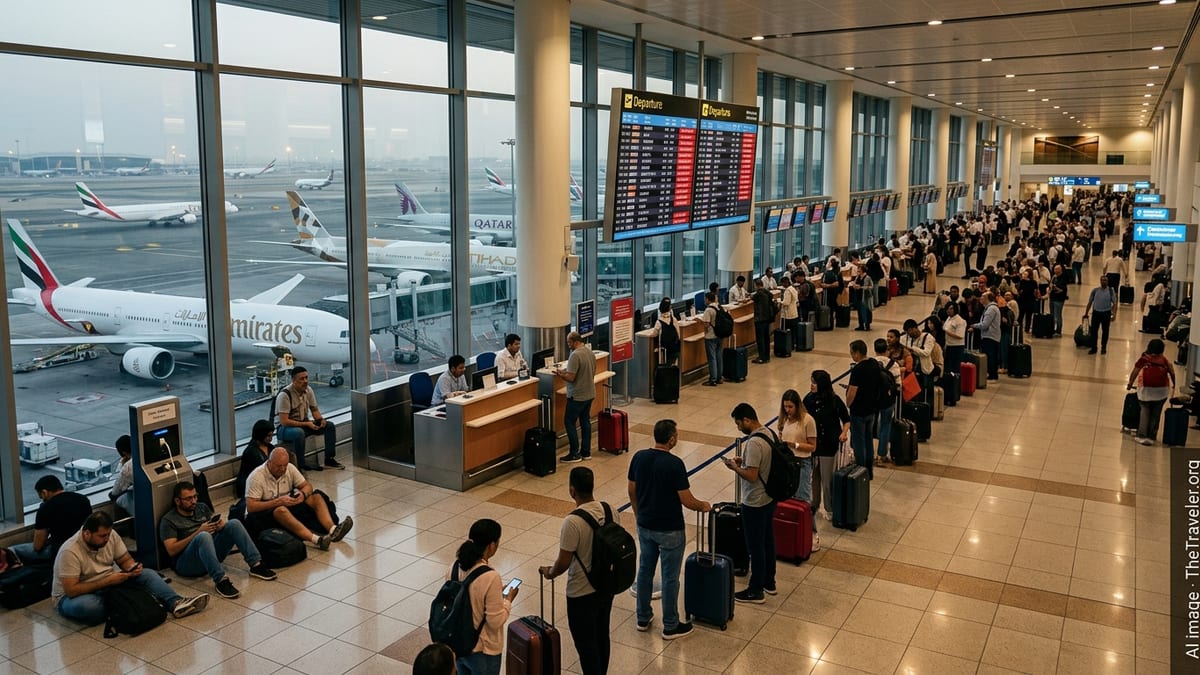
Major hub airports in Dubai, Abu Dhabi, Doha and other Gulf cities, normally vital connectors between Europe, Africa, Asia and North America, have faced waves of cancellations and diversions. Reports from aviation analytics firms indicate that during the initial days of the current escalation, several thousand flights to and from Middle Eastern hubs were cancelled, with tens of thousands more delayed worldwide as aircraft and crew were left out of position.
The current turmoil builds on a pattern of disruptions that began with the Israel–Hamas war in 2023 and intensified after repeated flare-ups between Israel and Iran. Over the past two years, airlines have repeatedly suspended and then partially restored services in the region, but the latest round of attacks, including missile and drone strikes on or near airports in the United Arab Emirates and Qatar in February and March 2026, has pushed many carriers to further scale back operations.
Which Major Airlines and Routes Are Affected?
U.S. carriers have been among the most prominent to trim Middle Eastern networks. According to published airline statements and travel-industry coverage, American Airlines has suspended select services to Doha and other Gulf destinations at various points during the conflict. United Airlines and Delta Air Lines had already halted Tel Aviv services in earlier rounds of fighting and subsequently extended suspensions as security conditions deteriorated; more recently, coverage indicates that United has paused some services touching Dubai, while American and other carriers have limited flying to Qatar and neighboring states during peak risk windows.
European airlines are also scaling back. Reporting from European travel and business outlets shows that Air France–KLM has cancelled flights to Dubai and Riyadh on multiple days as airspace closures ripple through the Gulf, while Finnair has temporarily halted flights to Doha. Earlier disruptions saw carriers such as British Airways, Lufthansa, and others divert or cancel flights that would normally overfly Iranian and Iraqi airspace, sometimes returning aircraft to their origin airports after several hours in the air when safe routing was no longer available.
Gulf-based airlines, including Emirates, Etihad and Qatar Airways, have not withdrawn from their home hubs but have been forced to trim schedules and consolidate services as missile and drone strikes damaged infrastructure and prompted brief airport closures. Travel and aviation reports describe periods when only limited operations were possible at Dubai International and Abu Dhabi, with dozens of long-haul services cancelled or delayed and some aircraft repositioned to secondary airports once airspace partially reopened.
Why Are Dubai, Riyadh and Other Hubs So Exposed?
The Middle East sits astride the shortest flight paths between Europe and much of Asia and Australasia. After large parts of Russian and Ukrainian airspace became off limits to many Western carriers in 2022, the importance of Gulf hubs such as Dubai, Doha and Abu Dhabi grew even further. Airlines restructured networks to funnel more passengers and freight through these cities, relying on relatively stable airspace and extensive long-haul fleets to bridge continents.
The current conflict directly threatens that model. Missiles and drones have targeted energy infrastructure and military facilities across the Gulf, and publicly available reports describe strikes and near-misses in proximity to major airports in the United Arab Emirates, Qatar and Saudi Arabia. Even when runways and terminals escape serious damage, the perceived risk of debris or miscalculation in crowded skies is enough for airlines and regulators to curtail operations.
Regional hubs are also vulnerable because many long-haul flights use them as overflight corridors rather than destinations. When airspace over Iran, Iraq or the Gulf closes, aircraft traveling between Europe and India, Southeast Asia or Australia must detour thousands of kilometers north via Central Asia or south via Egypt and the Arabian Sea. That adds hours of flight time, raises fuel costs and, in some cases, makes routes economically or operationally unviable, leading airlines to cancel entire rotations rather than operate heavily delayed services.
How Travelers Are Being Impacted
The most immediate effect for passengers is uncertainty. Travelers connecting through Dubai, Riyadh, Doha, Abu Dhabi or Jeddah are facing last-minute cancellations, extended layovers and sudden reroutings. Travel-compensation platforms and passenger-rights organizations report a spike in claims and assistance requests since the latest U.S.–Israel–Iran escalation, with many travelers stranded for 24 hours or more as airlines struggle to find alternative routings on limited remaining capacity.
Flight times are also increasing on many long-haul journeys, even when services are not cancelled. With key airways closed, airlines are scheduling longer routings that add one to three hours to typical Europe–Asia journeys, affecting itineraries that connect via Gulf hubs and those that simply overflew the region in the past. This can create knock-on delays across airline networks, particularly when aircraft and crews run up against strict duty-time regulations.
Travelers with upcoming trips to the broader region, including leisure destinations such as Dubai or coastal resorts in Oman and Saudi Arabia, are being urged in public advisories to closely monitor government travel guidance and airline communications. Some tour operators are allowing fee-free rebooking or destination changes, while flexible ticket policies that emerged during earlier phases of the Middle East crisis remain in place with certain carriers, at least for departures in the coming weeks.
What to Do If You Have a Flight Booked
For travelers holding tickets to or through Middle Eastern hubs in the short term, the most reliable information is coming from airline websites and mobile apps, which are updated as operational decisions change throughout the day. Travel experts and consumer groups recommend enabling push notifications for schedule changes, checking reservation details frequently and verifying airport of departure and arrival, as some services are being moved to secondary airports when primary hubs experience temporary shutdowns.
Airlines are generally offering rebooking on the next available flights or refunds when services are cancelled, although the availability of seats on alternative routings is limited on certain high-demand corridors. Passengers willing to accept longer itineraries or different connection points, such as routing via southern Europe or East Africa rather than the Gulf, may have better chances of reaching their destination within a reasonable timeframe.
Travel insurers are starting to publish clarifications on what is covered under existing policies in the context of the US–Israel–Iran conflict. In many cases, standard policies may cover delays and missed connections but exclude cancellations tied directly to acts of war. Travelers booking new trips are being encouraged by advisory notices to scrutinize policy language carefully, consider higher-tier coverage and weigh whether nonessential travel to or through affected hubs can be postponed until conditions stabilize.