

More news on this day
Airlines across the globe are pushing through rapid fare hikes, fuel surcharges and schedule changes as the escalating West Asia crisis tightens jet fuel supplies and forces lengthy detours around closed airspace, sharply increasing the cost of long-haul travel.
Get the latest news straight to your inbox!
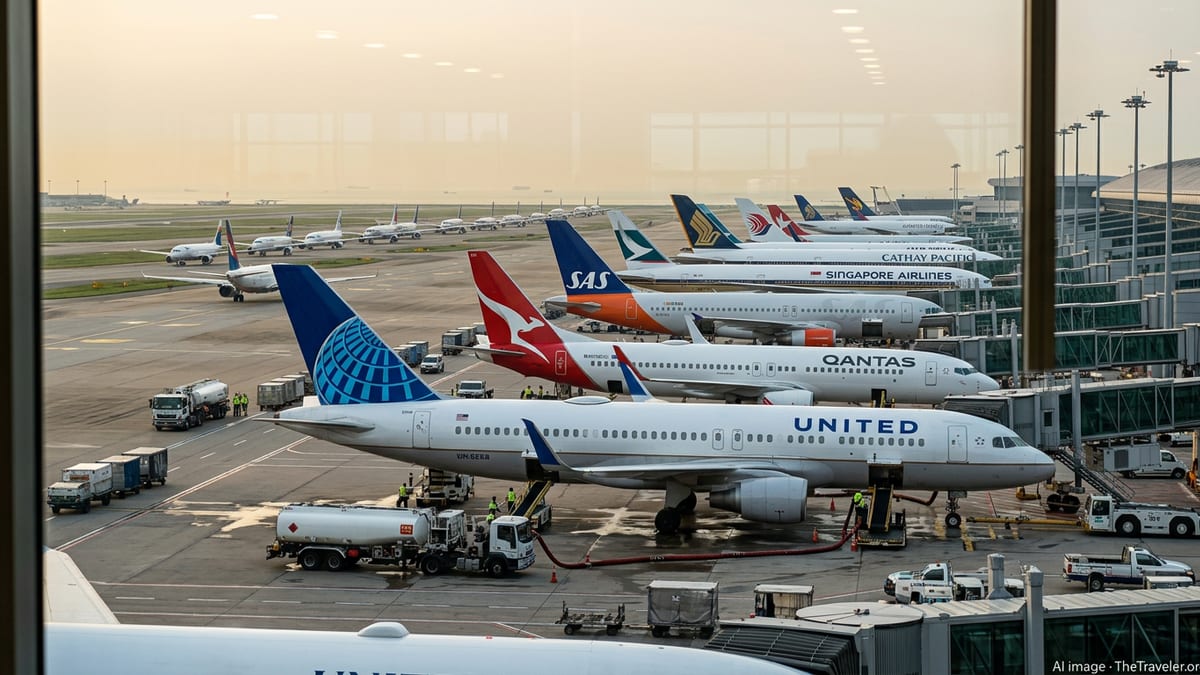
Jet Fuel Shock Ripples Through Global Aviation
Publicly available market data shows aviation fuel prices have almost doubled since early January, with jet fuel trading in recent days around levels not seen in years as oil exports from the Gulf are disrupted by the conflict in and around Iran. Industry analyses indicate that aviation turbine fuel typically makes up close to 40 percent of an airline’s operating costs, meaning even short price spikes can rapidly erode margins and force fare adjustments.
The current surge has been amplified by the partial closure of the Strait of Hormuz and missile strikes on energy infrastructure across several Gulf states, which have reduced crude output and complicated tanker movements. Economic assessments of the 2026 Iran war describe multi-million-barrel-per-day production losses and a sharp rise in oil benchmarks, translating directly into more expensive refined jet fuel for airlines from North America to Asia.
Specialist travel fare trackers report that on some Asia–Europe routes, one-way economy tickets briefly climbed several hundred percent above typical prices on peak days as carriers scrambled to reprice limited capacity and factor in higher fuel burn from longer routings. For many leisure travelers, particularly those connecting through key West Asia hubs, the era of relatively affordable long-haul tickets has given way almost overnight to premium pricing and tight seat availability.
United, Delta and Southwest Brace for Higher Costs
Major United States carriers are also being swept up in the turmoil, even as they operate far fewer flights through the immediate conflict zone than many Asian and European rivals. Publicly available financial commentary notes that United Airlines, Delta Air Lines and Southwest Airlines largely do not hedge fuel costs, leaving them more exposed to sudden increases in jet fuel prices than some European counterparts that lock in prices months in advance.
In response, analysts following the U.S. airline sector indicate that these carriers are leaning on a combination of yield management and targeted surcharges to protect profitability. On long-haul routes that skirt the Middle East or depend on refuelling in affected regions, fares have already been nudged higher, with dynamic pricing engines pushing up last-minute and peak-season tickets fastest.
While comprehensive fare tables for United, Delta and Southwest have not been publicly updated for every market, forward-looking guidance suggests these airlines will continue to adjust base fares and ancillary fees through the northern summer if jet fuel remains elevated. Passengers booking transatlantic or transpacific itineraries that rely on European or Asian partners may particularly feel the pinch, as joint ventures pass through rising operating costs.
Qantas, Air New Zealand and SAS Move First on Fare Hikes
Published coverage from Asia-Pacific and European outlets indicates that Australia’s Qantas Airways, Air New Zealand and Scandinavian carrier SAS were among the earliest to announce explicit airfare increases tied to the West Asia conflict. Reports from March 10 and 11 describe these airlines outlining near-term price rises and acknowledging the pressure created by jet fuel that has jumped from around 85 to 90 U.S. dollars per barrel before the latest strikes to as high as roughly 150 to 200 dollars per barrel.
Air New Zealand has detailed increases across its network, including additional charges on domestic, short-haul international and long-haul services, while also suspending its full-year 2026 financial outlook due to uncertainty around fuel and demand. Market commentary frames this as a sign of how difficult it has become for airlines to forecast costs and capacity in the current environment.
Qantas has similarly begun lifting international fares, including on its flagship Australia–Europe services. Australian media reports describe temporary schedule changes such as the carrier’s nonstop Perth–London flight taking a refuelling stop in Singapore to avoid flying near conflict-affected airspace, adding flight time and fuel burn. SAS, heavily reliant on connecting traffic between Scandinavia, Europe and Asia, is also identified in recent coverage as raising ticket prices as part of broader efforts to offset rising operating expenses.
Air New Zealand, Qantas and Thai Airways Reroute Around Closed Airspace
Route maps compiled by aviation data providers show that airspace closures spanning Iran, Iraq, Israel, Syria, Qatar, Kuwait and parts of the wider Gulf have dramatically narrowed the corridors available for flights between Europe, Asia and Australasia. To maintain service, carriers such as Air New Zealand, Qantas and Thai Airways have been rerouting across alternative paths, including over the Indian Ocean, the Red Sea, the Caucasus and Central Asia, in some cases adding hours to traditional great-circle routings.
These extended flight paths have technical and commercial consequences. Longer sectors require more fuel to be uplifted at departure, increase crew duty times and may reduce the amount of cargo that can be carried under weight restrictions. Airlines are responding with a mix of extra technical stops, revised departure times and selective frequency cuts on marginal routes to preserve operational resilience.
Travel advisories and airline statements collated by regional travel outlets list a series of temporary suspensions and schedule trims to destinations in and around the Middle East. At the same time, high-yield trunk routes between major hubs in Europe, Asia and Oceania are being protected, with premium-cabin pricing holding firm or rising as business and essential travelers compete for a smaller pool of seats.
Fuel Surcharges, Capacity Cuts and the Outlook for Travelers
Outside the headline fare increases, many carriers are turning again to fuel surcharges, a pricing tool heavily used during earlier oil shocks. Industry news sites document airlines across Asia, the Middle East and Europe publishing new surcharge tables for March 2026, with extra fees applied per sector that vary by distance and cabin. Some low-cost and leisure-focused airlines are raising surcharges by more than 30 percent on routes to popular holiday destinations in South Asia and the Indian Ocean, signaling that budget travelers may be among the hardest hit.
Capacity reductions are also starting to emerge as an important lever. Freight and logistics briefings describe how constrained hub connectivity in the Gulf, combined with reduced bellyhold cargo space on rerouted passenger flights, is pushing up rates for air freight. For airlines, operating fewer but fuller flights can help manage crew and fuel costs, yet for passengers this often translates into busier airports, fewer time options and steeper prices on the departures that remain.
For now, forward-looking commentary from travel analysts suggests that elevated airfares on routes touching Europe, Asia, Africa and Oceania are likely to persist at least into mid-2026, or until oil markets stabilize and key West Asia airspace is safely reopened. Travelers planning long-haul trips are being advised by consumer-facing outlets to book earlier than usual, remain flexible on dates and routings, and budget for significantly higher ticket prices than they would have faced even a few months ago.