

More news on this day
Germany’s proud reputation for precision is being stress tested in its skies. After a winter of sudden strikes, staffing bottlenecks and packed schedules, travellers flying to, from or through German airports are discovering that even confirmed bookings can evaporate hours before departure, with little warning and few easy alternatives.
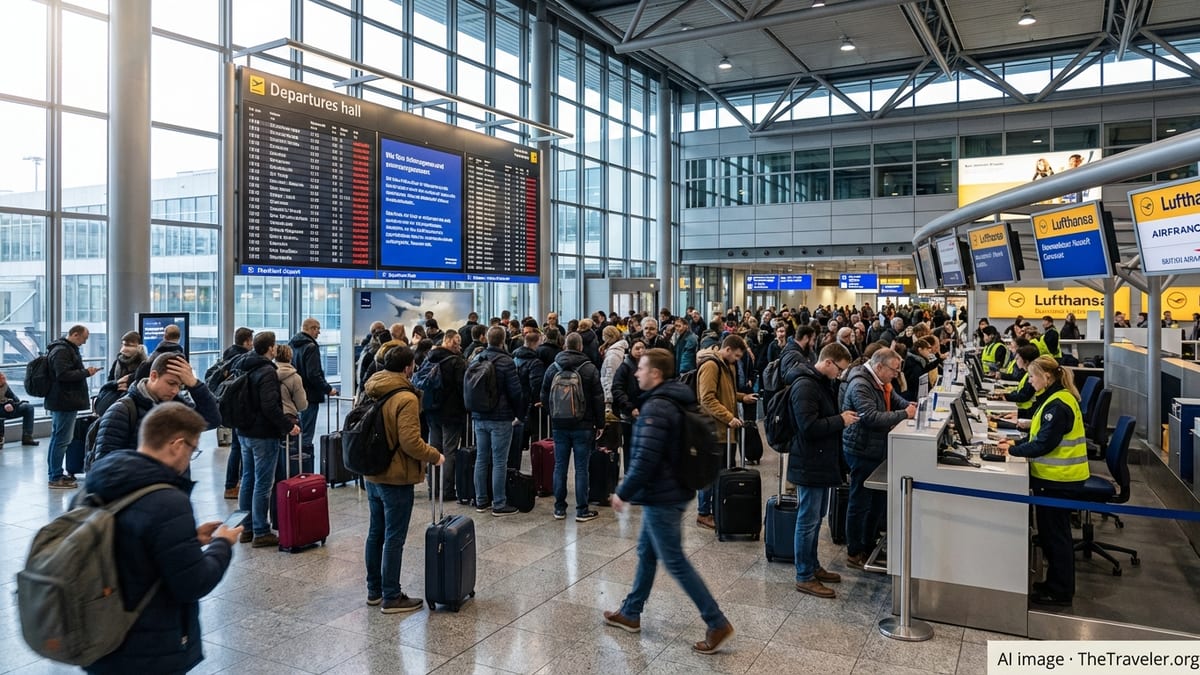
A New Wave of Strikes Throws German Travel Plans Into Turmoil
In mid-February 2026, Germany once again woke up to empty departure boards and swelling crowds in terminal halls as a coordinated 24-hour strike by Lufthansa pilots and cabin crew forced the airline to cancel around 800 flights in a single day. The walkout on 12 February disrupted travel for roughly 100,000 passengers, hitting Frankfurt and Munich particularly hard and rippling across European and long-haul networks.
The industrial action involved thousands of cockpit crew represented by the Vereinigung Cockpit union and some 20,000 cabin crew with the UFO union, each pursuing separate disputes over pensions, working conditions and job security at subsidiaries such as CityLine. With departures from all major German airports affected, large parts of the national and European schedule simply disappeared, often with less than 24 hours’ notice for travellers.
Although Lufthansa restored normal operations the following day and laid on extra flights to clear the backlog, the episode underscored a new reality for passengers: even a routine midweek journey through Europe’s largest economy can be derailed overnight. For many foreign travellers, particularly those connecting via Germany’s hubs, it has become harder than ever to judge whether a trip will run as ticketed.
This latest stoppage follows a broader trend. Over the past two years, Germany has seen repeated walkouts by airport security staff, ground handlers and public-sector workers that at times have shut down more than a dozen airports simultaneously. Each dispute may be time-limited, but together they have created an environment where sudden, mass cancellations are no longer the exception.
From Warning Strikes to Systemic Instability
To understand why flights in Germany can vanish at such short notice, it is essential to grasp the country’s strike culture. Unions often deploy “warning strikes” as a bargaining tool during wage negotiations. These tend to be announced only a few days in advance, but their impact can be dramatic. In March 2025, a nationwide warning strike by the ver.di union targeting public service, ground staff and aviation security workers at 13 airports led to the cancellation of more than 3,500 flights and affected an estimated 560,000 passengers in just 24 hours.
At Frankfurt Airport, one of Europe’s busiest hubs, more than 1,000 of the day’s 1,100-plus takeoffs and landings were scrapped, effectively shutting down normal operations. Berlin’s main airport saw all regular departures and arrivals cancelled, while Cologne/Bonn, Hamburg and several regional gateways also halted much of their passenger traffic. For travellers, many of whom had already checked in or were en route, the disruption felt sudden and absolute.
Even before that, in early 2024, a 24-hour strike by security staff brought 11 major airports to a standstill, forcing airlines to ground more than a thousand flights and stranding roughly 200,000 passengers. These repeated shutdowns show how dependent modern air travel is on specialized staff at security checkpoints, baggage belts and boarding gates. When those workers down tools together, the system has few fail-safes.
While German law requires advance notice of industrial action, the timelines are short enough that passengers often have little more than a weekend to react. For those flying for weddings, funerals or tightly timed business meetings, that can mean the difference between catching a crucial event and missing it entirely. As disputes over wages and inflation continue across the public sector, there is little sign that warning strikes will disappear from the travel calendar.
Staffing Shortages and Europe’s Strained Airspace
Strikes are not the only reason passengers are being caught off guard. Structural weaknesses in Europe’s aviation network are amplifying the impact of each disruption. Data from the International Air Transport Association show that European air traffic control delays more than doubled between 2015 and 2024, even though the number of flights rose only modestly. Capacity constraints and staffing shortages, particularly in France and Germany, account for the majority of these delays.
Eurocontrol, the continent’s air traffic coordination body, has highlighted that Germany’s air navigation service provider remains among the top contributors to air traffic flow management delays. While the average delay per flight caused by German air traffic control has come down from recent peaks and recruitment of new controllers is ramping up, shortages at key centres persist. Training new controllers takes years, and retirements during and after the pandemic have left gaps that cannot be filled quickly.
Complicating matters, European airspace is operating under unusual constraints. Large parts of eastern skies remain closed or restricted due to the war in Ukraine, forcing flights onto longer, narrower corridors through central Europe, including Germany. Summer storms and increasingly frequent drone sightings over airports add further unpredictability. Even a modest weather system over a busy hub can now push the network beyond its designed capacity.
For travellers, the result is a fragile system where any shock, from a local security strike to a distant thunderstorm, can cascade into last-minute cancellations and missed connections. Airlines, already running lean after the pandemic, have limited spare aircraft and crew to plug holes in the schedule. When a flight from Frankfurt or Munich is scrubbed, especially during peak seasons, there may simply be no alternative seats left the same day.
How Airlines Decide to Cancel at the Last Minute
Behind every cancelled flight lies a complex calculus that is often invisible to passengers. When unions announce a strike or airports signal capacity cuts, airlines build new schedules on the fly. They must decide which routes to preserve, which to reduce, and which to cancel outright, often within hours. Priority typically goes to long-haul services, high-yield business routes and aircraft positioned to avoid leaving crews and planes stranded in the wrong place.
In the February Lufthansa strike, the airline sought to protect as much of its intercontinental network as possible while axing hundreds of European and domestic legs. Some cancellations were communicated a day or more in advance. Others, however, were made far closer to departure as the carrier gauged how many pilots and flight attendants actually joined the walkout and how quickly back-up arrangements could be put in place. That left many passengers discovering their flights were cancelled only when they checked their apps or arrived at the terminal.
Operational constraints add further complexity. German hubs like Frankfurt, Munich and Berlin operate close to runway, gate and staffing limits during peak hours. When a snowstorm hits or a baggage system fails, airport authorities may instruct airlines to trim their schedules by a fixed percentage to keep remaining operations manageable. Carriers then often choose to cancel entire rotations rather than delay multiple flights, a strategy that minimises knock-on disruption but maximises the number of passengers whose flights disappear completely.
Once crew duty-time limitations, aircraft maintenance windows and connecting banks are factored in, it can be more practical for an airline to cancel a flight outright than to push it back by several hours. For travellers whose journeys depend on tight onward connections, a well-timed cancellation can be better than a long delay, but the lack of transparency around how and why such decisions are made feeds a perception of arbitrary chaos.
The Human Impact on International Travellers
For travellers, the numbers behind Germany’s airport disruptions translate into concrete personal losses. Business travellers report missing contract negotiations and industry conferences after last-minute cancellations left them unable to find replacement seats. Tourism-dependent regions complain of lost bookings as would-be visitors opt for routings that avoid German hubs during strike-prone periods.
Families and leisure travellers, often less familiar with the fine print of airline contracts, can fare particularly badly. When a one-day strike triggers hundreds of cancellations, hotels around major airports quickly sell out. Those who do not live near Frankfurt, Munich or Berlin may find themselves sleeping on terminal floors or paying high last-minute rates for whatever rooms remain. Language barriers and long queues at service desks add to the stress for visitors from abroad.
Inbound passengers are not immune. A traveller flying from North America to a secondary European city via Frankfurt, for example, may land in Germany on time but find their onward connection cancelled. If alternative flights are full, they can be left stranded far from their final destination, juggling missed hotel nights and rearranged ground transport. In winter, when train services themselves may be disrupted by weather, surface alternatives are not always reliable.
The psychological toll is harder to quantify but just as real. Frequent flyers describe building extra buffer days into itineraries, arriving earlier for airport procedures and double-checking bookings multiple times. For many, what was once a seamless experience has become a gamble, with each journey requiring contingency planning normally reserved for long-haul adventure travel rather than routine European hops.
Passenger Rights: What EU261 Really Offers
Despite the chaos, travellers in Germany are not without protections. Under European Union air passenger rules, commonly referred to as EU261, passengers whose flights are cancelled on short notice may be entitled to financial compensation in addition to rebooking or refunds. For most flights departing German airports, compensation ranges from 250 to 600 euros per person, depending on the distance of the journey and the length of the disruption.
Crucially, strikes by an airline’s own staff, such as the recent Lufthansa walkout, are generally not considered extraordinary circumstances that would exempt carriers from paying compensation. That means many of the passengers caught up in the February cancellations will be eligible to claim, provided they were informed of the disruption less than 14 days before departure and meet other criteria regarding delays and rerouting.
However, asserting those rights can be a challenge, particularly for foreign travellers unfamiliar with the process or daunted by language and documentation requirements. Airlines sometimes reject claims on technical grounds, leaving passengers to pursue appeals or turn to specialist claim companies that take a cut of any payout. During major strike events, call centres and online claim forms can be overwhelmed, leading to long waits for answers.
It is also important to distinguish between compensation and care. Even when a disruption is caused by extraordinary circumstances such as severe weather or airspace closures, airlines must still provide meals, refreshments and accommodation where appropriate. In practice, the scale of recent German strike days has sometimes outstripped the capacity of local hotels and catering services, leaving carriers struggling to meet those obligations in full.
How Travellers Can Reduce Their Risk
While no itinerary is completely immune to disruption, seasoned travellers are adjusting their habits in response to Germany’s turbulent skies. One strategy is to favour early-morning departures, which are less exposed to same-day knock-on delays and give more options for rerouting if something does go wrong. Another is to allow longer connection times through German hubs, particularly when travelling in or out of peak holiday periods or during seasons when wage negotiations are known to intensify.
Many travellers now monitor industrial relations news almost as closely as weather forecasts, especially if their tickets involve Lufthansa or German airports with a history of walkouts. Booking flexible fares, even at a premium, can offer more freedom to change plans if a strike is announced. Travel agents and corporate travel departments are advising clients to keep airline apps installed and notifications enabled, so that any last-minute cancellations appear on their phones as soon as they are logged.
For those with critical time-sensitive trips, routing through alternative hubs in neighbouring countries can be a pragmatic, if sometimes more expensive, option. Amsterdam, Zurich and Vienna are among the airports that frequently absorb diverted demand when Germany is hit by strikes. However, as Europe’s overall air traffic system remains under pressure from staffing constraints and congested airspace, even these alternatives are not guaranteed safe havens.
Above all, experts recommend building redundancy into travel plans. That may mean arriving a day early for a major event, reserving refundable hotels, or holding a back-up seat on a train where possible. The cost and inconvenience of such precautions are themselves a sign of how far Europe’s once-dependable aviation network has drifted from pre-pandemic norms.
Can Germany Restore Confidence in Its Airports?
German aviation leaders insist that the current turbulence, while serious, is not permanent. The country’s air navigation service provider has highlighted improvements in punctuality and a stepped-up recruitment drive that brought in more than 140 new air traffic control trainees in 2025, with higher intake planned for 2026. Airport operators are investing in upgraded security lanes, baggage systems and passenger flows in an effort to make existing capacity more resilient.
Yet much depends on factors beyond any single company’s control. Wage negotiations across the public and transport sectors are likely to flare again as inflation, housing costs and changing work expectations push unions back to the picket lines. Political pressure at the European level to reform airspace management and accelerate the long-delayed Single European Sky project is growing, but concrete changes will take years to materialise.
For now, Germany remains both an essential and an unpredictable node in global aviation. Its airports are too important to avoid entirely, especially for long-haul travellers and freight. But until structural staffing issues ease and labour relations stabilise, passengers can expect periodic episodes of sudden, large-scale disruption to continue.
For travellers planning trips in 2026, the message is clear: flying via Germany is still possible and often efficient when things go right, but it is no longer the low-risk default it once seemed. In an era of warning strikes, congested skies and tight airline resources, every ticket comes with a new level of uncertainty built in.