

More news on this day
One of the world’s busiest aviation corridors has been dramatically throttled as Dubai, Doha and Abu Dhabi slash or suspend operations, triggering days of cascading flight cancellations and leaving hundreds of thousands of travelers stranded across continents.
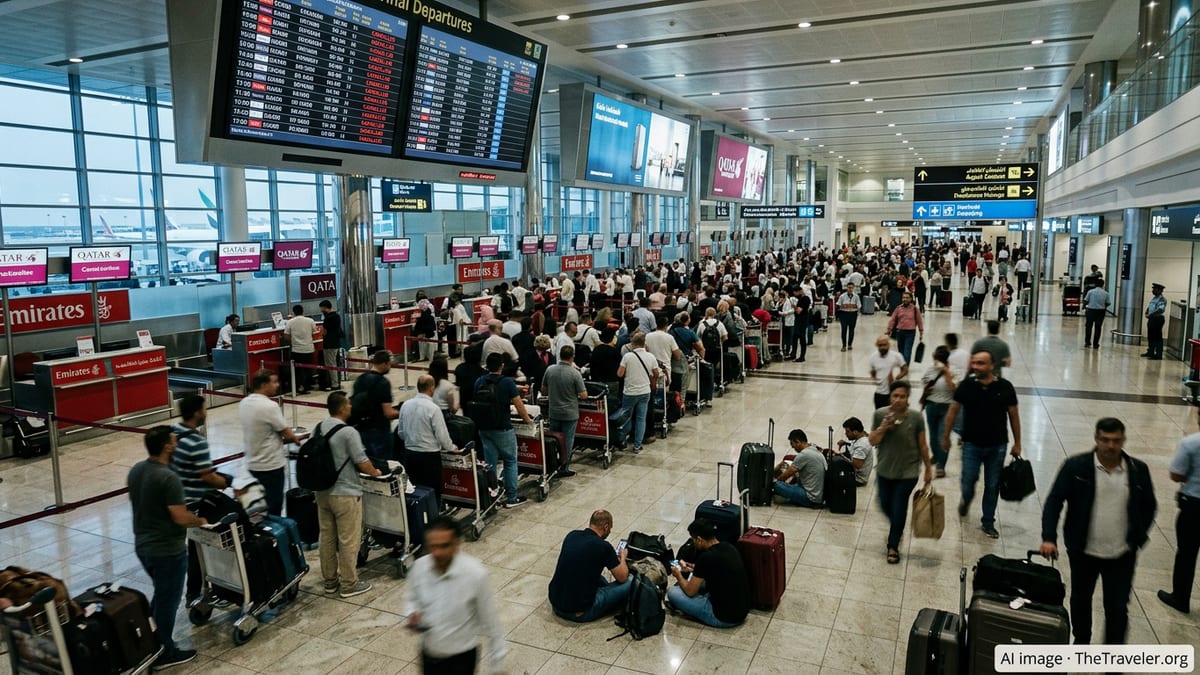
Coordinated Shutdown Ripples Across the Gulf
What began as a precautionary response to escalating Iran-related tensions has quickly become one of the most disruptive aviation crises the Gulf has seen in years. In a matter of hours between February 28 and March 2, 2026, authorities in the United Arab Emirates and Qatar moved to close or severely restrict their airspace, forcing the region’s three heavyweight hubs in Dubai, Doha and Abu Dhabi to curtail operations.
At Hamad International Airport in Doha, officials confirmed on February 28 that all aircraft movements were temporarily suspended following the closure of Qatari airspace. The move halted departures and arrivals at one of the Middle East’s most important transfer points, effectively freezing Qatar Airways’ global hub-and-spoke network and stranding passengers from Asia, Europe and Africa in transit.
In Abu Dhabi, Etihad Airways initially halted all departures from Zayed International Airport as airspace closures widened, cancelling inbound flights and warning travelers that even aircraft already en route could be forced to turn back. Although authorities later allowed a narrow window for exceptional services, the operating environment remained highly restricted and subject to rapid change.
Dubai, the region’s largest international hub, also saw its normally packed departure boards gutted. Following a sweeping suspension of scheduled services, Emirates confirmed that Dubai International Airport would run only a limited number of repatriation and cargo flights on March 3 and 4, even as the airline kept its broader network on pause pending security assessments.
Limited Flights Resume but Chaos Persists
By March 2 and 3, signs of a tentative restart began to emerge, but the recovery has been patchy and uneven. Airport operators in Abu Dhabi announced that Zayed International Airport had partially resumed operations, stressing that flights would operate in coordination with regulators and airline partners and that passengers should travel to the airport only after receiving confirmation from their carrier.
In Dubai, a handful of Emirates A380s began departing for key European and regional destinations, a symbolic milestone for a hub that handles more international passengers than any other in the world. Yet with operators warning that as many as eight in ten scheduled flights remain cancelled, the resumption has done little to ease pressure on travelers unable to secure new seats or clear information about when normal timetables will return.
Even as a few services lifted off from the UAE, Qatar’s skies stayed effectively shut. Qatar Airways said on March 3 that its operations remain temporarily suspended due to the continued closure of national airspace, with another update promised on March 4 and passengers offered complimentary date changes or refunds. The mismatch between partial openings in the UAE and a continued freeze in Qatar has complicated efforts by airlines to reweave their global networks.
Across the region, aviation data and airline statements suggest that more than 11,000 flights have been disrupted since late last week, impacting well over a million passengers. Repositioning sectors without passengers, repatriation charters and freight-only movements have created a confusing patchwork of activity that is hard for the public to interpret, fueling frustration at terminals and on social media.
Stranded Travelers and Unprecedented Support Measures
The human impact of the shutdown has been stark. With hubs in Dubai, Doha and Abu Dhabi operating far below capacity or fully suspended, travelers have found themselves marooned in hotels, terminals and even cruise ports as itineraries collapsed overnight. Long queues formed at service desks as passengers scrambled for rebookings, refunds or simply a place to stay.
In Qatar, authorities moved to cushion the blow. Qatar Tourism instructed hotels to extend stays for guests unable to depart and pledged to cover additional accommodation costs until airspace reopens and flights can safely resume. The move, rare in its scope, signaled both the severity of the disruption and the strategic importance of maintaining the country’s reputation as a reliable transit and tourism hub.
UAE officials have also worked with carriers to arrange exceptional flights focused on repatriating stranded nationals and residents, with some governments coordinating their own evacuation services using available slots in the reduced schedules. Travel advisers noted that while airlines are generally offering fee-free date changes and refunds, high call volumes, overloaded apps and fast-changing timetables have made it difficult for passengers to navigate options in real time.
Consumer advocates have urged travelers to document all expenses and communications, warning that the unprecedented nature of the conflict-driven shutdown means compensation rules will vary sharply between jurisdictions and carriers. For now, the priority for most passengers is simply finding a way home, regardless of route or airline.
Security Fears Reshape a Global Aviation Lifeline
Behind the operational paralysis lies an intensifying security crisis. As conflict between Iran and a US and Israeli-led coalition spiked at the end of February, missile and drone strikes around the Gulf raised alarm about the safety of civilian air corridors that underpin global long haul travel. Regulators responded by narrowing or closing chunks of airspace, forcing airlines to cancel flights outright or consider lengthy and costly detours.
Industry analysts say the Gulf’s role as a global aviation crossroads has magnified the impact. Dubai, Doha and Abu Dhabi sit at the heart of routings that connect Europe and the Americas with Asia, Africa and Australasia. When those hubs are constrained, entire networks must be redrawn, aircraft and crews end up out of position, and even unaffected regions feel the knock-on effects through missed connections and equipment shortages.
Major Gulf carriers have framed their decisions as strictly safety-driven, stressing that neither commercial considerations nor reputational concerns can override risk calculations when air defense systems are active and flight paths could intersect with military activity. For regulators and airlines alike, the painful lesson from past conflicts and incidents is that temporary shutdowns, however disruptive, are preferable to any threat to passenger and crew safety.
The crisis has also prompted renewed scrutiny of how concentrated global traffic has become through a handful of mega-hubs. Some aviation experts argue that the 2026 shutdown underscores the fragility of a system that relies so heavily on the uninterrupted functioning of a narrow geographic corridor, suggesting that airlines and regulators may need to diversify routings and invest in more distributed connectivity over the longer term.
Uncertain Timelines and a Slow Road to Normality
For now, there is no clear consensus on when full operations will resume. Qatar has yet to put a firm date on reopening its airspace, while UAE officials continue to describe the current pattern of limited departures and special operations as a temporary, security-driven arrangement. Carriers have signaled that broader network decisions will follow only once regulators confirm stable conditions.
Travel companies and tour operators are preparing for the disruption to stretch into at least the coming weeks, warning customers that last minute cancellations, schedule changes and reroutings are likely to be a feature of travel plans well beyond the immediate crisis window. Some are advising clients to postpone nonessential trips through Gulf hubs until there is greater clarity on airspace restrictions.
Meanwhile, foreign ministries from the United States, the United Kingdom and other major outbound markets have urged citizens to leave parts of the region while commercial options still exist, further intensifying demand for a limited pool of outbound seats. That pressure is complicating efforts to prioritize the most vulnerable travelers, including those with medical needs or expiring visas, who are often dependent on consular assistance.
As the 2026 airspace crisis continues to unfold, the only certainty for passengers, airlines and authorities alike is volatility. With every incremental reopening subject to the broader security picture, the Gulf’s flagship airports are likely to experience an extended period of partial operations, testing the resilience of global aviation and the patience of travelers in equal measure.