

More news on this day
Global aviation networks were thrown into turmoil on March 1 as widespread airspace closures across the Middle East forced thousands of passengers into unplanned diversions, including an Austrian Airlines evacuation service to Muscat and at least 22 flights rerouted into Egyptian airports under a declared state of “maximum readiness.”
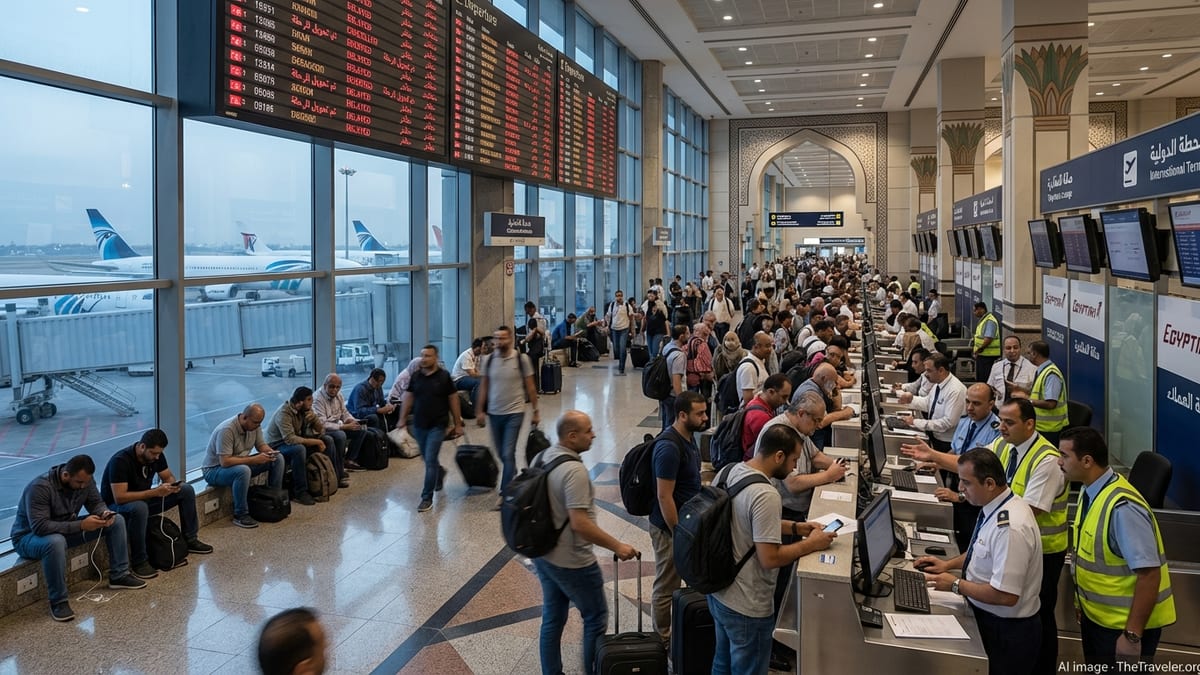
Strikes on Iran Ripple Through Global Air Corridors
The disruption follows coordinated US and Israeli strikes on targets in Iran late on February 28, prompting Iran and several neighboring states to shut or severely restrict their airspace over security concerns. Notices to airmen have effectively sealed off crucial flight information regions over Iran, Iraq, Israel, Syria and parts of the Gulf, severing one of the world’s most heavily used corridors between Europe and Asia almost overnight.
Flight-tracking data and aviation agency estimates indicate that well over a thousand flights were immediately affected as carriers abandoned standard routings and scrambled for longer, more complex paths via Saudi Arabia, Egypt, Turkey and southeastern Europe. Airlines from Europe, the Gulf and Asia reported cascading cancellations and diversions as aircraft, crews and passengers fell rapidly out of position, with travel experts warning that recovery will take days rather than hours.
Regulators in multiple countries have moved onto an emergency footing. India’s aviation authority has instructed airlines to avoid 11 high-risk Middle Eastern and Gulf airspaces until at least March 2, while European air traffic coordination centers have activated crisis protocols to manage congestion in alternative corridors further north and south of the conflict zone.
Austrian Airlines Evacuation Flight Reaches Muscat
Against this volatile backdrop, Austrian Airlines mounted a dedicated evacuation service, OS1005, from Vienna to Muscat on Sunday. The flight, normally a weekly scheduled service, departed Vienna International Airport with a delay before proceeding on a modified routing to avoid closed flight regions, arriving in Oman roughly 45 minutes behind schedule.
While Austrian authorities have not disclosed precise passenger counts, the operation forms part of a broader effort by the country’s foreign ministry to repatriate nationals and reposition travelers stranded by cancellations across the Levant and Gulf. Vienna previously raised its travel advisories to the highest warning level for Israel, Iran, Iraq and several Gulf states, and activated an emergency taskforce to assist the estimated thousands of Austrians believed to be in the region.
Austrian Airlines has already suspended flights to Tel Aviv, Amman and Erbil until at least March 8 and extended a longstanding halt on Tehran services through the end of March. Services to Dubai are cancelled until March 4 as the carrier and its Lufthansa Group partners recast schedules around the effective closure of the main eastbound air bridge out of Europe.
Egypt on “Maximum Readiness” as Diverted Flights Pour In
With much of the region’s airspace unavailable, Egypt has emerged as a critical safety valve. The country’s civil aviation ministry has declared a state of “maximum readiness” at airports nationwide, particularly Cairo International Airport, to receive diverted and emergency landings from airlines forced to bypass closed skies to the east.
Egyptian officials said airspace over the country remains fully open and that they are prepared to offer ground handling, refueling and passenger support for transit flights that suddenly find themselves without a viable route to their original destination. Airport operators have been instructed to prioritize safety and rapid turnaround for unscheduled arrivals while maintaining normal operations for existing services.
By Sunday, aviation sources reported at least 22 international flights, many of them long-haul services between Europe and Asia or the Americas and the Gulf, had diverted into Egyptian airports. Public-relations teams and ground staff at Cairo and other gateways have been mobilized to assist stranded travelers with rebooking, accommodation and onward connections once new routings are confirmed.
The influx is expected to continue as long as closures remain in place over neighboring airspaces. Authorities cautioned passengers flying anywhere near the region to check their flight status frequently, as diversions can be ordered mid-route with little warning when military risk assessments change.
Airlines Suspend Routes and Reroute Around a Closed Corridor
Airlines across Europe and the Middle East have announced sweeping schedule changes in response to the crisis. Major European brands including Austrian’s parent Lufthansa, along with Air France, KLM, British Airways and others, have temporarily halted many services to destinations such as Israel, Lebanon, Jordan, Iraq, Kuwait and Qatar. Gulf carriers are reworking long-haul operations as their home hubs sit on the edge of the affected airspace bands.
For flights that continue to operate, detours add significant time and complexity. Routes that once passed directly across Iran or Iraq are now bending south over Saudi Arabia or swinging north via Turkey and the Caucasus, stretching sector times by an hour or more. That in turn disrupts duty-time calculations for pilots and cabin crew, often forcing airlines to cancel subsequent legs even where aircraft remain serviceable.
Hub carriers that rely on tightly choreographed waves of arrivals and departures are particularly vulnerable. A missed bank of inbound flights at a hub such as Doha or Dubai can cascade into dozens of onward cancellations, as passengers and aircraft fail to connect with their scheduled departures. With many long-haul jets operating only one or two flights per day, repositioning them back into place once skies reopen can take several operating cycles.
Travel-risk consultants are advising corporate clients to expect extended volatility, urging companies to activate contingency plans refined during previous airspace crises. These include allowing critical staff to work remotely, splitting teams across regions to reduce exposure, and closely tracking travelers in or near affected zones.
What Travelers Should Expect in the Coming Days
For passengers, the most immediate impacts are long delays, missed connections and unexpected diversions to airports such as Cairo, Hurghada or Muscat. Even travelers with itineraries that do not touch the Middle East may encounter disruption if their aircraft or crew were scheduled to operate an earlier flight through the region and are now out of position.
Airlines and regulators continue to emphasize that safety considerations override schedule commitments. Where national authorities have closed airspace or issued strong risk advisories, carriers have little choice but to cancel or reroute. Passengers are being urged to monitor airline apps and airport departure boards closely, keep contact details up to date in booking records, and allow extra time for connections where possible.
Travel insurers are fielding a surge of inquiries as customers seek clarity on coverage for delay, missed connections and forced stopovers. Policies vary widely; in many cases, coverage depends on whether government advisories had been issued before a ticket was purchased and how insurers classify the underlying conflict.
Industry analysts warn that even a relatively short period of airspace closure can have outsized effects on global connectivity. As aircraft and crews are slowly repositioned and emergency routings refined, airlines will face difficult decisions about which routes to restore first, and when. For now, governments, regulators and carriers are focused on managing a fast-moving crisis and getting passengers on the ground safely, wherever that may be.