

More news on this day
Regional airspace closures and narrow emergency flight corridors across the Gulf are forcing Emirates and Etihad Airways to operate sharply reduced schedules, prolonging disruption for tens of thousands of travelers as the United Arab Emirates navigates an unfolding security crisis.
Get the latest news straight to your inbox!
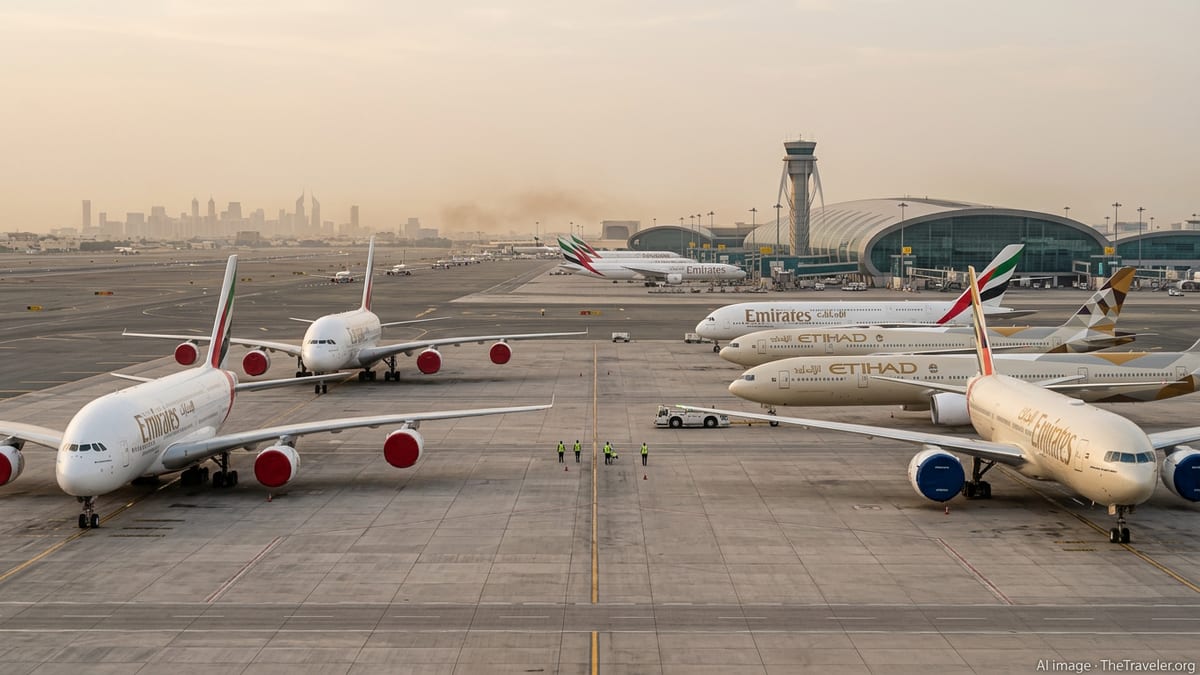
Gulf Security Crisis Triggers Sweeping Airspace Controls
The United Arab Emirates introduced sweeping airspace constraints from February 28, 2026, in response to escalating regional tensions that included missile and drone activity targeting key hubs around the Gulf. The rapid move, implemented through emergency security controls on air traffic, led to an initial shutdown of most commercial operations to and from Dubai and Abu Dhabi, followed by a gradual shift to tightly controlled corridors.
While a complete nationwide closure has since eased, the UAE’s General Civil Aviation Authority is maintaining significant restrictions, with only approved routes open and capacity capped on many sectors. Neighboring states including Qatar, Bahrain and parts of Saudi Arabia have also imposed closures or limited routing options, compressing traffic into a patchwork of contingent paths that complicates planning for airlines and air traffic managers alike.
These measures are layered over existing international conflict-zone advisories covering the broader Middle East and Persian Gulf. European regulators have extended warnings for overflights in the region, urging operators to exercise extreme caution and, where feasible, avoid the most exposed airspace, further constraining the options available to long-haul carriers.
Industry analysts say the result is an unusual combination of national restrictions, military coordination and commercial imperatives that has upended one of the world’s most strategically important aviation corridors almost overnight.
Emirates Cuts Back to Reduced Global Network
Dubai-based Emirates, normally operating one of the largest long-haul networks, suspended virtually all services during the first 48 hours of the UAE shutdown before restarting a limited schedule as authorities opened a handful of safe exit and entry corridors. The carrier is now running a reduced global network, serving around 80 destinations compared with its typical 140, focusing on trunk routes and repatriation traffic.
Capacity remains significantly below normal. Daily frequencies have been trimmed on many routes, upgauging to larger aircraft where possible is being used to consolidate demand, and some secondary cities are temporarily absent from the schedule. Priority is being given to flights that reconnect stranded passengers whose earlier journeys were cancelled or diverted, with crews and aircraft repositioned to Dubai as corridors allow.
Operationally, Emirates has warned that all flights remain subject to late changes as regional airspace conditions evolve. The airline continues to urge customers not to travel to Dubai International Airport unless they have received explicit confirmation that their flight is operating, in an effort to reduce congestion in terminals and avoid long queues at ticket desks.
Travel agents and corporate travel managers report that rebooking options on Emirates are frequently constrained by seat availability, with some travelers offered dates several days later than their original plans or reroutings that avoid the Gulf entirely. The airline is offering waivers for date changes in most affected markets, but standard cash refunds are taking longer than usual to process given the scale of the disruption.
Etihad Maintains Limited Schedule from Abu Dhabi
Abu Dhabi-based Etihad Airways has taken a similarly cautious approach. After suspending all scheduled commercial flights during the height of the closure, the airline began a phased resumption from early March, operating a limited schedule across roughly 70 destinations while keeping many frequencies on hold.
Etihad is prioritizing passengers whose previous flights were cancelled, with rebookings often channeled onto the first available services out of Abu Dhabi once corridors open and slots are confirmed. The airline has issued flexible rebooking policies for tickets issued before the crisis, allowing customers to shift travel dates at no additional change fee over an extended window, though fare differences may still apply.
Etihad has repeatedly stressed that every flight is contingent on ongoing security and airspace assessments. Operational approvals can be withdrawn or amended at short notice, leading to day-of-departure changes and, in some cases, rolling cancellations. Passengers are being advised to monitor their booking status closely and to ensure their contact details are up to date so the airline can push notifications about any changes.
Abu Dhabi International Airport itself is operating below usual capacity, with many retailers and lounges reporting reduced footfall even as the first waves of long-haul connections resume. Airport authorities are coordinating closely with Etihad and foreign carriers to manage peaks created by the compressed schedule and by clusters of repatriation flights.
Ripple Effects for Global Connections and Fares
The constrained operations at Emirates and Etihad are reverberating far beyond the Gulf. Both carriers function as major global connectors, funnelling traffic between Europe, Africa, Asia and Australasia through their hubs. With reduced schedules and fewer available seats, passengers traveling between third countries are facing longer journey times, rerouting via alternative hubs and higher last-minute fares.
Airports in Muscat, Istanbul and various European capitals have seen increased interest from airlines seeking alternative routings that bypass the most heavily restricted Gulf corridors. Some carriers are staging additional technical stops for refuelling or crew changes to avoid flying through airspace identified as high risk, which in turn adds cost and complexity to long-haul services.
Capacity constraints are also feeding into pricing. Aviation consultants say that on many affected city pairs, particularly those lacking strong competition from non-Gulf carriers, fares have risen sharply for near-term departures. Corporate travel buyers are reworking policies and advising staff to build in more flexibility around travel dates and to avoid non-essential trips to and through the region.
Airfreight is under similar pressure. The same airspace restrictions that limit passenger flights also disrupt cargo operations, squeezing bellyhold capacity on long-haul routes that depend on Gulf carriers. Freight forwarders report extended transit times and higher spot rates as shipments are rerouted or delayed while airlines adjust their networks.
What Travelers Should Expect in the Coming Days
Despite the resumption of limited services by Emirates and Etihad, travelers should not expect a rapid return to business as usual. Security analysts describe the operational environment as volatile, with the possibility of further closures or sudden restrictions if the regional situation deteriorates or new incidents occur near major airports or air corridors.
For passengers with upcoming itineraries via Dubai or Abu Dhabi, industry guidance is clear: do not rely on historical schedules or generic search-engine timetables. Only flights that have been explicitly confirmed by the operating airline should be treated as viable, and even then, travelers should be prepared for changes on short notice.
Travel experts recommend allowing extra time for connections, avoiding tight layovers in the Gulf and ensuring that accommodations at origin and destination can be modified without heavy penalties. Comprehensive travel insurance that specifically covers disruption linked to airspace closures and security incidents is also being strongly encouraged, particularly for long-haul leisure trips and complex multi-leg journeys.
While both Emirates and Etihad have signalled their ambition to rebuild their full networks as soon as conditions allow, their near-term reality is one of cautious, capacity-limited flying. Until regional airspace opens more fully and conflict-zone advisories are eased, passengers can expect schedules to remain trimmed, seat availability tight and the Gulf’s role as a seamless global crossroads temporarily diminished.