

More news on this day
Hundreds of holidaymakers and business travelers were stranded in Barbados at the weekend after a sudden staffing crisis in the island’s air traffic control service forced Grantley Adams International Airport to curtail operations, triggering at least eight cancellations and five significant delays on major routes to the United States, United Kingdom, and Canada.
Partial Airspace Closure Sparks Wave of Cancellations
The disruption unfolded over several hours when Barbados temporarily restricted use of its airspace because there were not enough qualified air traffic controllers available to safely manage normal flight volumes. Local aviation authorities confirmed that the move led to a sharp reduction in takeoffs and landings at Grantley Adams International Airport, the country’s primary gateway.
According to officials, the partial shutdown affected both inbound and outbound services. At least eight flights were cancelled, including departures and arrivals operated by American Airlines and Air Canada, while several regional and leisure carriers were also forced to scrub services at short notice. Another five flights faced extended delays as airlines attempted to navigate the limited access to Barbadian airspace and reposition aircraft and crew.
Some long haul arrivals from the United Kingdom were still accommodated under restricted operations, but the reduction in air traffic capacity meant that other services simply could not be handled. Aviation authorities stressed that safety was the overriding concern and that no aircraft would be cleared if staffing levels in the control tower and radar facilities fell below international standards.
The knock-on effect has been felt beyond the Caribbean, with passengers in North American and European hubs also reporting last minute cancellations on routes bound for Barbados as airlines adjusted schedules to reflect the constraints on the island’s airspace.
Travelers Left in Limbo as Major Carriers Adjust Schedules
American Airlines passengers on services between Barbados and key U.S. gateways such as Charlotte and Miami were among the hardest hit, with some flights cancelled outright and others held on the ground for hours while the airline assessed whether they could safely depart within the restricted operating window. Travelers reported receiving multiple schedule changes and rolling delay notices before learning their flights would not operate.
Canadian visitors were similarly affected. Air Canada customers on services linking Barbados with Toronto and Montreal faced returns to origin, diversions, or cancellations as the carrier complied with instructions from air traffic control. For many travelers, the disruption not only meant losing valuable vacation time but also scrambling to rearrange connecting domestic flights and accommodation back home.
British Airways services between Barbados and London were comparatively more fortunate, with selected flights granted landing clearances during the restricted period. Still, the disruption to the wider network created uncertainty for passengers at both ends of the route, particularly those with onward connections across Europe. Some UK-bound travelers opted to rebook for later dates, wary of further operational turbulence.
Other regional and international airlines serving Grantley Adams also reported schedule changes and operational challenges. With aircraft and crews out of position, carriers warned that residual delays could persist even after the immediate staffing crisis eased, as they worked to restore normal rotations and clear backlogs.
Unions Warn of Chronic Staffing Pressures in Air Traffic Control
The weekend’s events have intensified scrutiny of working conditions in Barbados’ air traffic control service. The island’s main public sector unions, which represent controllers and other aviation staff, say the disruption is a symptom of deeper, long standing staffing and workload problems that have gone unresolved despite repeated warnings to the government.
Union leaders argue that chronic understaffing, extended shifts, and the difficulty of recruiting and retaining qualified controllers for a high pressure role have combined to create a fragile system that can quickly tip into crisis. They have called for urgent investment in training, better pay and conditions, and a clear plan to ensure that staffing levels keep pace with the country’s ambitions as a year round tourism and air travel hub.
Officials at Grantley Adams International Airport have acknowledged the strain on air traffic control resources and signaled a willingness to work with unions and regulators to prevent a repeat of the weekend’s disruption. However, they also contend that the decision to restrict airspace was necessary and correct, describing it as an unavoidable measure taken in the interest of passenger safety.
The government has yet to set out a detailed timetable for reforms, but tourism and business groups are pressing for swift action, warning that confidence in Barbados as a reliable Caribbean gateway could be damaged if operational risks are not addressed before the busy Easter and summer travel periods.
Stranded Passengers Face Extra Costs and Complex Rebookings
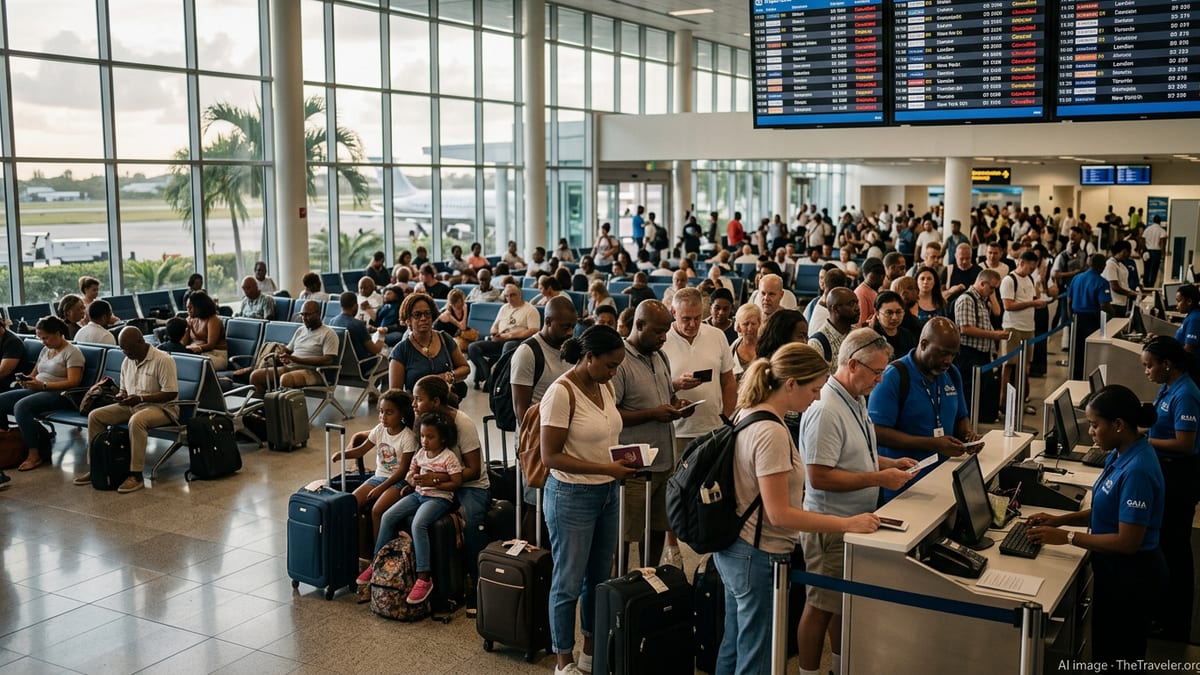
For travelers caught in the middle of the disruption, the immediate concern has been getting home or reaching their onward destinations. Many passengers reported long lines at airline service desks inside Grantley Adams International Airport, with some spending hours queuing to secure alternative flights or request hotel accommodation and meal vouchers.
Families with young children, cruise passengers due to embark or disembark, and business travelers facing missed meetings were particularly hard hit. Some visitors on package holidays were rebooked relatively quickly by tour operators, while independent travelers had to negotiate directly with airlines, often facing limited seat availability on already busy services to the United States, United Kingdom, and Canada.
Consumer advocates have urged passengers to keep all receipts for additional expenses such as extra nights in hotels, ground transportation, and meals. They note that while airlines typically provide certain forms of assistance when disruptions are caused by staffing and operational issues, the exact level of compensation or reimbursement can vary depending on the carrier, ticket type, and local regulations.
Travel insurers say they are already fielding an uptick in claims and inquiries from customers affected by the Barbados disruption. Policyholders are being advised to check the fine print of their coverage, particularly clauses relating to delays and cancellations stemming from staffing shortages or airspace restrictions, which may be treated differently from events such as severe weather.
Industry Braces for Ongoing Ripples Across Transatlantic Networks
Aviation analysts say the Barbados incident highlights the vulnerability of global flight networks to localized operational shocks, particularly in smaller but strategically important hubs that serve a mix of leisure, cruise, and long haul traffic. When a gateway such as Grantley Adams International Airport reduces capacity, the impact can cascade across airline schedules on both sides of the Atlantic.
Carriers including American Airlines, British Airways, Air Canada, and regional partners are expected to monitor staffing developments in Barbados closely over the coming days as they assess whether full schedules can be confidently maintained. Some industry observers suggest that airlines may temporarily build in additional buffer time between rotations to and from Barbados to reduce the risk of further knock on disruptions.
Tourism officials, meanwhile, are working to reassure prospective visitors that Barbados remains open for business, emphasizing that the island’s hotels, attractions, and cruise operations continue to function normally. However, they acknowledge that restoring traveler confidence will depend on clear communication from both authorities and airlines about the measures being taken to stabilize air traffic control operations.
With global air travel demand continuing to recover and grow, the episode at Grantley Adams is likely to fuel a wider debate about staffing resilience in critical aviation infrastructure across the Caribbean and beyond, and whether governments and industry are investing enough to keep pace with the pressures of a busier sky.