

More news on this day
Mizoram’s capital Aizawl is intensifying a citywide cleanliness drive that combines government initiatives with deep-rooted community participation, as the hilltop city positions itself to be counted among India’s cleanest urban centres.
Get the latest news straight to your inbox!
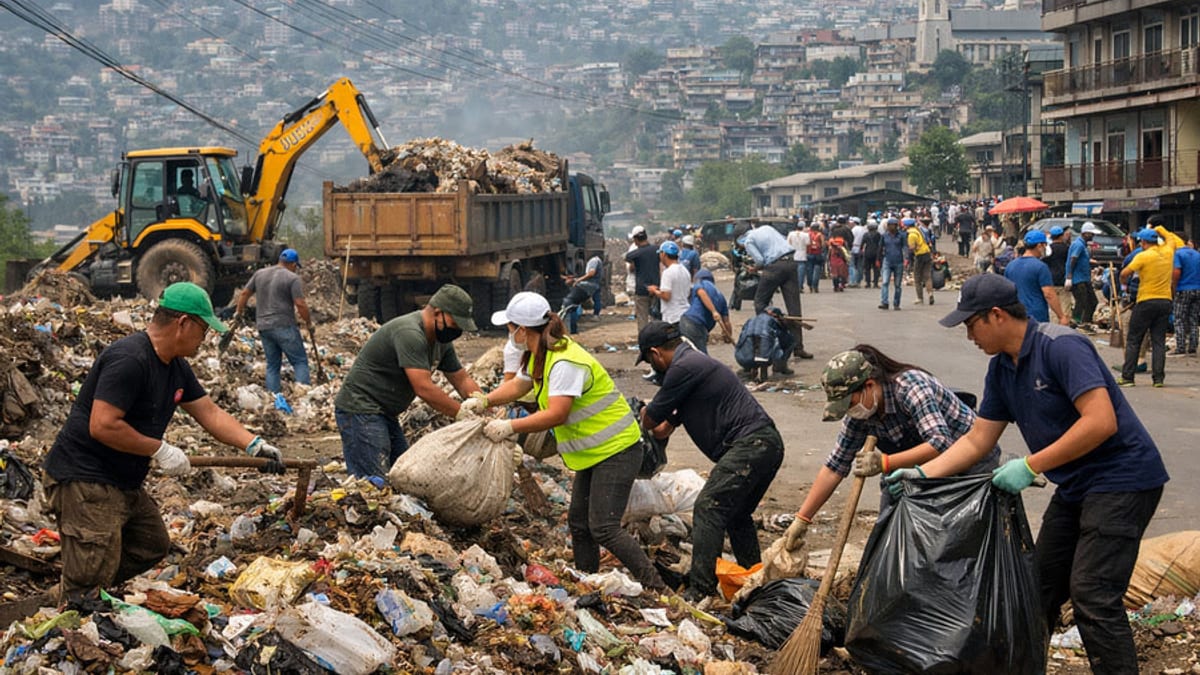
Image by Latest International / Global Travel News, Breaking World Travel News
A City With Clean Air Targets Cleaner Streets
Aizawl has already drawn national attention for its relatively clean air, with recent assessments placing the city among India’s best performers on air quality indices. Publicly available information shows that particulate levels often remain within the “good” category, helped by the city’s hilly terrain, compact urban form and comparatively low industrial activity.
Local authorities and civic groups are now trying to ensure that the same reputation extends from air quality to everyday street-level cleanliness. Reports indicate that the latest push focuses on systematic waste collection, unclogging roadside drains and keeping public spaces litter free, particularly in densely populated neighbourhoods that climb the surrounding ridgelines.
The drive is framed as part of a broader effort to align the city’s standards with national clean-city benchmarks under initiatives such as the Swachh Bharat Mission and related urban sanitation programmes. While Aizawl has not traditionally featured at the very top of national cleanliness rankings, residents and community organisations have cultivated a civic culture that visitors often describe as unusually tidy by Indian urban standards.
Online commentary and travel accounts frequently highlight traffic discipline, minimal visible litter and strong social pressure against public spitting or dumping. The current campaign seeks to lock these behaviours into more formal systems for waste segregation, collection and disposal, with an eye on making Aizawl a contender in future clean-city evaluations.
Statewide “Hnatlangpui” Campaign Sets the Tone
The latest citywide push builds on a broader Mizoram sanitation effort known as the “Hnatlangpui” cleanliness campaign. According to government documents and compilations of current-affairs material, the state launched this drive in Aizawl with the stated goal of keeping the capital neat and clean throughout the year, not only during festive or inspection periods.
The Hnatlangpui initiative, whose name echoes traditional community labour practices in Mizo society, is designed as a statewide cleanliness movement but has a particularly visible footprint in the capital. It encourages neighbourhoods to coordinate sweeping of streets, clearing of drains and collection of solid waste, often on pre-announced days when residents devote time specifically to public cleaning.
Reports suggest that this structured approach helps overcome the challenge of steep, narrow roads and multi-level stairways that are difficult for mechanised cleaning equipment to reach. By drawing on the existing custom of collective work, the campaign reinforces social norms around shared responsibility for public spaces.
Observers note that the Hnatlangpui drive has also given planners and local bodies an opportunity to test new waste-management routines, identify black spots where garbage tends to accumulate and update route planning for municipal collection vehicles serving Aizawl’s scattered localities.
Community-Led Experiments in Neighbourhoods
Alongside official programmes, the cleanliness push in Aizawl is increasingly characterised by locally designed experiments at the ward or neighbourhood level. Published coverage from regional media describes, for example, an initiative in Chawnpui locality in which residents launched a “plastic waste buying” campaign as part of an ongoing cleanliness competition in the city.
In that case, community members reportedly raised funds among themselves to purchase discarded plastic from households and public spaces, turning old bottles, wrappers and containers into a small income source for children and adults who collected them. The model, organised with support from urban development and civic bodies, effectively transformed litter into a tradable item while drawing attention to plastic pollution.
Other local drives documented in news and institutional reports include river and stream clean-ups in and around Aizawl, where volunteers remove solid waste from water bodies that cut through the city’s deep valleys. Such activities are often framed as both cleanliness and environmental-restoration efforts, addressing concerns about clogged waterways and downstream pollution.
These neighbourhood projects feed back into the broader cleanliness campaign by demonstrating what kinds of incentives and messaging resonate with residents. Officials and planners tracking the results have a growing set of real-world examples to draw from as they design citywide strategies.
Competitions and Campaigns Underpin Behaviour Change
Mizoram has for several years used cleanliness competitions as a tool to promote better sanitation practices, and Aizawl plays a central role in these efforts. According to published summaries of Swachh Bharat Mission activities in the state, towns and districts compete for awards based on criteria such as waste segregation, cleanliness of public places and community participation.
In Aizawl, this competitive approach has translated into ward-level contests, school-based initiatives and locality rankings that publicly recognise well-maintained areas. Media coverage of Republic Day functions and other state events frequently highlights prize distributions for high-performing urban centres and neighbourhoods, reinforcing the idea that cleanliness is a matter of civic pride.
Observers suggest that these competitions, coupled with educational campaigns in schools and colleges, have helped embed cleanliness in the daily routines of younger residents. Participation by eco-clubs, youth associations and women’s groups in street and river clean-ups has been cited as an important factor in sustaining the city’s reputation for tidy public spaces.
At the same time, the emphasis on visual cleanliness has drawn attention to the need for more robust infrastructure behind the scenes, including segregation at source, reliable collection schedules and adequate capacity for processing or safely disposing of waste generated by a growing urban population.
New Infrastructure and Policy Challenges Ahead
As Aizawl expands along its surrounding ridges and valleys, the cleanliness drive is increasingly tied to broader questions of urban planning and infrastructure. Government surveys and planning documents point out that a large share of Mizoram’s population now lives in the capital, placing considerable pressure on its roads, drainage networks and waste-management systems.
Developments such as planned transport links, including projects on the city’s periphery, are expected to reshape travel patterns and could alter how garbage is moved from hilltop neighbourhoods to disposal or processing sites. Urban planners and environmental advocates have argued that new infrastructure must be designed with both convenience and long-term sustainability in mind.
Waste segregation at source remains a key challenge, as in many Indian cities. Reports indicate that while community enthusiasm for visible cleanliness is strong, the back-end systems for sorting, recycling and processing waste are still evolving. Initiatives that link residents directly to recycling efforts, such as plastic buy-back schemes or neighbourhood collection centres, are being watched closely as potential models for scaling up.
For travellers, the outcome of these efforts is likely to be felt most immediately in the condition of streets, markets and viewpoints that define Aizawl’s visitor experience. For residents, the comprehensive cleanliness drive represents a test of whether long-standing civic pride, combined with new policies and infrastructure, can secure the city a place among India’s cleanest urban environments while preserving its distinctive hill-town character.