

More news on this day
Alaska Air Group is accelerating its shift from a largely domestic carrier into a global competitor, with new long-haul routes, alliance growth and a wider partner network expected to stimulate tourism across the Pacific, Atlantic and key North American gateways.
Get the latest news straight to your inbox!
From Regional Player to Global Connector
Publicly available information shows that Alaska Air Group is in the midst of its most ambitious international growth phase to date. Historically concentrated on the U.S. West Coast, Alaska Airlines and its regional affiliates are now using new widebody aircraft and strengthened alliances to extend their reach deep into Europe and Asia. Corporate filings and recent network announcements indicate that the group views global connectivity as central to its next stage of growth.
The acquisition of Hawaiian Airlines, completed in 2024, has been a catalyst for this transformation. Hawaiian’s widebody fleet and established links to Asia and the South Pacific have given Alaska Air Group immediate access to long-haul markets that previously relied almost entirely on partners. The combined company’s integration updates describe a strategy to deploy these aircraft from Seattle and Honolulu as global gateways, anchoring a more international network that can support both tourism and visiting‑friends‑and‑relatives traffic.
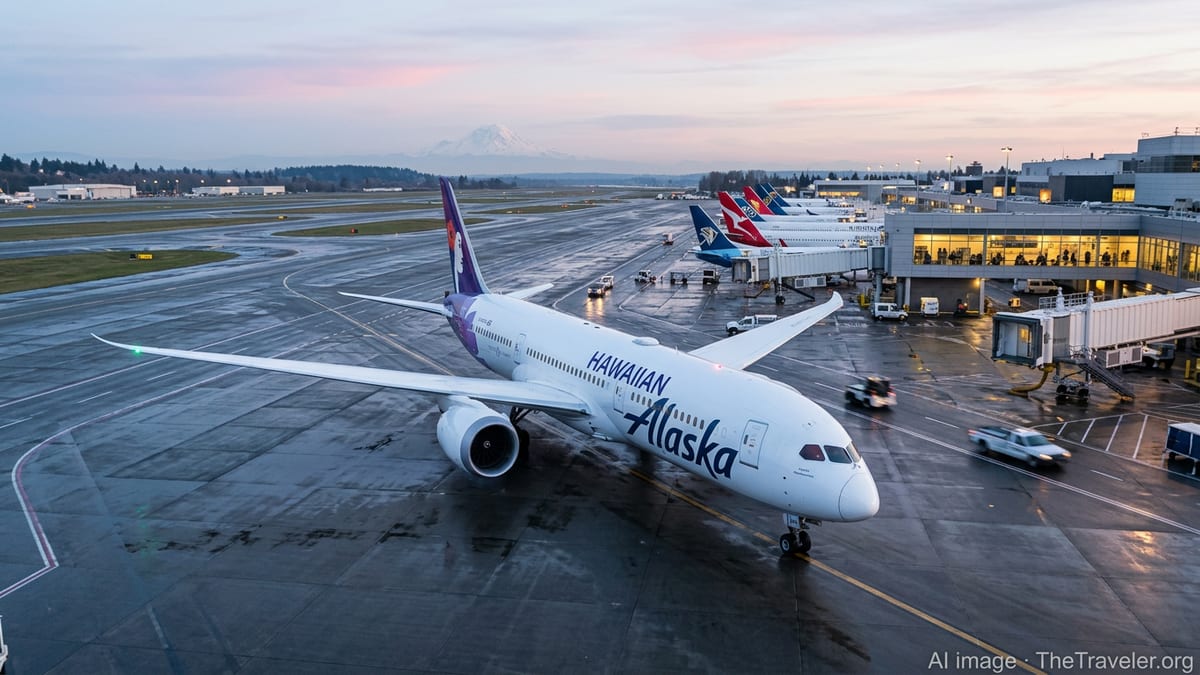
According to recent financial disclosures, the group closed 2025 emphasizing an “expanding global network” and unveiled a new international livery for its 787 fleet in early 2026. These long-haul aircraft are scheduled to serve new overseas routes from Seattle, signaling that Alaska intends to compete more directly for transoceanic passengers who might previously have defaulted to larger legacy carriers.
New Long-Haul Routes Reshape Leisure Travel Patterns
Route announcements over the past year point to a clear focus on tourism-heavy destinations. Alaska Airlines has confirmed its first nonstop transatlantic service between Seattle and Rome, scheduled to launch in May 2026. Travel industry coverage notes that this will be the only nonstop link on that city pair offered by a U.S. airline, positioning Seattle as a new West Coast gateway for American tourists heading to Italy’s capital and for European visitors accessing the Pacific Northwest.
In parallel, Alaska has disclosed plans for new nonstop flights from Seattle to London and Reykjavik beginning in spring 2026, broadening its European footprint beyond the initial Rome launch. Company communications highlight that these routes will be operated with 787-9 aircraft configured for a premium long-haul experience, a notable shift for a carrier long associated with narrowbody operations and regional flying.
The expansion is not confined to the Atlantic. Alaska Air Group previously announced nonstop service on Hawaiian-operated widebodies from Seattle to Tokyo Narita and Seoul Incheon, set to roll out in stages from 2025. These additions deepen the group’s presence in North Asia while opening new opportunities for two-way tourism between the Pacific Northwest and major urban centers in Japan and South Korea. Industry observers suggest that these flights, combined with partner connections beyond Tokyo and Seoul, are likely to encourage longer multi-stop itineraries that blend city breaks with nature-focused trips in Alaska and the Pacific Northwest.
Alliance Ties and Codeshares Extend Global Reach
Alaska Airlines’ membership in the oneworld alliance remains a central pillar of its global strategy. Alliance information and airline statements indicate that, by leveraging oneworld and additional bilateral partners, the group’s Atmos Rewards program offers earning and redemption options across more than a thousand destinations worldwide. This structure allows the carrier to project a global presence well beyond the city pairs it serves with its own aircraft.
Recent developments show Alaska Air Group fine-tuning its partner mix to align with its new long-haul ambitions. Reports indicate that codeshare agreements with Singapore Airlines and LATAM have been wound down, while ties with European and transatlantic partners such as Finnair and Icelandair are being deepened. An expanded codeshare with Icelandair, announced in 2025, is designed to provide seamless connections from Alaska’s West Coast network through Reykjavik into multiple European cities, reinforcing the strategic role of new Seattle–Reykjavik services.
The group is also building on partnerships inherited through Hawaiian Airlines, including links with carriers in Asia and the Pacific. Public coverage describes new and upcoming arrangements that will allow travelers to book itineraries from U.S. West Coast hubs and Honolulu to cities like Manila using a single ticket while earning Atmos Rewards points. For leisure travelers, this blend of Alaska-operated long-haul services and partner connections is expected to make once‑complex multi‑stop journeys more straightforward and potentially more affordable.
Tourism Benefits for Key Gateways and Regions
Tourism organizations and airport authorities in Seattle, Anchorage, Honolulu and secondary hubs such as San Diego and Portland have been watching Alaska Air Group’s expansion closely. Coverage focused on Seattle-Tacoma International Airport notes that the wave of new long-haul routes, especially Rome and other European launches, is helping the airport reposition itself as a true global gateway rather than a primarily domestic hub. Increased nonstop connectivity typically leads to higher inbound visitor numbers, as travelers are more likely to choose destinations that can be reached without multiple connections.
Within Alaska itself, state transportation reports highlight new and expanded services linking Anchorage and Fairbanks to domestic and Canadian hubs. While many of these flights are operated with narrowbody aircraft, the broader global network means international visitors can now more easily combine long-haul arrivals into Seattle or Honolulu with onward trips into Alaska’s interior. This is expected to support growth in adventure tourism, cruise add‑ons and Northern Lights travel, which depend on reliable air links and varied seasonal schedules.
On the U.S. West Coast, Alaska Air Group has also announced additional routes from San Diego and Portland, emphasizing their roles in a wider global network. For local tourism boards, more nonstop options to and from these cities can help attract international conferences, cruise passengers and leisure visitors who might previously have connected through Los Angeles or San Francisco. Economists who track air service development often point to this kind of incremental capacity as a driver for hotel, restaurant and cultural-sector growth.
Challenges and Opportunities in a Competitive Global Market
Despite the strong growth narrative, Alaska Air Group’s global ambitions come with challenges. Competition on key long-haul routes out of Seattle remains intense, with larger U.S. and international carriers already operating to many of the same regions. Analysts note that Alaska must differentiate through schedule convenience, onboard experience and the value of its Atmos Rewards program to capture high-yield leisure and premium passengers.
Balancing partner relationships with an expanding proprietary network is another strategic test. Public commentary and investor materials indicate that alliance constraints and overlapping partnerships can limit how many non-oneworld carriers participate fully in Alaska’s loyalty ecosystem. The recent shift away from certain codeshares, while clarifying the carrier’s long-haul focus, may reduce some one-stop options for travelers to specific regions, especially parts of South America and Southeast Asia.
Even so, the overall trajectory suggests significant opportunity for tourism. By 2026, Alaska Air Group expects to serve its largest-ever number of destinations, supported by a growing widebody fleet and reinforced partner links. For travelers, the practical impact will be more nonstop options from West Coast cities to high‑demand leisure destinations across Europe and Asia, along with smoother onward connections into Alaska, Hawai‘i and secondary U.S. markets. For destination marketers and local economies, the carrier’s global expansion is emerging as a key factor shaping visitor flows in the latter half of the decade.