

Alaska Airlines is expanding its Seattle–Seoul Incheon service as part of a broader strategy to turn Seattle into a premier trans-Pacific gateway, underscoring how closer U.S.–South Korea aviation ties are reshaping travel, trade, and tourism across the Pacific.
Seattle Emerges as a Strategic Trans-Pacific Gateway
Seattle-Tacoma International Airport has rapidly evolved from a primarily domestic hub into one of the most closely watched trans-Pacific gateways on the U.S. West Coast. Building on the 2025 launch of nonstop service between Seattle and Seoul Incheon, Alaska Airlines is now increasing frequencies and refining schedules to capture growing demand between North America and Northeast Asia. The route has quickly become a cornerstone of the carrier’s long-haul ambitions.
Alaska’s strategy hinges on leveraging its dominant domestic footprint in Seattle to feed long-haul flights operated with widebody aircraft inherited through its acquisition of Hawaiian Airlines. Travelers from across the Pacific Northwest, the Mountain West, California, and Alaska now have a more direct path into Asia via Seattle, with Seoul positioned as both a destination and a powerful connecting hub for onward travel across the region. This model is intended to rival more established gateways such as Los Angeles, San Francisco, and Vancouver.
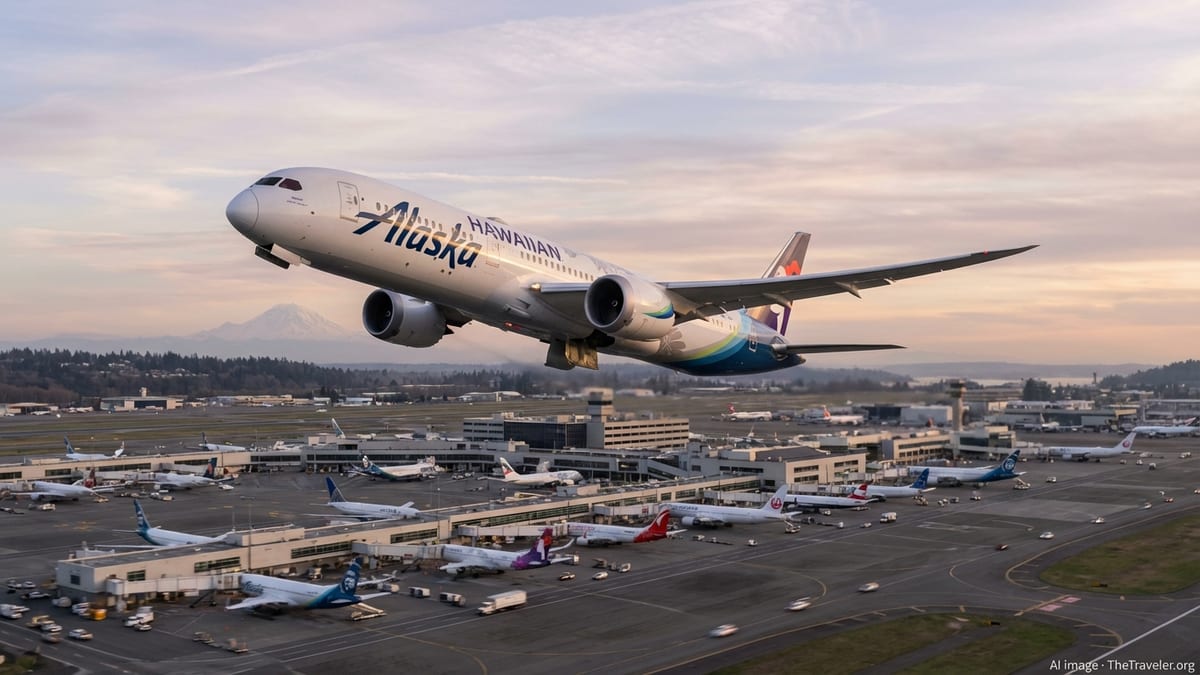
Since debuting the Seattle–Seoul Incheon link in September 2025, the combined Alaska and Hawaiian operation has emphasized reliability and connectivity. Flight status data and published schedules now show the route operating on a near-daily basis, with Hawaiian’s Boeing 787-9 widebodies flying under Alaska’s banner as the integration of the two brands progresses. For passengers, that means a blend of Alaska’s network strength and Hawaiian’s long-haul cabin experience on a key trans-Pacific lane.
The shift solidifies Seattle’s role in a changing map of U.S.–Asia air corridors. As traditional West Coast hubs confront congestion, slot constraints, and shifting airline alliances, Seattle’s rising profile gives carriers more flexibility and passengers more choice, particularly on routes linking the U.S. heartland to East Asia via a single, well-timed connection.
Alaska Airlines Scales Up the Seattle–Seoul Incheon Route
Alaska Airlines’ Seattle–Seoul Incheon service launched in September 2025 with five weekly frequencies, operated by widebody aircraft and timed to support onward connections on both sides of the Pacific. Since then the airline has steadily strengthened the route. Traffic figures and booking trends have exceeded early projections, prompting Alaska to add capacity for peak seasons and adjust schedules to better match business and leisure demand.
Industry schedule data for 2026 shows Alaska, working with Hawaiian, moving toward a daily or near-daily pattern, including the introduction of additional Monday services during the Northern Hemisphere summer. Operationally, the flights continue to be flown by Hawaiian’s Boeing 787-9s, but the flight numbers and commercial control are shifting under the Alaska brand as the integration process advances. For travelers, the most visible changes are more departure-day options and improved connectivity in Seattle.
Travel industry analysts say the decision to grow the Seoul route reflects a vote of confidence in Korea’s role as both a source market and a connecting hub. Alaska is positioning its Seattle–Seoul flights not just for point-to-point traffic between Washington state and Korea, but also for passengers traveling from across North America to destinations such as Tokyo, Bangkok, Singapore, and other Asian cities via Incheon’s extensive network.
Schedule refinements are also designed to appeal to corporate travelers. Departure and arrival times at Seattle and Incheon are being aligned with banked waves of connecting flights, allowing same-day onward journeys in both directions. With more frequencies and better timing, Alaska is seeking to move beyond a purely leisure-oriented model and capture a larger share of high-yield business and premium traffic.
Widebody Fleet, Alliance Ties, and a Dual-Brand Strategy
Central to the expansion is Alaska’s access to Hawaiian Airlines’ long-haul fleet. The Seattle–Seoul route is operated with Hawaiian’s Boeing 787-9 aircraft, which offer higher fuel efficiency, longer range, and greater cargo capacity than the older Airbus A330-200s that first flew Alaska’s new international services. The 787s allow the airline to support both passenger and cargo growth while maintaining competitive operating costs on the approximately 10- to 11-hour sector.
The dual-brand strategy means passengers often see Hawaiian aircraft and crews on flights that are sold and marketed within Alaska’s broader network. As the two carriers progress toward a single operating certificate, flights between Seattle and Seoul are gradually transitioning to Alaska flight numbers, even as the Hawaiian brand remains visible on the cabin experience. This hybrid arrangement is intended to preserve the strong customer recognition of each airline while unlocking operational efficiencies and a unified long-haul strategy.
Alaska’s membership in the oneworld alliance amplifies the impact of the Seoul expansion. Partner airlines in Asia and beyond can feed and distribute traffic over both Seattle and Incheon, while Alaska’s large domestic network channels U.S. passengers to the gateway. For flyers, this means more opportunities to earn and redeem miles, reciprocal elite benefits, and a wider range of itineraries that combine Alaska’s domestic legs with Asian and European partners on a single ticket.
Aviation observers note that the strategy also positions Alaska to expand its long-haul reach beyond Asia. The airline has already signaled its intent to launch European routes from Seattle using Hawaiian’s widebodies in 2026. The growing Seattle–Seoul operation offers a template for how Alaska might open and scale additional long-haul markets, using the same combination of fleet sharing, alliance ties, and domestic feed.
Trans-Pacific Travel Demand Rebounds and Diversifies
The strengthening of Alaska’s Seattle–Seoul network comes amid a broader rebound in trans-Pacific travel demand. After years of pandemic disruptions, passenger volumes between North America and Asia have returned to robust levels, driven by resurgent tourism, a revival in corporate travel, and the return of student and family traffic. Seoul has emerged as one of the standout beneficiaries, buoyed by South Korea’s pop culture influence, culinary tourism, and growing reputation as a technology and innovation hub.
For U.S. travelers, nonstop flights from Seattle to Seoul Incheon significantly shorten journey times and reduce the uncertainty associated with multi-stop itineraries through other hubs. For Korean travelers, the route offers new one-stop access to dozens of cities across the United States and Canada that previously required more circuitous connections. This has produced a more diversified passenger mix, with strong representation from leisure, visiting-friends-and-relatives, and business segments on most departures.
Travel agencies and tour operators on both sides of the Pacific report heightened interest in itineraries that pair Seattle and other Pacific Northwest destinations with Korea and neighboring Asian countries. The region’s appeal, from national parks and wine regions in Washington and Oregon to Korea’s historic cities and coastal landscapes, supports year-round demand rather than strictly seasonal peaks. Alaska’s decision to expand frequencies on the Seattle–Seoul route reflects confidence that this more balanced demand profile will sustain the service through off-peak months.
The route’s growth is also occurring against the backdrop of ongoing network adjustments by other carriers. Competitors such as Asiana Airlines and Korean Air have been recalibrating their U.S. services as part of fleet renewals and merger-driven restructuring, including selective capacity reductions on some trans-Pacific routes. Alaska’s expansion from Seattle into Seoul positions it to absorb some of that displaced demand while differentiating itself with strong regional connectivity across the American West.
Economic, Cultural, and Diplomatic Dimensions of U.S.–Korea Air Links
Beyond airline strategy, the expansion of Seattle–Seoul flights highlights the deepening economic, cultural, and diplomatic ties between the United States and South Korea. Air connectivity is a visible indicator of the broader relationship, enabling trade, investment, tourism, and academic exchange. Seattle’s tech-driven economy has long-standing links with Korean electronics, automotive, and semiconductor firms, while Korean conglomerates and startups alike look to the U.S. West Coast for partnerships and market access.
More frequent and reliable air service between Seattle and Seoul lowers the barrier to cross-border collaboration. Executives, engineers, and researchers can travel more flexibly, supporting everything from short-notice project meetings to longer-term relocation assignments. Meanwhile, the route’s substantial belly cargo capacity supports trade in high-value, time-sensitive goods, including electronics, aerospace components, e-commerce shipments, and fresh foods such as Northwest seafood and Washington cherries destined for Korean markets.
Cultural and educational ties are also reinforced. South Korea is a major source of international students at universities across Washington state and the broader Pacific Northwest, while Korean-American communities in the region maintain close family links to cities across Korea. Additional flights make it easier for students to travel home during holidays, for families to visit relatives, and for cultural organizations to stage performances and exchanges.
Diplomatic observers point out that such connectivity fits within a wider pattern of U.S.–Korea cooperation that includes defense, technology, and climate policy. While new or expanded air routes are typically commercial decisions, they often complement government-level efforts to encourage cross-border engagement. For local and national policymakers, a growing network of flights between U.S. cities and Seoul is seen as both an economic asset and a symbol of shared strategic interests.
Passenger Experience and Competitive Landscape on the Seoul Route
Alaska and Hawaiian’s approach to the Seattle–Seoul route aims to stand out in an increasingly competitive market. The Boeing 787-9 aircraft deployed on the route feature a modern long-haul cabin with lie-flat business class, premium economy, and standard economy seating. Cabin interiors emphasize quieter engines, higher cabin humidity, and larger windows, all designed to reduce fatigue on the long trans-Pacific crossing. Inflight service blends Hawaiian’s hospitality with menus and entertainment options tailored for both Korean and North American passengers.
On the ground, Alaska has worked to tighten connection times at Seattle-Tacoma International Airport, where a growing array of international departures share the terminal with a dense network of domestic flights. Priority check-in, expedited security lanes for eligible passengers, and access to lounges for premium and elite flyers help the carrier compete with established trans-Pacific players. The airline also leans on its loyalty program, encouraging frequent flyers to consolidate their domestic and international travel under one mileage currency.
Competition on the Seoul–Seattle corridor remains intense. Major Asian and U.S. carriers, including Korean Air, Delta Air Lines, and Asiana Airlines, operate their own nonstop services between the two cities, each backed by alliance partners and code-share agreements. Alaska’s move to increase frequencies and sharpen its product is, in part, a response to this landscape. The airline is betting that its strong presence in the Pacific Northwest and its integration with Hawaiian’s long-haul expertise will give it a distinctive edge.
For consumers, the result is a wider range of options in terms of schedules, cabin products, and pricing. As capacity grows and carriers vie for loyalty, passengers on both sides of the Pacific are likely to benefit from more competitive fares, improved onboard amenities, and more seamless connection possibilities across North America and Asia.
Outlook: A Platform for Further Trans-Pacific Growth
Alaska Airlines’ decision to deepen its Seattle–Seoul Incheon network underscores a broader trend: mid-sized U.S. carriers are no longer content to cede long-haul markets to the largest global airlines. By pairing a powerful domestic hub with inherited widebody capacity and alliance partnerships, Alaska is carving out a more ambitious role in trans-Pacific aviation than it held just a few years ago.
The performance of the Seoul route will be closely watched as Alaska prepares to launch new long-haul services, including its first forays into Europe from Seattle using Hawaiian aircraft. If demand on the Seattle–Seoul corridor continues to grow and the airline can maintain strong load factors and yields, the route is likely to serve as a template for further expansion into both established and emerging international markets.
For the United States and South Korea, the implications extend beyond the aviation sector. Each additional frequency between Seattle and Incheon represents new opportunities for trade, tourism, education, and cultural exchange, reinforcing the trans-Pacific ties that underpin the broader relationship. As aircraft depart nightly from Seattle’s runways bound for Seoul, they carry not just passengers and cargo, but also the momentum of a partnership that is increasingly taking flight across the Pacific.