

More news on this day
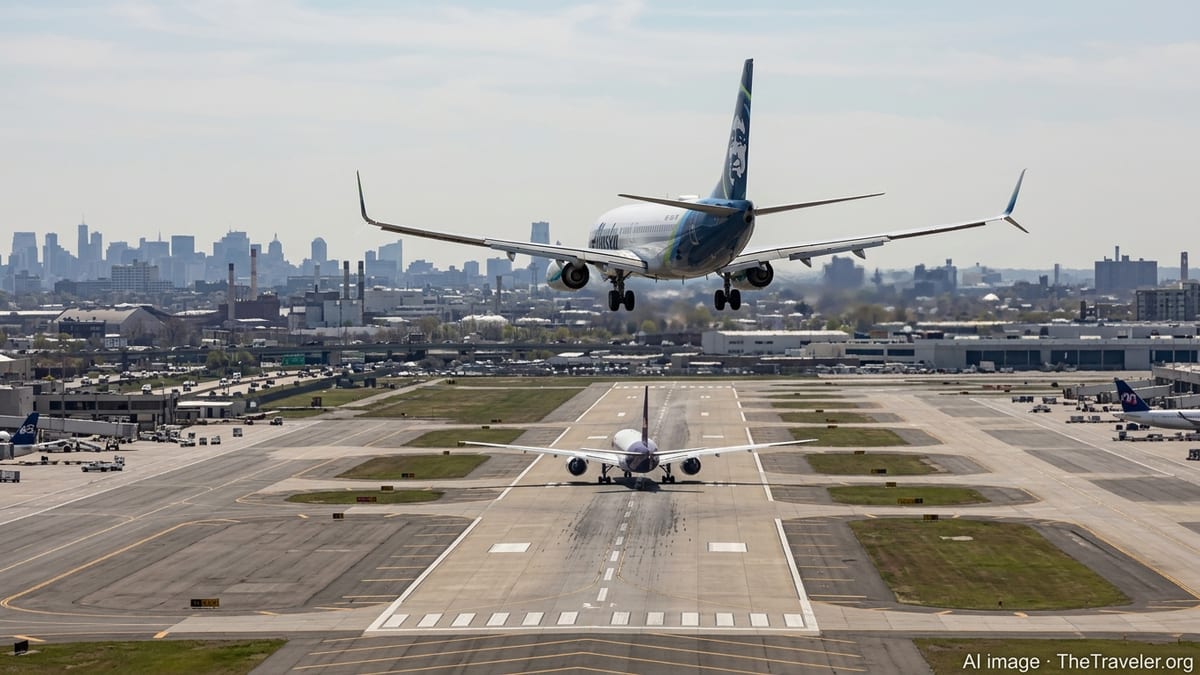
An Alaska Airlines Boeing 737 passenger jet and a FedEx Boeing 777 cargo aircraft narrowly avoided a collision at Newark Liberty International Airport after an air traffic controller ordered a last-second go-around, according to preliminary information released by federal investigators and public flight data.
Get the latest news straight to your inbox!
Close Call on Intersecting Runways
Publicly available information indicates the incident occurred on Tuesday evening, March 18, 2026, as Alaska Airlines Flight 294 from Portland, Oregon, and FedEx Flight 721 from Memphis, Tennessee, converged on intersecting runways at Newark Liberty International Airport. The Alaska aircraft was on final approach when the FedEx freighter was also cleared to continue its approach to a crossing runway, creating a potentially hazardous conflict.
Reports indicate that the Alaska jet overflew the FedEx 777 by a relatively small vertical margin as it initiated the go around, an evasive maneuver in which pilots discontinue the landing and climb away from the runway for another approach. Despite the dramatic nature of the event, both flights ultimately landed safely at Newark, and no injuries were reported among passengers or crew.
Runway layouts at Newark include several intersecting configurations that allow the airport to handle heavy traffic in varying wind and weather conditions. Aviation safety specialists note that this complexity requires continuous coordination between the control tower and arriving and departing aircraft, particularly during peak periods.
Swift Air Traffic Control Intervention
According to published coverage and preliminary federal summaries, the key safety action in the near collision sequence was a prompt instruction from air traffic control directing the Alaska flight to execute a go around. Pilots train extensively for such maneuvers, which are considered a standard and expected response when spacing or runway conditions become uncertain.
Publicly available radar and tracking data show the Alaska 737 climbing away from its approach while the FedEx 777 continued its landing on the intersecting runway. The rapid climb created the vertical separation needed to avoid contact, even as the aircraft paths briefly converged over the airfield.
Analysts note that while the episode is classified as a serious close call, it also illustrates how layered safety systems can work as intended. Air traffic controllers monitor approach paths in real time, and when emerging conflicts are detected, a go around order is one of the most powerful tools available to break the chain of events.
Federal Investigation Underway
The National Transportation Safety Board has opened an investigation into the Newark incident, focusing on how the two aircraft came to be on conflicting approaches and whether existing procedures were followed appropriately. The Federal Aviation Administration is also reviewing the event as part of its oversight of air traffic operations and runway safety.
Investigators are expected to examine cockpit voice recordings, flight data, controller audio, radar tracks and tower procedures to reconstruct the sequence of clearances and decisions. Attention is likely to center on the timing of approach instructions, runway assignments and any potential miscommunication or misunderstanding between the tower and the two flight crews.
Preliminary findings in such cases typically take weeks, while a full safety report can require many months. The process may also consider broader patterns, including previous runway incursions or close calls at Newark and other large US airports, in order to identify any systemic risks that might warrant changes in training, staffing or technology.
Runway Safety in a High Traffic Environment
Newark Liberty International is among the busiest airports in the United States, serving the New York metropolitan area with dense banks of arrivals and departures. The airfield layout and local weather patterns often require the use of intersecting runways, which can contribute to complex traffic flows when demand is high.
Recent public discussions about Newark have highlighted air traffic controller staffing challenges and runway construction work, factors that can place additional pressure on the system. Nationally, aviation safety reports have documented an uptick in serious runway incursions and near midair collisions, prompting renewed attention to airport surface surveillance tools, controller workload and pilot situational awareness.
Industry observers note that while commercial aviation in the United States maintains a strong overall safety record, the margin for error in crowded terminal areas remains narrow. Close calls such as the Alaska and FedEx incident have intensified calls for further investment in modernizing air traffic control infrastructure and expanding the use of automated warning systems that can alert controllers to emerging conflicts on intersecting approaches.
Implications for Travelers and Airlines
For passengers, the Newark episode underscores why go around maneuvers, though sometimes unsettling, are an important safety safeguard rather than a sign that something has gone wrong with the aircraft itself. Airlines routinely emphasize that such procedures are built into flight operations and that crews are trained to execute them whenever conditions warrant, without hesitation.
Airlines and cargo operators are likely to review their own internal guidance on approach briefings, cockpit coordination and crew resource management in light of the near collision. These reviews typically focus on ensuring that flight crews maintain clear mental models of intersecting traffic, runway assignments and potential escape routes if a go around becomes necessary.
As the federal investigation progresses, any recommendations that emerge could influence how traffic is sequenced at Newark and other major hubs, particularly during periods of heavy demand or constrained runway availability. For now, the swift intervention by air traffic control and the successful execution of a go around by the Alaska flight are being cited in public reporting as key reasons a serious incident did not become a catastrophe.