

More news on this day
Spring Break travelers heading for sun, surf and gaming tables are seeing a major capacity push this year, as the combined Alaska and Hawaiian Airlines network rolls out what industry data indicates is roughly twelve million seats across Hawaiʻi, Las Vegas and a web of connecting routes on the U.S. West Coast and beyond.
Get the latest news straight to your inbox!
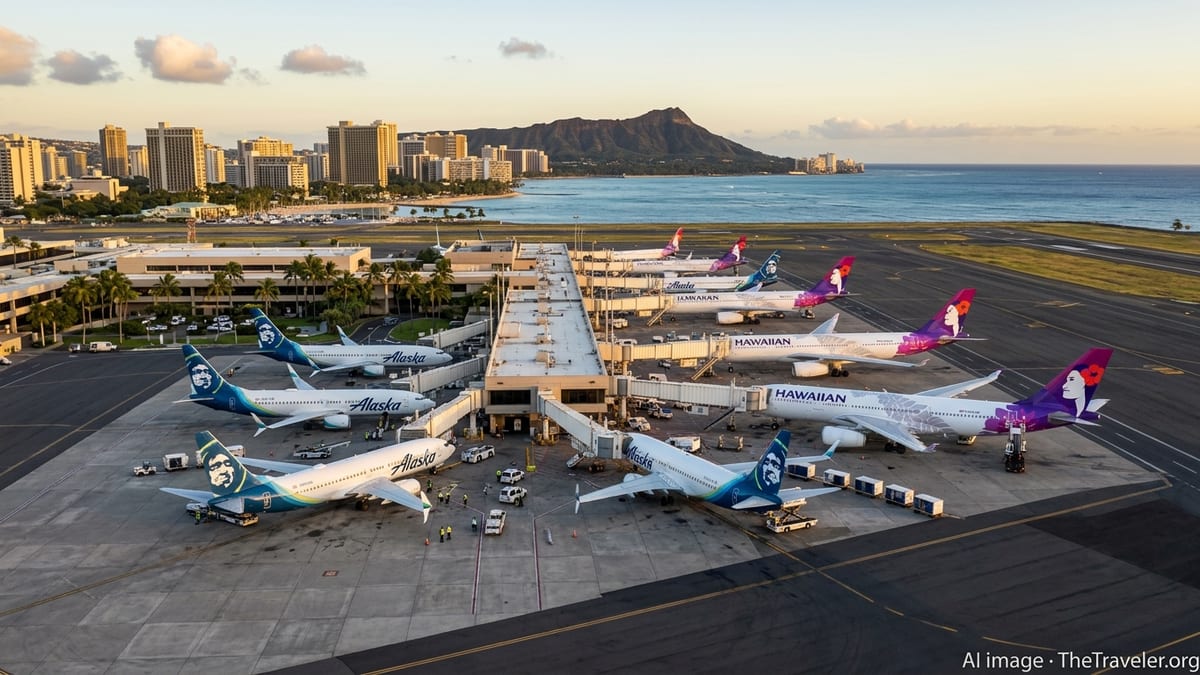
A Bigger Network After the Alaska–Hawaiian Merger
The 2024 completion of Alaska Airlines’ acquisition of Hawaiian Airlines created a single airline group with unusually dense coverage of the Pacific, Hawaiʻi and the western United States. Publicly available information shows that Hawaiian now operates as a wholly owned subsidiary within Alaska Air Group while maintaining its own brand and island-focused identity. The combined operation links Honolulu and other Hawaiʻi gateways with a broad network of West Coast cities, as well as Las Vegas, a perennial favorite for island residents and mainland visitors alike.
Industry overviews of the merged carrier suggest that the strategic focus is firmly on leisure demand, particularly families and vacationers traveling during peak holiday periods such as Spring Break. With hubs in Seattle, Los Angeles, San Diego, San Francisco and Anchorage, plus Honolulu as a core Pacific hub, the group can funnel travelers from across North America into key beach, resort and entertainment destinations with relatively few connections.
This expanded footprint and fleet flexibility underpin the aggressive seat offering being deployed for the upcoming Spring Break period. By coordinating schedules across both brands, planners are able to direct capacity toward time-sensitive leisure peaks while trimming frequencies in shoulder periods or on underperforming routes.
Twelve Million Seats to Hawaiʻi, Las Vegas and Beyond
Tourism and aviation data sets tracking nonstop capacity into Hawaiʻi over recent seasons show that Hawaiian and Alaska together regularly handle several million seats annually into the islands. When combined with their robust flows between the West Coast and Las Vegas, and connecting itineraries that link interior U.S. cities to both Hawaiʻi and Nevada through major hubs, schedule filings and capacity estimates for this Spring Break indicate that the group is making roughly twelve million seats available system-wide on routes tied to these leisure flows.
Those seats are spread across a mix of widebody and narrowbody aircraft, including Hawaiian’s long-haul fleet on transpacific sectors and Alaska’s high-frequency Boeing 737 services from cities such as Seattle, Portland, San Francisco, Los Angeles and San Diego. In scheduling terms, this translates into multiple daily departures from major gateways to Honolulu, Maui, Kauaʻi and Hawaiʻi Island, paired with thickened schedules between West Coast cities and Las Vegas to capture both origin-and-destination and connecting traffic.
Capacity planners appear to be leaning into peak-week demand rather than maintaining uniform volumes throughout the season. Public schedule data points to stronger seat counts clustered around traditional Spring Break weeks in March and early April, aligning flights with school holidays and university breaks across the western and central United States. Outside these windows, frequencies on some routes ease back, allowing aircraft to be redeployed where demand is strongest.
Key Spring Break Corridors and Timing
For travelers starting on the mainland, the Alaska brand remains the primary workhorse on short and medium-haul routes feeding the Spring Break network. Morning and early afternoon departures from Seattle, Portland, San Francisco Bay Area airports, Southern California and select interior markets position passengers to connect same day onto Hawaiian-operated flights to the islands or onto Las Vegas and other desert and mountain destinations.
In Hawaiʻi, Hawaiian continues to handle a significant share of long-haul flying, particularly from the West Coast into Honolulu and other island gateways, as well as inter-island services that allow visitors to divide their vacations between multiple islands. Schedule patterns for the Spring Break period show dense morning and evening banks into Honolulu and Kahului, supporting both same-day connections and extended stays.
Las Vegas remains a standout in the combined network, reflecting its enduring popularity with travelers from both Hawaiʻi and the mainland. Publicly available booking displays highlight multiple daily options linking Honolulu and other Hawaiʻi airports with Las Vegas, as well as high-frequency service from West Coast cities. For many travelers, this enables hybrid itineraries that combine a Hawaiʻi beach stay with a short Las Vegas stopover, all within the same airline family.
What the Expanded Capacity Means for Travelers
For travelers, the upshot of this capacity surge is a wider choice of departure times and routings during a period that often sees full flights and elevated prices. A larger pool of seats into Hawaiʻi and Las Vegas tends, in competitive markets, to moderate fares compared with a scenario where capacity is constrained, and it can also make it easier to secure last-minute bookings or to travel as a family group.
The merged network also has implications for loyalty members. Public information about the integration indicates that frequent flyer benefits and recognition are gradually being aligned across the two brands, allowing mileage earn and redemption, as well as elite perks, to be applied across a broader set of routes. For Spring Break travelers, this can translate into more opportunities to use miles for upgrades or award travel on both Hawaiʻi and mainland segments linked to the same trip.
At the same time, aviation analysts note that the combined carrier faces the challenge of matching capacity closely to demand. Over-scheduling can lead to softer yields, while insufficient capacity during peak weeks can drive up prices and limit availability. The twelve-million-seat Spring Break push is being watched as an early test of how effectively the merged operation can calibrate supply across its most important leisure corridors.
Positioning for Future Holiday Peaks
Looking beyond the immediate Spring Break period, the scale of the current schedule signals how Alaska and Hawaiian intend to position themselves for other peak travel windows such as summer, Thanksgiving and the year-end holidays. By demonstrating that they can mobilize millions of seats to Hawaiʻi, Las Vegas and associated connecting markets in a relatively short seasonal burst, the group is underscoring its role as a leading leisure carrier for the Pacific region.
Industry commentary suggests that future refinements will likely focus on smoothing operational handoffs between the two brands, optimizing aircraft assignments and further integrating sales channels so that customers experience the network as a single, coherent system. As that integration deepens, analysts expect the airline group to continue leveraging its West Coast and Hawaiʻi strengths to attract travelers who might otherwise choose competitors based in other hubs.
For now, the twelve-million-seat Spring Break schedule stands as one of the most visible expressions of the merger’s strategic intent. With a combined network that places Hawaiʻi and Las Vegas at its core, the airline group is using scale and coordination to compete for travelers’ attention at one of the busiest leisure travel moments of the year.