

Alaska is often described through its icy fjords, towering mountains, and vast tundra, yet the deepest story of the state belongs to the Indigenous peoples who have lived there for thousands of years. Their cultures, languages, and knowledge systems continue to shape daily life, politics, food, and art across the region. Understanding Alaska today means centering the perspectives of Alaska Native communities and recognizing both the resilience that sustained them and the pressures that continue to challenge them.
Peoples and Regions of Indigenous Alaska
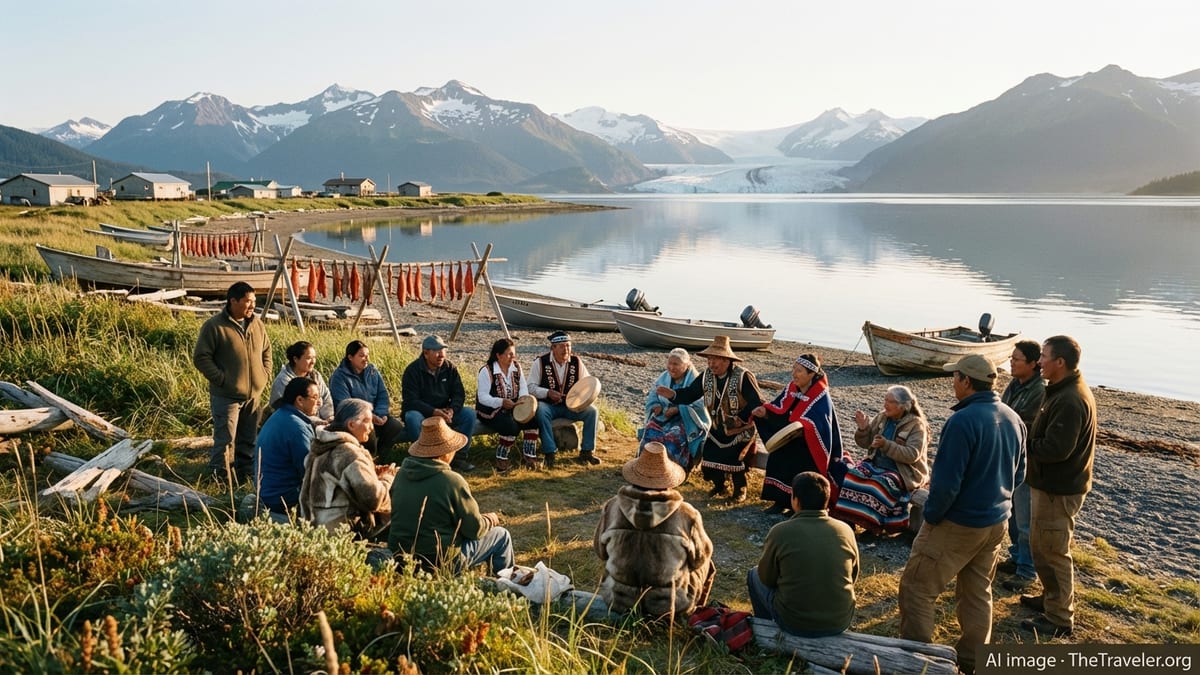
Before Alaska was a state or even a U.S. territory, it was and remains the homeland of diverse Indigenous nations. Broadly speaking, Alaska Native peoples are often grouped into cultural regions that share related languages, subsistence practices, and histories. These include the Inupiat and St. Lawrence Island Yupik of the Arctic, the Yupik and Cup’ik peoples of the Yukon-Kuskokwim Delta and Bering Sea coast, the Unangax̂ (Aleut) and Alutiiq/Sugpiaq peoples of the Aleutian and Alaska Peninsula region, the Dena’ina and other Athabascan peoples of the Interior, the Eyak, Tlingit, Haida, and Tsimshian of Southeast, and several others whose homelands span rivers, coasts, and islands.
Each of these groups maintains distinct languages and cultural practices, yet they also share deep connections to land and water. Coastal peoples developed rich sea hunting traditions focused on marine mammals and fish, while Interior Athabascan communities organized their lives around river systems, caribou, and seasonal plant gathering. These relationships are not only economic but spiritual, embedded in stories that explain how particular places came to be and what responsibilities humans have to animals and the environment.
While non-Native observers once spoke of Alaska Native people as living in isolation, the reality has always been more dynamic. Trade routes connected regions long before colonial borders, and art, songs, and technologies moved through these networks. Feasting, gift-giving, and kinship ties linked communities separated by long distances and harsh weather, creating a sophisticated social landscape that outsiders are only beginning to fully appreciate.
Today, many Alaska Native people live between rural villages and urban centers like Anchorage, Fairbanks, and Juneau. This mobility adds new layers to identity, as families maintain village ties while adapting to city life, building Native organizations, and reshaping what it means to be Indigenous in a changing Alaska.
Worldviews Grounded in Land, Subsistence, and Community
Alaska Native cultures are grounded in the understanding that people and environment are inseparable. Subsistence is one of the most important concepts for grasping this worldview. The term often refers to hunting, fishing, and gathering for food, but for Indigenous communities in Alaska it is far more than a way of eating. Subsistence is a cultural system that includes knowledge of weather and sea ice, rules about how to treat animals respectfully, and the obligation to share food with elders and neighbors.
In many villages, the first seal, moose, or salmon of a young hunter’s season is distributed to others as a way of honoring both the animal and community. This practice reinforces humility and interdependence. Even when people work in wage jobs or buy groceries, subsistence foods such as salmon, walrus, wild berries, or herring eggs remain central to identity, ceremony, and health. The taste of these foods often evokes childhood memories and ancestral stories, and losing access to them can feel like losing a language.
Spiritual beliefs are just as intertwined with land and sea. While some communities adopted Christianity during the Russian and American colonial periods, traditional understandings of the world persist. Many Alaska Native people speak of animals as sentient beings who offer themselves to respectful hunters or fishers and who require reciprocity. Ceremonies, songs, and rules about waste, noise, and behavior during hunting seasons reflect these relationships and frame human actions within a larger moral universe.
Community cohesion is another defining aspect of Alaska Native culture. Extended families span multiple generations and households, and kinship obligations can reach far beyond immediate relatives. Seasonal gatherings, dance festivals, and potlatches in various regions serve not only as celebrations but as mechanisms for redistributing wealth, reaffirming alliances, and honoring those who have passed away. Through these practices, social networks remain strong even as economic and political conditions shift.
From First Contact to Colonization and Displacement
European contact with Alaska Native peoples intensified in the 18th century as Russian traders pushed eastward in search of seal and sea otter pelts. These encounters disrupted local power balances, exposed communities to new diseases, and introduced foreign trade goods that altered economies and status. In many areas, Unangax̂ and coastal peoples were coerced into labor for Russian fur companies, while missionization began to reshape religious life.
The United States purchased Alaska from Russia in 1867, yet for decades federal presence in the territory was inconsistent. Mining, whaling, and commercial fishing expanded, drawing waves of settlers and companies. These newcomers increasingly competed with local communities for land and resources. Government schools and missions, often run by churches, sought to assimilate Native children, banning Indigenous languages and punishing traditional practices. Many elders today recall or report stories of relatives who were beaten or shamed for speaking their language in class.
The 20th century brought new forms of displacement. Military bases, large-scale fishing operations, and infrastructure projects carved up homelands. Epidemics, including the 1918 influenza, devastated villages with little access to health care. Policies often ignored or misunderstood Indigenous governance structures, and Native people were rarely included in decisions about land, education, or development. Despite these pressures, Alaska Native leaders organized politically, forming advocacy groups to push for civil rights, land recognition, and voting power.
World War II and the Cold War dramatically altered life for some communities, particularly in the Aleutian and Pribilof Islands and the Arctic. Unangax̂ civilians were forcibly relocated from their homes while military installations spread along the coast and into the Interior. These experiences contributed to a growing sense of urgency among Native leaders who recognized that without legal recognition of their rights and territories, their cultures faced existential threats.
Land, Law, and the Alaska Native Claims Settlement Act
One of the defining legal moments in modern Alaska Native history came in 1971 with the Alaska Native Claims Settlement Act, commonly known as ANCSA. The law emerged during a time when land rights disputes were slowing major oil development projects and when Alaska Native organizations had begun pressing their case more forcefully at the state and federal levels. ANCSA extinguished Indigenous claims to traditional lands in exchange for financial compensation and title to a portion of Alaska’s land base.
Under the settlement, Alaska Native people received rights to a significant share of land and monetary payments that were distributed through newly created Native regional and village corporations. These are for-profit entities with Alaska Native shareholders, distinct from tribal governments recognized elsewhere in the United States. Supporters have argued that the corporate structure created economic engines that could participate in modern markets while still serving Native communities, funding education programs, cultural grants, and dividends.
Critics, including many Alaska Native scholars and activists, point out that ANCSA converted communal land relationships into corporate stock and that it did not fully address issues of tribal sovereignty. Some argue that the requirement to operate as profit-driven corporations can conflict with cultural priorities and long-term environmental stewardship. Others note that territorial loss and ongoing disputes over hunting, fishing rights, and resource development continue to generate tension between Native communities, state agencies, and industry.
Since ANCSA, additional legislation and court decisions have clarified aspects of subsistence rights, co-management of wildlife, and tribal jurisdiction in certain areas, yet the legal landscape remains complex. For visitors and outside observers, one of the key takeaways is that modern Alaska is shaped by a unique blend of corporate, tribal, state, and federal authorities. Understanding Indigenous heritage means recognizing this legal framework and listening carefully to how Alaska Native communities describe their own priorities within it.
Language Revitalization and Cultural Renewal
Across Alaska, Indigenous languages once suppressed in schools are now central to a powerful movement of revitalization. Many of the state’s Native languages are considered endangered, with a limited number of fluent elder speakers. In response, communities, universities, and families are launching immersion programs, language nests for young children, community classes, and digital resources. In some urban schools, students can now learn in dual-language programs that center Yupik or other Alaska Native languages as a medium of instruction.
Higher education institutions in Alaska have partnered with tribal and Native organizations to develop teacher training, archives, and curricula that respect Indigenous knowledge. Grants from federal and state agencies have helped fund these efforts, although many programs still rely heavily on grassroots energy and volunteer work. Master-apprentice initiatives pair elders with younger learners in intensive language relationships, capturing not only vocabulary but the stories, humor, and values that live inside phrases and idioms.
Language work is often intertwined with broader cultural renewal. Reviving traditional place names, teaching children original songs and dances, and recording oral histories all reinforce a sense of continuity. Social media and community radio have become tools for sharing words and stories, connecting people who live far from their ancestral villages. For Indigenous youth navigating two worlds, having access to their ancestral language can help counter the effects of discrimination and historical trauma and provide a foundation for pride and confidence.
At the policy level, Alaska has recognized several Native languages as official alongside English, a symbolic step that acknowledges their importance. Implementation on the ground remains uneven, and many communities stress that long-term funding and respectful partnerships are necessary to move beyond symbolic recognition toward everyday use in schools, services, and public life.
Art, Storytelling, and Ceremonial Life
Indigenous art in Alaska is both ancient and contemporary, encompassing carving, weaving, beadwork, regalia, performance, and multimedia installation. Traditional forms such as Inupiat and Yupik ivory carving, Athabascan beadwork, Unangax̂ bentwood visors, and Tlingit, Haida, and Tsimshian formline carving reflect deep philosophical systems and stories about clan history, animal powers, and spiritual relationships. Each line, bead, and figure can carry lineage information and moral teachings, not merely decoration.
Contemporary Alaska Native artists build on these legacies while responding to modern realities. Many experiment with new materials like steel, glass, and digital media, or address themes such as climate change, relocation, and resource extraction. Urban galleries, cultural centers, and museums in cities like Anchorage and Juneau now feature exhibitions curated by Indigenous experts, challenging older museum practices that removed items from communities or misinterpreted their meanings.
Storytelling and dance remain essential forms of cultural expression. In some regions, winter dance festivals bring together multiple villages for days of singing, drumming, and masked performances that recall historic events or mythic journeys. In Southeast Alaska, potlatches and memorial ceremonies incorporate songs, speeches, and the display of clan regalia. These gatherings are times to pass knowledge to younger generations and to reaffirm obligations between clans, villages, and families.
For visitors, art can be an accessible entry point into Alaska Native culture, yet it is important to remember that many designs and ceremonial items have specific cultural protocols. Buying from recognized Native artists and organizations, and learning when photography or public display is inappropriate, helps support both economic livelihoods and cultural integrity.
Climate Change, Community Challenges, and Resilience
Alaska is warming faster than many other parts of the world, and Indigenous communities are often on the front lines of these changes. Thawing permafrost, coastal erosion, and unpredictable sea ice conditions directly affect subsistence activities and village infrastructure. Some communities face the difficult prospect of relocating entire settlements as shorelines erode or storm surges worsen, raising complex questions about funding, land rights, and the preservation of burial grounds and sacred places.
These environmental pressures compound other challenges, including housing shortages, high fuel and food costs in remote areas, and health disparities. Historical trauma from boarding schools and forced relocations continues to reverberate in issues such as mental health struggles, substance use, and loss of language. At the same time, Alaska Native leaders and organizations are at the forefront of climate research, adaptation planning, and co-management of wildlife, bringing Indigenous knowledge into scientific and policy conversations.
Community-based monitoring programs, for example, document sea ice thickness, animal migrations, and unusual events through the observations of local hunters and elders. This knowledge helps scientists refine their models and supports local decision making about when it is safe to travel or hunt. Youth groups are also stepping into leadership, combining traditional skills such as sewing, dog mushing, or berry picking with advocacy for clean energy and environmental justice.
Resilience in this context does not mean that communities are unaffected by hardship. Rather, it refers to the ways Alaska Native peoples draw on deep cultural reserves of knowledge, humor, and solidarity to face uncertainty. Ceremonial gatherings, language classes, and art-making can become forms of healing, while legal and political advocacy seeks more equitable partnerships with state and federal agencies.
Experiencing Alaska Respectfully as a Visitor
Travelers to Alaska today have more opportunities than ever to learn about Indigenous cultures in ways that are guided by Alaska Native voices. Cultural centers, tribal museums, and locally owned tour companies offer programs that highlight traditional knowledge, subsistence activities, and contemporary life. Visitors may have the chance to watch dance performances, see carving or weaving demonstrations, or hear directly from local residents about their history and hopes for the future.
Respectful travel begins with recognizing that you are entering Indigenous homelands. Taking time to learn the name of the Native nation whose territory you are visiting, listening to local guidelines about photography and sacred sites, and supporting Native-owned businesses are all meaningful steps. In many rural communities, resources like fresh water or clinic space may be limited, so advance planning and modest expectations help minimize strain on local infrastructure.
Understanding the importance of subsistence can also shape visitor behavior. Whether fishing on a charter, hiking in berry patches, or boating near marine mammals, it is wise to remember that local residents may depend on those same resources for food security and cultural practices. Following local regulations, respecting closed areas, and avoiding waste demonstrate consideration for the communities whose livelihoods are tied to the land and sea in ongoing ways.
For many Alaska Native hosts, the goal is not to present a frozen image of tradition but to share living cultures that continue to evolve. Visitors who approach with curiosity, humility, and a willingness to listen can leave with a deeper appreciation of how Indigenous heritage informs every part of Alaska’s story, from place names and art to politics and environmental stewardship.
The Takeaway
Alaska’s landscapes may captivate the eye, but it is the Indigenous presence across those lands that gives them depth and meaning. From ancient subsistence practices and oral traditions to contemporary legal struggles and climate adaptation, Alaska Native peoples continue to define what the state is and what it may become. Their stories challenge simple narratives of wilderness and frontier, offering instead a vision of homeland, responsibility, and continuity over thousands of years.
To truly understand Alaska, one must listen to the many Native voices that have long described its mountains, rivers, and coasts in detailed, relational terms. Whether through language revitalization, art, ceremony, or advocacy, these voices are insisting on futures where Indigenous knowledge is central rather than marginal. For travelers, educators, and residents alike, engaging thoughtfully with this heritage is both an ethical responsibility and an invitation to see the North with new eyes.
FAQ
Q1. Who are the main Indigenous peoples of Alaska?
Alaska is home to many Native nations, including Inupiat, Yupik and Cup’ik, Unangax̂ (Aleut), Alutiiq/Sugpiaq, numerous Athabascan peoples of the Interior, and the Eyak, Tlingit, Haida, and Tsimshian of Southeast, among others.
Q2. What is the Alaska Native Claims Settlement Act?
The Alaska Native Claims Settlement Act is a 1971 federal law that extinguished Indigenous land claims in Alaska in exchange for monetary compensation and title to a portion of the state’s land, distributed through Native regional and village corporations.
Q3. How important is subsistence to Alaska Native cultures?
Subsistence is central to Alaska Native life. It is not only about obtaining food from hunting, fishing, and gathering but also about cultural values, sharing networks, spiritual beliefs, and teaching younger generations how to live responsibly on the land and sea.
Q4. Are Alaska Native languages still spoken today?
Yes. Many Alaska Native languages have few fluent speakers and are considered endangered, but communities across the state are investing in revitalization through immersion programs, school curricula, community classes, and digital tools.
Q5. How did colonization affect Alaska Native communities?
Colonization brought disease, resource competition, mission schools that punished Indigenous language use, forced relocations, and legal marginalization. Despite this, Alaska Native communities maintained cultural practices and organized politically to assert rights and protect their homelands.
Q6. What role do Native corporations play in Alaska today?
Native regional and village corporations created under the settlement act manage land and financial assets on behalf of Alaska Native shareholders, operating as for-profit entities that can fund scholarships, cultural programs, and business ventures, while sometimes facing tension between profit goals and cultural priorities.
Q7. How are Alaska Native artists preserving and evolving tradition?
Alaska Native artists work in traditional forms such as carving, weaving, and beadwork, and also in contemporary media. They preserve ancestral techniques while addressing modern themes like climate change, identity, and political struggles, keeping culture vibrant and visible.
Q8. What climate challenges are Alaska Native communities facing?
Communities confront thawing permafrost, coastal erosion, and unpredictable sea ice that threaten homes and subsistence activities. Some villages are considering or planning relocation, while also leading research and adaptation efforts based on Indigenous knowledge.
Q9. How can visitors engage respectfully with Alaska Native cultures?
Visitors can learn the names of local Native nations, support Indigenous-owned businesses and cultural centers, follow guidance on photography and sacred sites, respect subsistence resources, and approach experiences with humility and willingness to listen.
Q10. Why is Indigenous heritage essential to understanding Alaska?
Indigenous heritage shapes Alaska’s place names, art, governance, subsistence practices, and relationships to the environment. Without centering Alaska Native perspectives, any picture of the state remains incomplete and misses the depth of its human history.