

More news on this day
A tense go-around involving an Alaska Airlines passenger jet and a FedEx cargo aircraft at Newark Liberty International Airport this week is sharpening focus on the risks posed by intersecting runways at one of the New York region’s busiest hubs.
Get the latest news straight to your inbox!
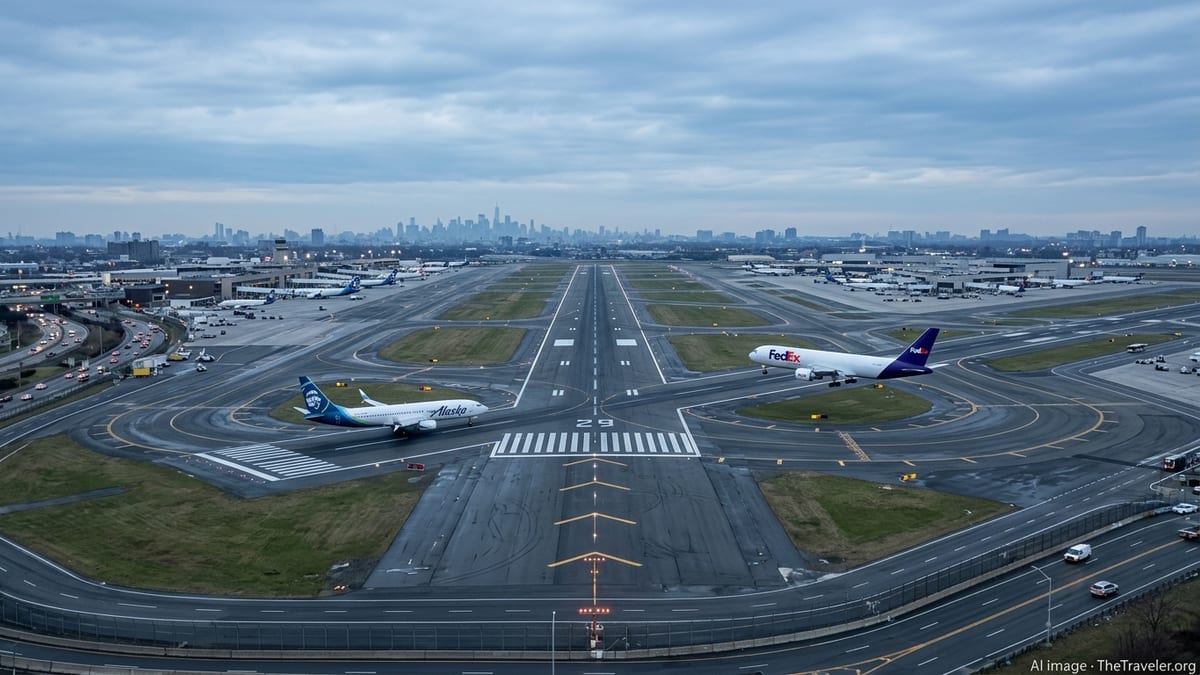
Close Call on Crossing Runways
Publicly available information indicates that the National Transportation Safety Board has opened an investigation into a near miss on the night of Tuesday, March 17, at Newark Liberty International Airport. According to coverage by major news outlets, an Alaska Airlines Boeing 737 arriving from Portland, Oregon, overflew a FedEx Boeing 777 freighter arriving from Memphis, Tennessee, as both aircraft converged on intersecting runways.
Data summarized in published reports shows that the Alaska flight had been cleared to land when air traffic control instructed the crew to conduct a go-around because the FedEx jet was also on final approach to an intersecting runway. The Alaska pilots executed the maneuver, climbing away as trained, and both aircraft later landed safely. Initial accounts note that 171 passengers and six crew members were on board the Alaska flight.
Coverage from outlets including the Associated Press describes the event as a serious runway incursion involving converging approaches on crossing runways. While the exact vertical and horizontal separation between the two jets has not yet been detailed in public investigative documents, the fact that the incident triggered a federal safety investigation underscores how close the sequence came to a potential collision.
Both airlines have issued prepared statements referenced in news coverage, indicating that their flight crews complied with air traffic control instructions and completed their flights without injuries or aircraft damage. For travelers, the episode was largely invisible in real time, but the subsequent federal review has made it a high-profile example of the risks that can arise when traffic builds on complex runway layouts.
Newark’s Intersecting Runway Layout Under the Spotlight
Newark Liberty operates a mix of parallel and intersecting runways that must accommodate intense passenger and cargo traffic in a relatively compact footprint. Aviation reference materials note that runway pairs used for different flow configurations intersect at angles that can bring aircraft paths together close to the touchdown zones. When winds, traffic volume, and scheduling pressure align, controllers may sequence arrivals and departures on crossing runways to maximize capacity.
Experts who have examined other U.S. runway incursions have repeatedly pointed to intersecting runway systems as a particular challenge. Public NTSB testimony to Congress has highlighted how converging traffic patterns, visibility limitations, and human workload can interact in ways that narrow margins of safety even when individual decisions appear reasonable. Those same themes are now being raised in commentary about Newark’s design and operating environment.
Newark’s role as both a major passenger gateway and a cargo hub adds to the operational complexity. Passenger airlines rely on tightly timed banks of arrivals and departures that feed connecting flights across North America and beyond. At the same time, overnight and early morning cargo operations, including FedEx and other freight carriers, use the same airfield infrastructure. Coordinating these flows on intersecting runways can leave little room for delay or miscommunication.
Urban geography also limits options for major airfield expansion. The airport is hemmed in by highways, industrial areas, and tidal wetlands, constraining how runways can be lengthened, realigned, or replaced. As a result, safety improvements at Newark have historically focused on procedures, lighting, signage, and technology rather than wholesale runway redesign, an approach that is likely to remain central as investigators analyze the latest near miss.
A Near Miss in a Wider Pattern of Runway Incursions
The Alaska and FedEx encounter at Newark is the latest in a string of close calls on U.S. runways that have drawn national attention. In public reports and testimony, the NTSB has cited several high-profile cases in recent years, including a near collision in Austin, Texas, where a FedEx 767 came within roughly one hundred feet vertically of a Southwest Airlines Boeing 737 that was departing from the same runway in low visibility conditions.
Other serious events referenced in NTSB documents include runway incursions at Boston, New York’s John F. Kennedy International Airport, and regional airports such as Sarasota. In many of these cases, aircraft were cleared to land or take off on intersecting or shared surfaces, and safety margins depended heavily on real-time controller judgment, crew situational awareness, and, where available, automated ground radar alerts.
In formal findings on the Austin incident, the NTSB has emphasized that the absence of runway surveillance systems and cockpit alerting tools can allow errors or incorrect assumptions to go uncorrected until aircraft are dangerously close. The board has urged wider deployment of airport surface detection systems and new cockpit technologies that would warn pilots of traffic on intersecting runways or conflicting approaches.
The Newark episode fits into this broader narrative of a system operating safely most of the time, yet revealing vulnerabilities when traffic loads are high or when configurations such as intersecting runways increase complexity. For travelers and airlines alike, the pattern has raised questions about whether current safeguards are keeping pace with demand at major hubs.
Technology, Training, and the Push for Safer Surfaces
In response to recent incursions, federal safety recommendations have increasingly focused on technology designed to give both controllers and pilots a clearer real-time picture of runway activity. Airport surface detection systems that combine radar with multilateration and automatic dependent surveillance data can display aircraft and ground vehicles on controller screens, generating visual and aural alerts when potential conflicts arise.
Some large airports already use these tools, and publicly available information shows that the Federal Aviation Administration has committed funding to expand and upgrade surface monitoring at a range of facilities. However, the level of protection varies from airport to airport, and not all intersecting-runway layouts benefit from full-featured detection systems. That variability is a recurring theme in NTSB recommendations that call for standardized, nationwide deployment.
On the flight deck, investigators have urged the development of onboard systems that would alert pilots to conflicting traffic on or near the runway environment. Industry reporting indicates that the FAA has been encouraged to work with aircraft and avionics manufacturers to bring such capabilities into both new and existing fleets. For crews operating into airports like Newark, this type of independent cross-check could provide an extra layer of assurance when instructions involve crossing or intersecting runways.
Training and procedures remain another critical pillar. Airlines and cargo operators routinely rehearse go-arounds, runway confusion scenarios, and last-minute changes to approach clearances in simulators. The successful go-around executed by the Alaska crew at Newark, as described in news reports, illustrates how procedural discipline and recurrent training can turn a potentially catastrophic situation into a non-event for those on board, even as investigators examine how the situation arose in the first place.
What Newark’s Near Miss Means for Future Flights
For passengers scheduled to pass through Newark in the coming days and weeks, operations are expected to continue largely as normal while investigators collect data from radar recordings, radio transmissions, and flight recorders. Historically, most runway incursion inquiries have resulted in detailed safety recommendations rather than immediate schedule disruptions, although specific air traffic procedures can change quietly behind the scenes.
Industry analysts note that serious incidents often become catalysts for broader reforms that extend well beyond a single airport. Past runway incursions have led to changes in phraseology used by controllers and pilots, upgrades to lighting and signage, and new limits on how intersecting or crossing runways can be used simultaneously. The latest event at Newark is likely to feed into that ongoing policy conversation, especially as federal agencies review how intersecting runway operations are managed at other legacy airports.
For Newark itself, the near miss has renewed attention on long-discussed questions about capacity, modernization, and the balance between efficiency and safety. Some aviation specialists expect the investigation to prompt fresh evaluations of arrival and departure spacing, the conditions under which intersecting runways can be used for concurrent approaches, and whether additional technology investments are warranted on the airfield.
Travelers may never see most of these changes directly, but the close call between the Alaska Airlines and FedEx jets serves as a reminder that safety margins in modern aviation are maintained through constant adjustment. As federal investigators work through the Newark case, their findings and recommendations are likely to shape how intersecting runways are managed not just in New Jersey, but across the national airspace system.