

More news on this day
Alaska Airlines is rapidly transitioning former Hawaiian Airlines Boeing 787 Dreamliners into its new aurora-inspired global livery, signaling an ambitious push into long-haul international markets from its Seattle hub.
Get the latest news straight to your inbox!
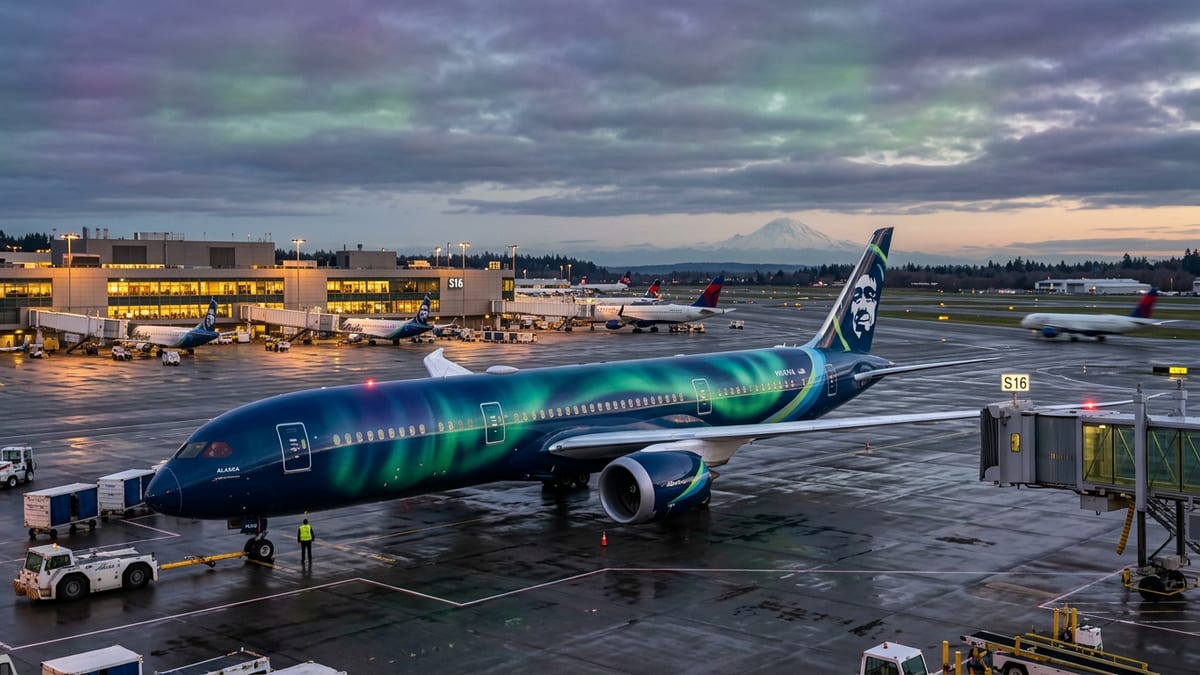
Aurora-Inspired Look Marks New Global Era
The new Alaska Airlines Boeing 787-9 design takes direct inspiration from the aurora borealis, with deep blues and vibrant greens flowing along the fuselage and tail. Publicly available images show a gradient effect that wraps around the widebody’s curves, creating a sense of motion that is markedly different from Alaska’s familiar narrowbody look.
The 787-9s now entering service under the Alaska brand were originally ordered and, in some cases, delivered in Hawaiian Airlines’ Pualani livery. As the two carriers integrate under Alaska Air Group, those aircraft are being repainted into what the company is positioning as its dedicated “global” livery, distinct from the mainline scheme used on domestic narrowbody jets.
Industry coverage indicates that all Boeing 787s in the combined group are slated to move into this aurora-themed Alaska identity over the coming months, while Hawaiian-branded Airbus aircraft continue to operate with their existing liveries. The shift concentrates the long-haul brand message squarely on the Dreamliner fleet that will anchor Alaska’s intercontinental ambitions.
Former Hawaiian Dreamliners Shift to Alaska Branding
The Dreamliners at the center of this transition began their service life in Hawaiian Airlines colors, operating transpacific routes that linked Honolulu with key cities across North America and Asia. Following Alaska Air Group’s acquisition of Hawaiian, fleet plans have evolved to transfer those 787-9s into the Alaska operating certificate and repaint them into the new aurora livery as they rotate through maintenance and paint facilities.
Aircraft tracking and enthusiast reports show former Hawaiian frames appearing at repaint centers and later emerging with Alaska’s aurora design and new registrations tied to the Seattle-based carrier. This process effectively transforms Hawaiian’s young widebody assets into the launch platform for Alaska’s first-ever in-house long-haul widebody operation.
Analysts note that the decision to prioritize repainting the 787s, rather than Hawaiian’s A330 or other types, reflects how central the Dreamliner has become to the group’s future. The 787’s fuel efficiency, range and cargo capacity align with Alaska’s stated focus on long-haul flying to Europe and Asia from its Pacific Northwest gateway.
Building an International Network from Seattle
The aurora livery is more than a cosmetic refresh; it is designed as a visual flag for Alaska’s new global strategy. Company updates and aviation industry reporting describe plans to grow a network of at least a dozen long-haul international destinations by the early 2030s, with the 787 fleet based primarily at Seattle-Tacoma International Airport.
The former Hawaiian 787s, once fully repainted and integrated, are expected to support services linking Seattle with major markets in Europe and Asia, complementing the group’s strong West Coast and Hawaii presence. For travelers, the change means more nonstops from the Pacific Northwest on Alaska metal, rather than relying solely on alliance partners or connections through other hubs.
Cargo planners are also watching the transition closely. The 787-9 offers significantly more belly cargo volume than the narrowbody jets that dominate Alaska’s domestic network, unlocking additional capacity for high-value freight and e-commerce shipments on long-haul routes. This capability supports Alaska’s broader cargo strategy, which increasingly spans Asia, the South Pacific, Canada and Mexico.
Balancing Brand Identity Across Alaska and Hawaiian
The repainting of Hawaiian’s former 787s into Alaska’s aurora global livery has sparked debate among frequent flyers and aviation enthusiasts who closely follow both brands. Public discussion on industry forums highlights a tension between maintaining Hawaiian’s strong cultural identity and presenting a unified global look for the combined group’s flagship widebody fleet.
Available information suggests that, for now, Hawaiian’s Airbus A330s, Boeing 717s and A321neo aircraft will continue flying in full Hawaiian colors, particularly on routes to, from and within the islands. The Alaska aurora livery, by contrast, is being reserved for 787s that will be based mainly in Seattle and deployed on long-haul international missions.
This dual-brand approach allows Alaska Air Group to preserve Hawaiian’s distinctive visual presence in its core markets while still creating a consistent Alaska-branded product for global routes. For travelers, the result is a network that increasingly interlines under one corporate umbrella but still appears under two recognizable and regionally rooted brands on the tarmac.
What Travelers Can Expect Onboard
Inside the repainted 787-9s, travelers can expect cabin layouts tailored for long-haul comfort, including a new international business class product, premium economy seating and modern inflight entertainment at every seat. Alaska has indicated through public materials that these aircraft will offer upgraded soft products and service touches positioned a step above its domestic narrowbody experience.
The Dreamliner’s large dimmable windows, higher cabin humidity and lower pressurization altitude are inherent features of the aircraft type that should be noticeable to passengers, particularly on overnight transoceanic flights. Coupled with the aurora-themed exterior, Alaska is aiming to create an experience that feels purpose-built for global travel rather than simply an extension of its domestic routes.
As more former Hawaiian 787s complete repainting and join the Alaska-branded fleet over the coming seasons, travelers departing Seattle and other West Coast gateways are likely to see the aurora livery become an increasingly common sight. For aviation watchers, the transformation of these widebodies from Hawaiian’s signature Pualani to Alaska’s northern lights motif has become a tangible symbol of a rapidly changing U.S. airline landscape.