

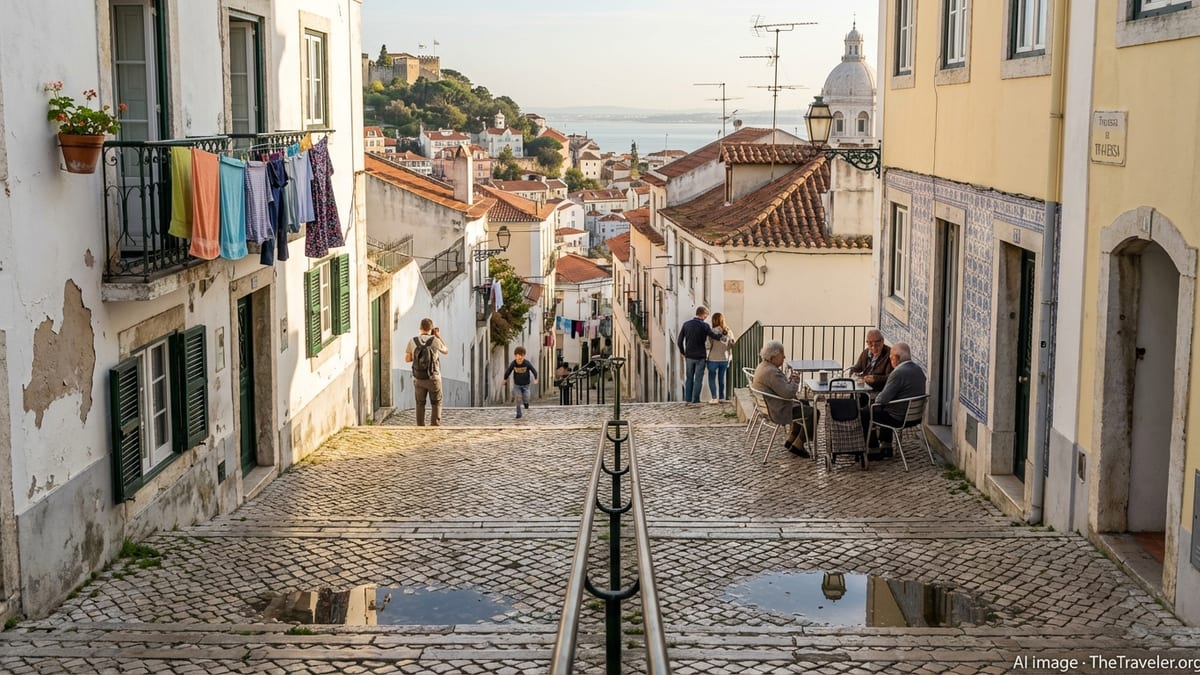
Alfama is the Lisbon visitors dream of when they picture the Portuguese capital: a hillside of terracotta roofs and pastel houses, sliced by tight alleys, stone staircases, and unexpected terraces opening over the Tagus River. It is the city’s oldest neighborhood, shaped by Phoenicians, Romans, Moors, and medieval kings, and one of the few areas whose haphazard medieval street plan survived the 1755 earthquake.
Today Alfama is both a living village and an open-air museum of Lisbon’s past, where fado music drifts from taverns, laundry hangs above centuries-old cobbles, and locals share their streets with an ever-growing stream of visitors. This guide explores the history, alleys, and landmarks that define Alfama’s old town and offers practical insight for experiencing it with respect and depth.
Alfama Through the Ages
Alfama’s story begins long before Portugal existed as a country. Archaeological evidence suggests settlement on this hill above the Tagus as far back as the first millennium BCE. Later, Romans built infrastructure along the river and on the surrounding hills, but it was under Islamic rule from the 8th to the 12th centuries that the neighborhood took on the dense, labyrinthine layout that still defines it. The very name Alfama is rooted in Arabic, derived from “al-hamma,” a reference to thermal springs and baths once associated with the area.
When Christian forces reconquered Lisbon in the 12th century, the new rulers installed their fortress, Castelo de São Jorge, on the hilltop and built the Sé Cathedral nearby. Around them, Alfama evolved as a mixed district of fishermen, small traders, and craftspeople, with a significant Jewish community and long-established Christian parishes. Narrow lanes, dead-end alleys, and stepped passages were shaped more by topography and tradition than by any urban plan, resulting in a street network that feels more North African than Western European.
The 1755 earthquake and tsunami, among the most destructive in European history, leveled much of downtown Lisbon and reshaped the city’s political and architectural future. Alfama, anchored to dense bedrock and set higher on the slope, avoided complete ruin. Many buildings were damaged and later rebuilt, but the underlying street pattern and village-like character survived while the Baixa district below was redesigned in a rational grid. This contrast is still striking today: step from the broad, geometric avenues of downtown into Alfama’s folds of stone, and you cross several centuries in a few dozen meters.
In the 19th and early 20th centuries Alfama was associated with poverty and overcrowding. Yet it was also in these streets that fado, Lisbon’s melancholy urban song, took root and flourished in taverns and family homes. In the last two decades, an intense wave of restoration and tourism-driven investment has transformed much of the housing stock, turning once-crumbling dwellings into guesthouses and short-term rentals. While this revitalization has saved many buildings, it has also pushed rents up and raised questions about how much of Alfama’s soul can survive relentless visitor pressure.
Understanding the Layout: Alleys, Largos, and Miradouros
Alfama’s charm is inseparable from its complexity. Where newer districts rely on car traffic and broad sidewalks, Alfama is built around “becos” (alleys), “travessas” (passageways), “escadinhas” (stepped streets), and “largos” (small squares). Many of these pathways are barely wide enough for two people to pass. GPS signals bounce unpredictably between stone walls, and maps flatten what is essentially a vertical village. Getting lost is inevitable, and for many visitors it becomes the highlight of their time in Lisbon.
The basic geography is simple enough: Castelo de São Jorge and its walls crown the top of the hill; the Tagus River and the waterfront spread out at the bottom. Tram 28 and various bus routes trace lines just above or beside the neighborhood, but deep inside the old fabric there is little motorized access. As you walk, you will constantly move between narrow corridors and sudden openings: a stairway revealing a patch of blue river at its end, a tiny square with a lone tree and a café kiosk, a balcony lined with azulejo tiles that seems to float above a cascade of rooftops.
Key streets like Rua de São Miguel, Rua dos Remédios, and Rua de São Pedro help orient you, but they twist and climb in irregular ways. Rather than attempting an exact itinerary, think in terms of zones. The upper zone, closer to the castle and viewpoints like Miradouro de Santa Luzia and Miradouro das Portas do Sol, feels more overtly scenic and is where many visitors begin their exploration. The middle section, with its concentration of everyday shops, small bars, and the Fado Museum, has a more lived-in atmosphere. The lower edges, near the waterfront and Santa Apolónia, are flatter and a bit less dense, connecting Alfama to the rest of the city.
Alfama’s miradouros, or viewpoints, are more than postcard spots. Terraces like Santa Luzia, Portas do Sol, and Santo Estêvão serve as social stages where visitors and residents pause, rest, and observe the city. At Santa Luzia, blue-and-white tile panels depict Lisbon before the earthquake, offering a visual time capsule to compare with the modern skyline. Portas do Sol, often busy with photographers, street performers, and the rattle of tram 28, functions as a balcony over the old town. Smaller outlooks, such as the Santo Estêvão terrace or hidden gardens within the castle walls, reward those willing to wander off the main paths.
Walking the Alleys: How to Explore on Foot
The only way to truly understand Alfama is on foot. Elevation changes are significant, but most people in moderate health can manage the climbs if they allow time and adopt a slow, observant pace. Comfortable footwear is essential. The calçada portuguesa, Portugal’s traditional mosaic pavement, is beautiful but can be polished smooth; when wet, the stones become slick, and uneven edges can catch unprepared ankles.
One popular approach is to start at the river level or in Baixa and walk upward. From Praça do Comércio or nearby streets, you can follow signs or tram tracks toward the Sé Cathedral. After visiting the cathedral’s Romanesque interior and cloister, slip behind it onto Rua de São João da Praça or Rua Augusto Rosa and begin threading into the heart of Alfama. These streets soon yield to narrower alleys where house numbers look hand-painted and balconies are lined with flowerpots and clotheslines.
Alternatively, you can climb by public transport and then descend mostly downhill. Tram 28 and several buses and tuk-tuks reach viewpoints such as Portas do Sol near the castle. From there, you can drift slowly down, roughly following the flow of the tram tracks at first, but deliberately turning off into smaller routes whenever a staircase or archway catches your eye. The descent might take an hour or an entire afternoon, depending on how often you stop to photograph details, have a coffee, or listen to a street musician.
Respect for residents is crucial. Many of Alfama’s most photogenic corners are residential front doors and private courtyards, not tourist sets. Early mornings often see elderly neighbors chatting in doorways, shopping trolleys clattering over stones, and schoolchildren rushing through the lanes. Late evenings bring diners heading to fado houses and the last of the day’s terrace-hoppers. Keep noise to a reasonable level, avoid pointing cameras directly into people’s windows, and remember that voices carry very easily in this dense built environment.
Landmarks: Castles, Churches, and Viewpoints
Above all else, Alfama is defined by Castelo de São Jorge. Perched on the hilltop, this medieval fortress was once a royal residence and defensive stronghold overlooking the harbor. Today its ramparts and towers form one of Lisbon’s most visited monuments. From the battlements you can trace the flow of the Tagus, see the grid of Baixa below, and appreciate how Alfama winds around the hillside in an irregular web. The castle grounds also contain archaeological remains documenting Lisbon’s occupation across centuries, along with shady gardens and peacocks that have become unofficial mascots.
Below the castle, Lisbon’s Sé Cathedral anchors the western edge of Alfama. Built in the 12th century and modified repeatedly after earthquakes, it combines Romanesque bulk, Gothic details, and Baroque chapels. Inside, a treasury and excavated cloister reveal layers of Roman and medieval history baked into the site. The cathedral has seen kings married and explorers blessed before their voyages, and tram 28’s passage in front of its façade has become one of the city’s most iconic scenes.
On the eastern side of the neighborhood, the Monastery of São Vicente de Fora stands out as a major architectural and historical landmark. Its mannerist façade and twin bell towers rise above the low roofs of Alfama, while inside visitors can explore tiled cloisters, a royal pantheon, and an upper terrace with expansive views over the Tagus and the National Pantheon. The Pantheon itself, in the former Church of Santa Engrácia, is another essential stop. Its vast white dome is visible from almost every terrace in Alfama and shelters the tombs and cenotaphs of significant Portuguese figures, from presidents to cultural icons.
Near the river, the Fado Museum offers a curated window into the music so closely tied to Alfama. Exhibits trace the evolution of fado from 19th-century taverns to concert halls and modern recordings, highlighting the Portuguese guitar and the lives of singers who made the genre famous. Just steps away, the Santa Apolónia area and the low streets near the waterfront connect the old quarter to train and metro links, making it a convenient transition point between the medieval maze and the wider city.
Fado, Everyday Life, and Alfama’s Changing Character
For many visitors, Alfama is synonymous with fado. The music’s themes of longing, loss, and bittersweet memory are often described as capturing Lisbon’s soul. Historically, fado was associated with working-class bars, sailors’ hangouts, and neighborhood celebrations, and Alfama was one of its core heartlands. While much of what visitors experience today is curated for tourism, the emotional intensity of a good performance and the sense of continuity with past generations can still feel profoundly authentic.
Modern Alfama hosts a spectrum of fado experiences, from polished, reservation-only restaurants where dinner and an evening of music blend into a single program, to small informal venues where locals and visitors sit shoulder to shoulder over glasses of wine. The sound of the Portuguese guitar drifting through alleyways at night is part of the neighborhood’s acoustic landscape. When choosing a venue, it is worth seeking out places that are respectful to performers and audience alike, avoiding spots that treat the music as a background soundtrack rather than a central experience.
Beneath the postcard surface, Alfama remains a real community in flux. Longstanding residents still shop at tiny grocery stores and open-air markets, hang laundry across alleyways, and decorate their streets with paper garlands during the June festivals honoring Lisbon’s saints. At the same time, many traditional rental homes have been converted to short-term tourist apartments or boutique guesthouses. This shift, accelerated in the last decade, has brought economic opportunity but also pressure on housing costs and a gradual thinning of everyday services aimed at locals.
City authorities and neighborhood organizations continue to debate how to manage crowds, regulate short-term rentals, and preserve community life. Visitors play a role in this balance. Choosing local businesses over multinational chains, treating residential lanes as shared space rather than attractions, and avoiding excessive noise late at night all help keep the neighborhood liveable. The more Alfama continues to function as a genuine village, the more compelling its atmosphere remains for those who come to experience it.
Practical Tips for Visiting Alfama Today
Alfama has become one of Lisbon’s busiest quarters, particularly in the peak season from late spring through early autumn and on days when large cruise ships dock nearby. Mornings tend to be quieter, especially before mid-morning tour groups arrive. Early evening brings a different mood as locals return from work, terraces fill with people watching the light soften over the Tagus, and the first fado performances begin. Late night can see crowds concentrated around popular restaurants and bars, though many side streets remain calm.
Recent visitor trends in Lisbon mean that advance planning is helpful. Major monuments such as Castelo de São Jorge, the National Pantheon, and the Monastery of São Vicente de Fora often operate with timed ticket systems or recommended visiting windows to ease congestion. Checking opening hours in advance, especially outside the peak summer season or on public holidays, can prevent disappointment. Some churches and smaller cultural sites close at midday or on specific weekdays, reflecting their dual roles as places of worship and heritage attractions.
Public transport offers multiple access points to Alfama’s fringes. Trams and buses run along the upper and lower edges, and the Santa Apolónia area connects to regional trains and the metro network. Within the neighborhood itself, be prepared to rely on walking. Steep inclines and staircases may not be suitable for all mobility levels, and not every route that appears on a map will feel comfortable for those who tire easily or use assistive devices. Taxis and ride-hailing services can usually drop passengers near larger squares or viewpoints but cannot navigate the narrowest lanes.
As in any heavily visited neighborhood, simple precautions improve the experience. Keep valuables secure in crowded trams and viewpoints, watch for uneven paving stones, and carry water during the hotter months. Summers in Lisbon have seen higher temperatures in recent years, and the stone surfaces of Alfama, while picturesque, can reflect heat. In winter, rain can make the cobbles slippery, but the softer light and fewer visitors bring their own rewards for photographers and those who prefer a quieter city.
The Takeaway
Alfama is not a single monument but an accumulation of small moments. It is the way light falls on whitewashed walls and blue tiles, the echo of footsteps in a narrow beco, the silhouette of the castle against a pink sky, and the sound of a voice rising in song from a tavern doorway. Its history reaches back through Moors and medieval kings, disasters and rebirths, yet it remains stubbornly intimate, a place built at human scale. As Lisbon grows and changes around it, Alfama’s challenge is to remain a neighborhood rather than a stage set.
For travelers, the reward of engaging with Alfama thoughtfully is immense. Walking slowly through its alleys, visiting its churches and viewpoints, listening to fado with attention, and supporting local businesses all deepen the experience beyond a quick photograph. The district’s enduring appeal lies in the way it compresses centuries into a few steep streets, allowing you to feel the layers of Lisbon’s past beneath your feet while watching present-day life unfold at arm’s length. Treat it with care and curiosity, and Alfama will repay you with some of the most lasting memories of any trip to Portugal.
FAQ
Q1: What is the best time of day to explore Alfama?
Early morning and late afternoon are ideal. In the morning, streets are quieter and cooler, which suits photography and unhurried wandering. Late afternoon brings warmer light, fuller terraces, and, as evening approaches, the atmosphere around viewpoints and fado venues becomes especially evocative.
Q2: How much time should I plan to spend in Alfama?
A focused visit to key sights such as the castle, cathedral, a viewpoint or two, and the Fado Museum can be done in half a day. To wander the alleys at a relaxed pace, linger over meals, and explore additional churches and viewpoints, most travelers find that a full day or two separate visits are more satisfying.
Q3: Is Alfama suitable for travelers with limited mobility?
Alfama’s steep slopes, staircases, and uneven cobblestones can be challenging. Visitors with limited mobility may prefer to focus on the upper viewpoints, accessible by tram or taxi, and on larger squares and streets near the edges. Planning routes in advance and allowing time for rest breaks can make a visit more comfortable.
Q4: Are there safety concerns when walking Alfama’s narrow alleys?
Alfama is generally considered safe, and people are out on the streets at many hours. As with any popular destination, pickpocketing can occur in crowded trams and viewpoints, so it is wise to secure valuables and remain aware of your surroundings. At night, sticking to better-lit routes and main paths helps ensure a comfortable walk.
Q5: Do I need a guide to appreciate Alfama’s history?
A guide is not essential, but a good walking tour or audio guide can add context that might otherwise remain invisible, especially regarding the neighborhood’s Moorish legacy, religious buildings, and fado traditions. Independent travelers who prefer to explore alone may still benefit from reading about the district’s history before or during their visit.
Q6: Can I visit Castelo de São Jorge and the main viewpoints in one outing?
Yes. Many visitors combine a visit to Castelo de São Jorge with time at Miradouro de Santa Luzia and Miradouro das Portas do Sol, which are within walking distance of the castle. From these viewpoints, you can decide whether to continue exploring deeper into the alleys or descend toward the river or downtown.
Q7: What should I wear when exploring Alfama’s old town?
Comfortable, closed footwear with good grip is important due to uneven and sometimes slippery cobblestones. In warmer months, light breathable clothing, a hat, and sunscreen help with exposure to sun at viewpoints and open squares, while a light layer is useful in cooler seasons or inside stone churches.
Q8: Is it necessary to book fado shows in advance in Alfama?
In busier months and on weekends, reservations for popular fado restaurants are strongly recommended, as seating can be limited and early evening slots fill quickly. Smaller, more informal venues may accept walk-ins, but having a backup option in mind helps avoid disappointment.
Q9: Are there still local residents living in Alfama, or is it mostly tourism-based now?
Despite the growth of tourism accommodations and visitor-oriented businesses, Alfama remains home to a significant number of long-time residents. You will see evidence of daily life in the form of grocery deliveries, neighbors talking across balconies, and children playing in squares. The balance is shifting, but the neighborhood has not yet become purely a tourist enclave.
Q10: How can I explore Alfama respectfully as a visitor?
Move at a considerate pace, keep noise low in residential alleys, avoid photographing people without permission, and remember that many of the most picturesque corners are doorsteps and windows of private homes. Supporting locally run cafés, shops, and cultural venues, and choosing accommodations that respect community guidelines, also contributes positively to the neighborhood’s future.