

More news on this day
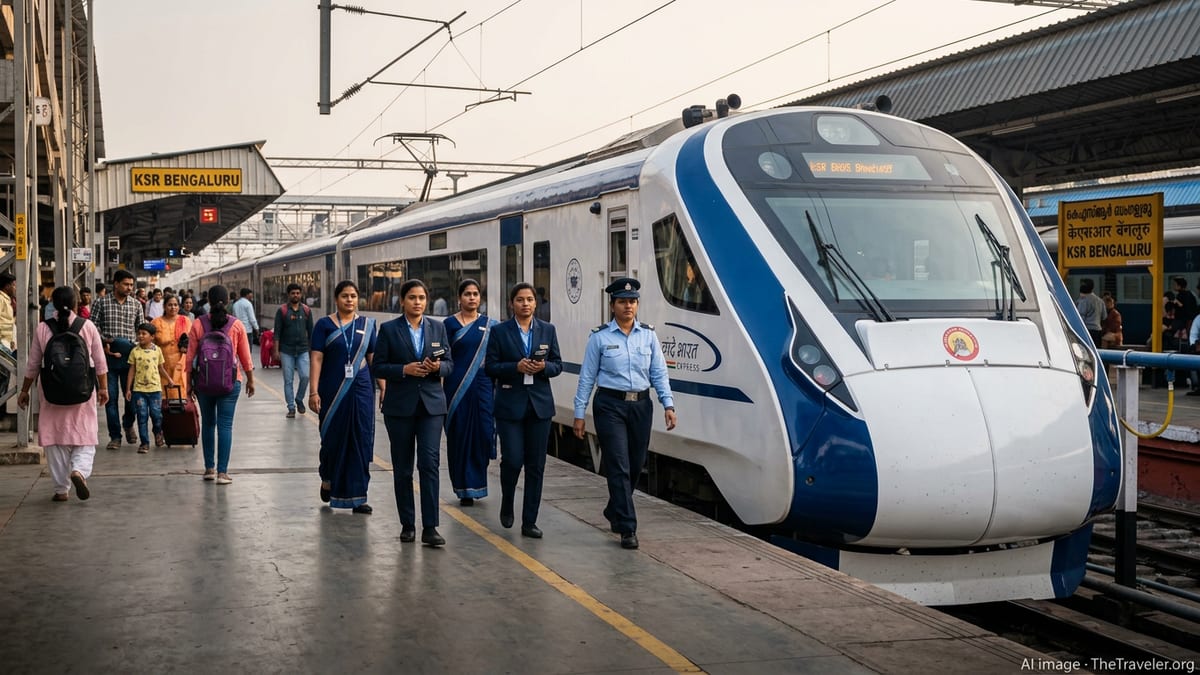
Indian Railways has marked a new chapter in its modernisation story by fielding an all-woman operating and on-board crew on the flagship Bengaluru–Mysuru Vande Bharat Express, turning a popular high-speed corridor into a powerful showcase of gender inclusion on the tracks.
A First for a Flagship Southern Corridor
The Bengaluru–Mysuru Vande Bharat Express, one of South Western Railway’s premier services, has become the latest stage for a visible push toward gender parity in India’s rail operations. On a recent commemorative run, a fully women-led team took charge of the semi high-speed service, from the locomotive cab to the aisles of its sleek, blue-and-white coaches.
The deployment builds on national momentum around women’s participation in rail operations, following headline-making all-women crews on other Vande Bharat routes, including the Chhatrapati Shivaji Maharaj Terminus to Sainagar Shirdi service, and on earlier specials celebrating International Women’s Day. By bringing the initiative to the high-density Bengaluru–Mysuru sector, railway officials sought to spotlight women’s leadership on a corridor that has come to symbolise Karnataka’s economic dynamism and modern connectivity.
Railway managers described the move as both symbolic and operationally seamless, stressing that the focus was on competence, not ceremony. The women crew members underwent the same training, route familiarisation and safety drills as their male counterparts before being rostered to the high-profile service.
Passengers boarding at Bengaluru and Mysuru were greeted by all-woman station and on-board teams, with announcements, ticket checks and hospitality services handled exclusively by women. Social media posts from the journey quickly turned the run into a talking point for both rail enthusiasts and advocates of workplace equality.
Breaking the Glass Ceiling in the Loco Cab
At the heart of the milestone was the presence of women in the driving cab of the Bengaluru–Mysuru Vande Bharat rake, long viewed as a bastion of male employment. The crew roster drew inspiration from trailblazers such as Surekha Yadav, celebrated as Asia’s first woman loco pilot and the first woman to drive a Vande Bharat Express on a different corridor, whose high-profile runs have helped normalise the idea of women at the controls of India’s fastest trains.
Senior officials within South Western Railway noted that the Bengaluru–Mysuru route, with its mix of dense commuter traffic, intercity demand and semi high-speed operations, presents a complex operating environment well suited to underscore women drivers’ technical skills. In briefings before departure, safety protocols, route gradients, signalling peculiarities and schedule adherence were reviewed with the crew, in line with the stringent procedures applied to any high-speed service.
Within the cab, the women loco pilot and assistant loco pilot managed speed profiles, regenerative braking and communication with control panels and station staff in real time. Railway officials later highlighted the run as incident-free and precisely on schedule, reinforcing their core message that gender is no barrier to handling demanding, technology-intensive operations.
The milestone is also intended to feed into recruitment drives, with officials saying that showcasing women drivers on marquee services can encourage more female candidates to consider careers in locomotive operations, signalling and technical roles that have traditionally seen limited female representation.
On-Board Experience: Service, Safety and Symbolism
Inside the Bengaluru–Mysuru Vande Bharat coaches, the all-woman crew lent the journey a distinct atmosphere without altering the service standards regulars have come to expect. From executive class to chair car, women ticket examiners, train hostesses and housekeeping staff coordinated seating, catering and cleanliness while fielding a steady stream of questions and compliments from passengers.
Families and solo women travellers in particular described a heightened sense of comfort and relatability, noting how the crew’s presence subtly changed the tone of interactions on board. For many, seeing women manage security checks, troubleshoot seat allocations and coordinate with the control office in a packed, fast-moving train helped normalise the idea of women in visible authority roles in public transport.
Railway officials pointed out that the all-woman operation did not involve any compromise on security arrangements. Railway Protection Force and state police personnel, including women constables, were deployed along the route and at key stations, mirroring arrangements for other premium services. The emphasis, they said, was on ensuring that the symbolic value of the crew did not eclipse fundamental commitments to safety and punctuality.
For tourism stakeholders, the event provided a fresh narrative hook for the Bengaluru–Mysuru corridor, already popular with business travellers, tech professionals and leisure visitors headed to Mysuru’s palaces, heritage quarters and nearby wildlife reserves. Travel industry observers said the initiative dovetails with a broader shift in how destinations market themselves to women and younger travellers looking for both convenience and inclusive experiences.
Part of a Wider Gender-Inclusion Push on the Rails
The Bengaluru–Mysuru Vande Bharat initiative forms part of a wider effort to advance gender inclusion within Indian Railways, building on earlier all-women crews on Rajya Rani Express services in Karnataka and flagship Vande Bharat runs from Mumbai. In recent years, railway zones have experimented with women-operated suburban services, women-managed stations and all-women freight operations, using prominent dates in the calendar to showcase the breadth of roles women now occupy.
Policy shifts have underpinned these visible milestones, with incremental increases in the recruitment of women into technical, operating and security cadres. Training institutes have reported a gradual uptick in female trainees across disciplines ranging from signalling and telecommunications to traction and mechanical maintenance, expanding the pipeline of women eligible for frontline operational posts on trains like the Vande Bharat.
Experts caution, however, that one-off commemorative runs, while powerful, must be accompanied by sustained institutional support if they are to translate into long-term change. They point to issues such as housing near depots, night-shift safety, childcare support and career progression pathways as critical factors in retaining women in demanding operating roles that involve irregular hours and frequent outstation duties.
Railway officials involved in the Bengaluru–Mysuru initiative say that lessons from this and other all-woman runs will be used to refine internal policies, with a view to making such rosters a routine option rather than an exception. The broader ambition, they add, is for passengers to see women at every level of train operations so frequently that it no longer draws special attention.
Significance for Karnataka’s Rail and Travel Landscape
For Karnataka, the all-woman Vande Bharat crew is being read as a reflection of the state’s aspirations to pair rapid infrastructure growth with social progress. The Bengaluru–Mysuru corridor is a critical economic spine linking the state capital’s technology and services hub with a heritage-rich city that anchors tourism, culture and education. Upgraded highways, semi high-speed rail and proposed future connectivity projects have all been pitched as part of a broader modernisation drive.
Putting women at the forefront of one of the corridor’s most visible rail services sends a signal about the kind of growth story policymakers hope to tell, one that places inclusion alongside speed and connectivity. Regional travel operators say that such milestones help burnish the image of south India’s rail network among domestic tourists and international visitors who increasingly weigh safety, comfort and social attitudes when choosing how to travel.
Rail enthusiasts and gender advocates alike say the historic run on the Bengaluru–Mysuru Vande Bharat Express will be remembered less for speeches and ceremonies, and more for the sight of women confidently handling every aspect of a complex, fast, intercity operation. As photos and passenger accounts continue to circulate, the hope is that they will inspire more women to see a future for themselves in the control cabs, platforms and operations rooms that keep India’s railways moving.
In the longer term, railway planners hint that similar all-woman deployments could be extended to other high-profile services radiating from Bengaluru and Mysuru, ensuring that the symbolic breakthrough on this corridor becomes a stepping stone toward a more balanced workforce across India’s rapidly expanding rail network.