

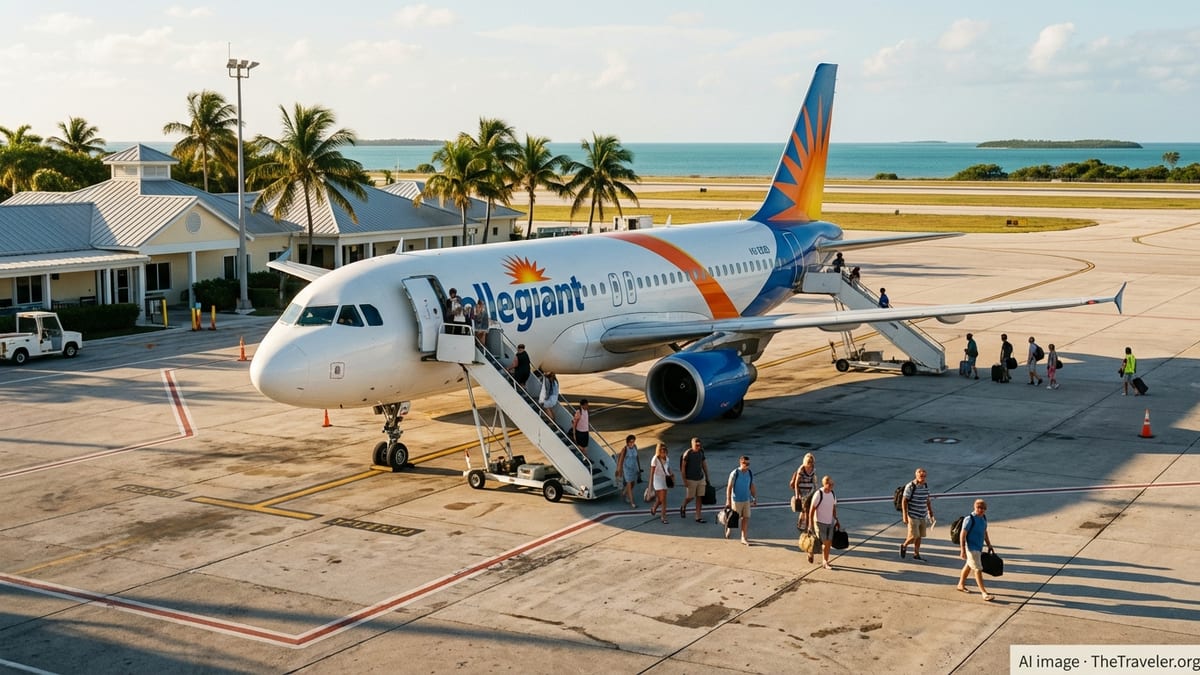
Central Ohio travelers will gain direct access to one of America’s most sought-after island getaways next year, as Allegiant Air prepares to launch new nonstop flights from Columbus’ Rickenbacker International Airport to Key West, a move expected to further boost tourism across the Florida Keys.
Twice-Weekly Service Set to Take Off in May 2026
Allegiant Air’s new Columbus to Key West route is scheduled to begin on May 21, 2026, connecting Rickenbacker International Airport with Key West International Airport on a twice-weekly basis. Flights will operate on Thursdays and Sundays, placing the leisure-focused service squarely around long weekend getaways and extended vacations.
The low-cost carrier announced the route as part of a broader expansion of 30 new nonstop services nationwide, underscoring the strength of demand for point-to-point leisure travel. Introductory one-way fares for the Columbus–Key West route were promoted from as low as 59 dollars, reflecting Allegiant’s strategy of courting price-sensitive vacationers in mid-sized markets.
The service gives Columbus-area residents their first direct scheduled link to Key West, eliminating the need for time-consuming connections through larger hubs such as Miami or Fort Lauderdale. Airport officials say the route is designed to meet pent-up demand for beach and island travel from the rapidly growing Central Ohio region.
Rickenbacker International, long known primarily as a cargo hub, has been steadily building a role as a convenient alternative for leisure passengers. The arrival of nonstop Key West service marks one of its most high-profile additions to date, further cementing Allegiant’s presence in the Columbus market.
Columbus Airport Leaders See Milestone for Leisure Travel
Leaders at the Columbus Regional Airport Authority, which oversees Rickenbacker, have framed the new service as both a vote of confidence in the region’s travel demand and a milestone in the airport’s evolution. They point to record passenger performance in 2024 and continued growth in 2025 as evidence that Central Ohio travelers are embracing nonstop, low-cost options for vacation destinations.
The authority has highlighted its long-standing partnership with Allegiant, which has operated out of Rickenbacker since 2012 and now offers a network of popular leisure routes from the airport. With up to 38 weekly flights during peak summer periods and 10 nonstop destinations already on the map, the Key West addition is viewed internally as a strategic next step in maturing Rickenbacker’s passenger portfolio.
Airport executives note that Rickenbacker’s compact terminal, easy parking and relatively short security lines contribute to its appeal for vacation travelers who prioritize convenience and value. For many Central Ohio residents, the shorter drive and simpler airport experience compared with larger hubs are seen as key selling points.
The Columbus region itself has been among the faster-growing metropolitan areas in the Midwest, with new residents and expanding corporate footprints translating into higher demand for air service. Officials believe that more nonstop options to warm-weather destinations will be essential to retaining local travelers who might otherwise begin their journeys at competing airports.
Allegiant’s Strategy: Point-to-Point Access to Sun Destinations
The Columbus–Key West route fits neatly into Allegiant’s long-standing strategy of linking smaller and mid-sized cities directly to high-demand leisure markets. Unlike network carriers that rely heavily on connecting traffic through major hubs, Allegiant has built its model around all-nonstop service tailored to vacation-focused travelers.
Industry analysts note that the carrier’s Florida portfolio has expanded steadily in recent years, with new routes added to both Gulf Coast and Atlantic Coast destinations. Key West, with its mix of tropical scenery, historic sites and cruise traffic, has emerged as one of Allegiant’s premium leisure offerings, drawing strong interest from Midwestern markets seeking island experiences without leaving the country.
By operating flights only a few days per week on certain routes, Allegiant aims to match capacity to leisure demand cycles, concentrating service around weekends and peak holiday periods. This approach allows the airline to maintain low fares while still providing what many travelers see as a substantial upgrade from driving or navigating complex connections.
The new Columbus link also extends Allegiant’s footprint in Ohio, where it already serves other cities and connects them to beach destinations. Adding direct service to Key West from Rickenbacker underscores the airline’s view that Central Ohio has reached the scale and travel appetite to support more ambitious leisure routes.
Key West and the Florida Keys Brace for Visitor Uptick
On the receiving end of the new route, tourism and hospitality stakeholders in Key West and the broader Florida Keys are anticipating a tangible bump in visitors from Central Ohio once the flights begin. The region already draws millions of travelers annually, many of whom arrive via connections through South Florida or by driving the Overseas Highway from the mainland.
Nonstop service from Columbus is expected to generate new demand among travelers who might have previously seen the Keys as too complicated or time-consuming to reach. Tourism officials say that in addition to traditional winter sunseekers, the island chain increasingly attracts spring and summer visitors interested in outdoor recreation, water sports and cultural events.
Key West International Airport has been working to manage growth from low-cost and leisure carriers while preserving the island’s small-scale feel. Airport and county authorities have undertaken terminal improvements and operational upgrades to handle rising passenger volumes, balancing convenience for visitors with the constraints of operating on a compact island.
Local businesses in Key West, from hotels and vacation rentals to restaurants, tour operators and charter boat companies, are expected to benefit from the direct pipeline to Columbus. Many hospitality operators say Midwest visitors tend to stay several nights and spend widely on experiences, contributing to a diversified tourism base beyond traditional snowbird patterns.
Easy Access to an Island Destination in High Demand
The new route effectively compresses what can be a complex journey into a single flight of a few hours, positioning the Florida Keys as a realistic long weekend option for Columbus travelers. Instead of juggling connections through multiple airports or undertaking a lengthy drive through Florida, passengers will be able to step off the plane just minutes from Old Town Key West and the island’s waterfront.
Travel advisors in the Midwest say that simplified access often reshapes how clients plan their vacations. When nonstop options become available, travelers who might have considered a more conventional beach resort in Florida or the Carolinas may instead opt for an island destination that previously felt out of reach.
The timing of the flights, straddling Thursday and Sunday, dovetails with rising demand for flexible work-and-travel arrangements, where vacationers extend long weekends or work remotely from warmer destinations. Tourism observers expect that combination of convenience and flexibility to resonate particularly strongly with younger professionals and families seeking memorable getaway experiences.
For Key West and the broader Florida Keys, those additional visitors from Central Ohio could help smooth seasonal patterns, supporting steady occupancy across more months of the year. Hotels, guesthouses and short-term rentals often look to air service developments as key signals for future demand planning and staffing decisions.
Economic Ripple Effects in Central Ohio and the Keys
Beyond the immediate convenience for passengers, the new Columbus–Key West service carries wider economic implications for both ends of the route. In Central Ohio, additional leisure air options can strengthen the region’s appeal as a place where residents have ready access to diverse vacation experiences, a factor that increasingly plays into quality-of-life considerations for employers and prospective talent.
Rickenbacker’s continued growth as a passenger gateway complements its core role as a cargo hub, supporting jobs in ground handling, customer service, airport operations and tourism marketing. As Allegiant adds more destinations, local businesses that cater to travelers, from parking operators to travel agencies, may also see incremental benefits.
In the Florida Keys, the economic impact of new air service is often felt quickly. Tourism remains a central pillar of the local economy, supporting employment in lodging, food service, attractions and marine activities. Nonstop flights from new source markets help diversify the visitor base, making the islands less vulnerable to disruptions in any single region.
Local officials in Monroe County have increasingly focused on balancing economic growth with environmental stewardship, recognizing that the natural marine environment is the foundation of the area’s appeal. Additional air service typically prompts renewed discussions about visitor management, infrastructure needs and conservation priorities, especially in sensitive coastal communities.
Travelers Weigh New Nonstop Against Competing Options
For Central Ohio residents considering a trip to the Florida Keys, the arrival of Allegiant’s nonstop service introduces a new set of choices. Some travelers may continue to favor larger airports and legacy carriers, particularly if they are seeking loyalty benefits, business-class cabins or daily frequency.
However, for leisure passengers primarily focused on price and simplicity, a nonstop from Rickenbacker may prove especially appealing. The airport’s smaller footprint can translate into shorter walking distances, easier parking and reduced congestion, which are often cited as deciding factors for families traveling with children or groups coordinating trips.
As with many low-cost carriers, Allegiant’s base fares are typically supplemented by optional fees for services such as seat selection and checked baggage. Travel planners say it will be important for prospective passengers to factor those extras into their total trip cost when comparing the nonstop option to connecting itineraries on other airlines.
Still, the prospect of stepping directly from Central Ohio into the streets of Key West without a plane change is expected to carry significant weight. For many travelers, especially those with limited vacation time, the hours saved in transit can be as valuable as any onboard amenity.
Signals of Continued Growth in Sun-Seeking Demand
The Columbus–Key West launch is part of a broader pattern of airlines tailoring schedules to persistent demand for warm-weather escapes, even as domestic travel patterns evolve. Industry observers note that while business travel has been slower to return to pre-pandemic norms in some markets, leisure demand for coastal and island destinations has remained robust.
Carriers like Allegiant, with flexible fleets and a focus on point-to-point leisure flying, have been particularly active in responding to these shifts. By testing new markets with limited weekly service and adjusting capacity as demand dictates, they can move quickly to capture emerging travel trends.
For both the Florida Keys and Central Ohio, the new connection may mark just one step in a longer trajectory of increasing ties between inland metropolitan regions and coastal getaways. If the route performs strongly, it could encourage additional seasonal or year-round services, further integrating the two destinations in the minds of travelers.
As airlines finalize schedules for 2026, industry watchers will be looking closely at how new routes like Columbus to Key West perform, seeing them as barometers for the endurance of Americans’ appetite for quick, sun-filled escapes to distinctive island locales.