

More news on this day
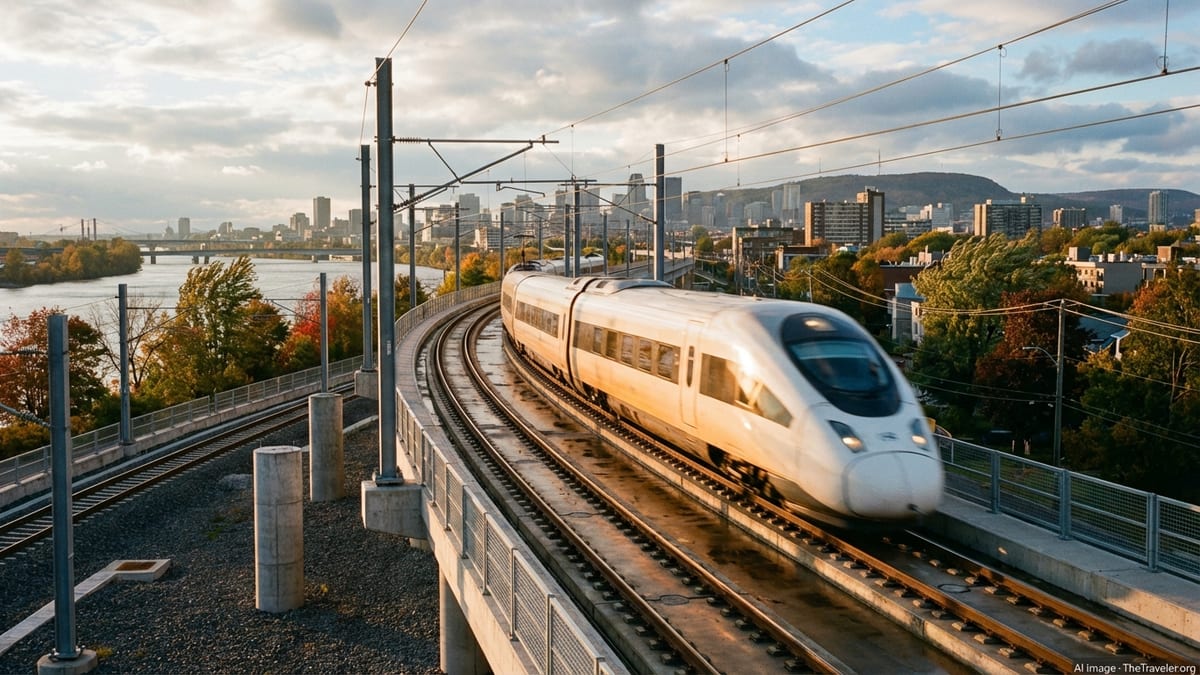
Canada’s long-discussed dream of true high-speed rail is finally taking shape with Alto, a planned 300 km/h line linking Québec City and Toronto that could redefine how travelers move across Central Canada.
From Vision to Viable Project
For decades, high-speed rail in Canada lived mostly in political speeches and feasibility studies. That changed on February 19, 2025, when Prime Minister Justin Trudeau formally unveiled Alto, a fully electric high-speed rail corridor between Québec City and Toronto. The announcement confirmed that the government’s earlier "high-frequency rail" concept would instead become a true high-speed system, designed for top speeds of 300 km/h on dedicated passenger tracks.
Stretching roughly 1,000 kilometers, the Alto corridor is planned to run from Toronto through Peterborough, Ottawa, Montreal, Laval and Trois-Rivières before reaching Québec City. Officials say the line will cut Toronto–Montreal journey times to just over three hours and offer sub-two-hour trips on other key segments such as Ottawa–Montreal and Montreal–Québec City. The network would be Canada’s first genuine high-speed rail line, bringing the country closer to the standards long familiar to travelers in Europe and parts of Asia.
The federal government has created a dedicated Crown corporation to oversee the project and signed a development agreement with the Cadence consortium, a private-sector partnership including global rail and infrastructure players. The design phase is budgeted at 3.9 billion Canadian dollars and is expected to last four to five years, with construction tentatively targeted to begin around 2029 or 2030. If timelines hold, the first Alto trains could be carrying passengers in the mid-to-late 2030s.
While costs are still preliminary, federal estimates suggest an overall price tag between 80 and 120 billion dollars. That scale places Alto among the largest infrastructure efforts in modern Canadian history, and it sets the stage for years of intense scrutiny over spending, benefits and long-term ridership.
What Alto Means for Travelers
For travelers in the busy Québec–Windsor corridor, Alto promises to disrupt deeply ingrained habits of flying or driving between major cities. Early projections suggest travel times of about three hours between Toronto and Montreal, just over two hours for Toronto–Ottawa, and around an hour and a half between Montreal and Québec City. Those schedules compare favorably not only with current passenger rail journeys, which can take roughly twice as long, but also with the door-to-door time of flying once airport transfers and security are factored in.
The key difference for passengers would be a shift toward city-center to city-center travel, with trains departing from and arriving into central stations in each metropolitan area. For tourists, that could make weekend getaways between Ontario and Québec considerably easier, encouraging more spontaneous trips to festivals, historic districts and cultural attractions. For business travelers, the combination of onboard connectivity, reduced check-in times and reliable schedules could make high-speed rail more appealing than short-haul flights.
Alto is also being pitched as a more predictable and comfortable option for winter travel. With much of the route designed to be grade-separated and electrified, the system is intended to be less vulnerable to the snowstorms, freezing rain and highway closures that frequently complicate travel in Central Canada. Modern high-speed trains operating in comparable climates abroad have demonstrated robust performance in winter conditions, and designers say Alto’s rolling stock and infrastructure will be engineered with Canadian winters in mind.
For regional travelers, new high-speed stations in Peterborough, Laval and Trois-Rivières could open up fresh tourism flows and commuting patterns. While initial timetables are still years away from being finalized, officials say a mix of express and stopping services is likely, balancing fast intercity trips with more frequent trains serving intermediate stops.
Inside the Alto Route and Service Plan
The planned Alto corridor traces a broad arc across southern Ontario and Québec, knitting together some of the country’s most populous regions. From a new or upgraded hub in downtown Toronto, trains would head northeast to Peterborough, then continue toward Ottawa, before crossing into Quebec and turning southwest toward Montreal and Laval, and finally following the St. Lawrence River corridor to Trois-Rivières and Québec City.
Travel-time modeling published to date envisions Alto trains averaging close to 200 km/h over the full distance, including stops. Between Toronto and Montreal, the route via Ottawa is estimated at roughly 610 kilometers, with schedules targeting just over three hours for trains that stop at Ottawa and intermediate stations. On shorter city pairs, projected times are even more competitive: under an hour between Ottawa and Montreal, and about 50 minutes between Montreal and Trois-Rivières.
Alto is being developed as an electrified, fully grade-separated system. That means trains will run on their own tracks, without sharing with freight traffic, and road crossings will be replaced with bridges or tunnels. Planners say this separation is essential to achieve both the high speeds and improved on-time performance promised by the project. It should also allow for more frequent service, as passenger trains will no longer be slowed by freight movements or congested legacy infrastructure.
Officials stress that key elements of the route, station design and service plan remain open to refinement during the multi-year design phase. Noise mitigation, land acquisition, alignment through sensitive areas and connections to local transit networks are all being studied. The Crown corporation overseeing Alto has indicated that the final route choices will seek a balance between engineering efficiency, community impacts and the goal of maximizing ridership.
Economic Stakes and Regional Development
Federal projections suggest that building Alto could support tens of thousands of jobs over roughly a decade, from construction and engineering to specialized manufacturing and project management. The government has also pointed to longer-term economic gains, estimating tens of billions of dollars in productivity and regional development benefits over several decades as travel times shrink and connectivity improves.
Economists say much of that value would stem from what high-speed rail tends to do best: pairing large cities more tightly together and pulling smaller communities into their orbit. For Ottawa, Montreal and Toronto, closer travel times could deepen business ties, make cross-border collaboration easier with the northeastern United States, and help attract global talent looking for efficient, low-carbon mobility.
Intermediate cities expect to see their own dividends. Peterborough, Laval and Trois-Rivières, for example, could become more attractive bases for commuters priced out of big-city housing markets but still needing fast access to downtown offices and universities. Local tourism boards are already watching Alto’s progress closely, seeing an opportunity to position their communities as weekend destinations for urban residents seeking historic sites, riverfront walks and regional cuisine.
Critics caution, however, that such benefits are not automatic. The scale of Alto’s investment means every dollar spent will be closely evaluated against competing priorities such as healthcare, housing and climate adaptation. Urban planners also warn that high-speed rail can fuel speculation around station sites if not accompanied by robust land-use planning, affordable housing policies and coordinated transit investments.
Climate Goals and the Shift from Air and Road
Alto is being sold not just as a transportation upgrade, but as a climate policy tool. The corridor between Québec City and Toronto is currently dominated by short-haul flights and long highway drives, both of which are major sources of greenhouse-gas emissions. By offering high-speed trips on electric trains powered by a largely decarbonized grid, the project aims to shift a significant portion of travel away from planes and private vehicles.
Analyses prepared for the federal government highlight that high-speed electric trains can reduce per-passenger emissions dramatically compared with jet aircraft on distances of 400 to 800 kilometers. Officials are setting expectations that Alto must generate a meaningful modal shift to rail on those city pairs, particularly on heavily traveled links like Toronto–Ottawa and Montreal–Québec City.
There are also local environmental considerations. A grade-separated, electrified corridor could reduce noise and air pollution in some areas currently served by diesel-powered trains. At the same time, new infrastructure will cut across farmland, wetlands and communities, raising concerns about habitat fragmentation, construction emissions and long-term land-use impacts. These issues are expected to feature prominently in the project’s environmental assessments and route optimization work.
How strongly Alto supports Canada’s broader emissions-reduction goals will depend on the details of pricing and service frequency. If fares are set high to maximize private returns, environmental groups warn that many travelers could continue driving or flying. If the federal government prioritizes lower fares and high frequencies to maximize ridership, Alto could become a central pillar of a lower-carbon national transport strategy.
Public–Private Partnership Under the Microscope
The Alto project is being pursued through a public–private partnership model that assigns major responsibilities to the Cadence consortium, including co-designing, financing, operating and maintaining the system. Supporters say this approach brings international expertise in high-speed rail, transfers some delivery risk away from taxpayers and can encourage innovation in design and operations.
Opponents argue that large rail projects structured as public–private partnerships often face challenges, including complex contracts, opaque decision-making and pressure to prioritize shareholder returns. In Canada, the debate has been sharpened by the project’s projected cost, which independent analysts say appears high compared with similar high-speed lines in Europe and Asia once adjusted for purchasing power and local conditions.
Advocacy groups for public rail point to the risk that fare levels will be set to ensure profitability rather than maximize public benefit. They warn that without strong safeguards, governments could end up subsidizing private operators through availability payments, while travelers face higher ticket prices than they would under a fully public model. The federal government maintains that its agreements will require specific outcomes, such as strong ridership growth, accessibility and reliable on-time performance.
The success of Alto’s partnership model will likely hinge on contract transparency, regulatory oversight and the ability of the Crown corporation to enforce performance standards over several decades. Travelers, meanwhile, will ultimately judge the system by more immediate metrics: how much tickets cost, how often trains run and whether they arrive when promised.
Community Voices and Early Consultations
As the design phase accelerates, community engagement has become a focal point. In early 2026, Alto began a first round of public consultations in Ontario and Québec, inviting residents, businesses and local governments to weigh in on everything from station locations to noise mitigation and environmental concerns. Organizers describe these sessions as foundational, informing choices on route alignment and helping identify sensitive areas that require special treatment.
For many communities, the arrival of high-speed rail is both exciting and unsettling. Local leaders in cities slated to receive stations are advocating for integrated transit hubs, pedestrian-friendly access and development that benefits existing residents rather than pushing them out. In rural areas and smaller towns near the proposed corridor, landowners are raising questions about property impacts, expropriation rules and the long-term footprint of the line across agricultural land.
Travelers, too, are making their expectations known. Frequent riders of current intercity trains are calling for seamless connections to local transit, transparent pricing and amenities such as reliable Wi-Fi and accessible boarding. Tourism operators want schedules that support weekend trips and late-evening returns, while business groups emphasize the need for early-morning arrivals that line up with workdays in Toronto, Ottawa and Montreal.
Project officials say feedback from these consultations will be folded into successive design stages, with further rounds of engagement planned as alignments are refined and environmental studies advance. For many observers, the authenticity and responsiveness of this process will be a key test of whether Alto can truly claim to be a project built with, rather than merely imposed upon, the communities it will serve.
What Comes Next for Canada’s High-Speed Future
In the near term, Alto’s progress will be measured less in track laid than in technical studies completed and agreements signed. Over the next four to five years, engineers and planners will work to narrow route options, finalize station sites, assess environmental impacts and prepare detailed designs. Regulatory approvals and land acquisition efforts will likely spark further political and legal debates, particularly in areas where residents oppose the chosen alignment.
For travelers, the practical implication is that Canada’s high-speed rail era remains several election cycles away. Even under optimistic scenarios, initial Alto services are not expected to launch until the mid-2030s, with full build-out stretching potentially into the early 2040s. That long horizon means today’s decisions on design, governance and public engagement will shape not only the first generation of Alto passengers, but also how future extensions and complementary rail projects unfold.
Still, the very fact that Canada has moved beyond studies to a funded design phase for a high-speed network marks a major shift. If Alto succeeds, it could serve as a template for further electrified corridors, from potential extensions toward Windsor in the southwest to new links with Western Canada. If it stumbles, proponents fear it could chill enthusiasm for large-scale rail investment for years to come.
As consultations continue and design teams get to work, the Alto project is emerging as a litmus test for Canada’s infrastructure ambitions. For the millions who move each year between Québec City, Montreal, Ottawa and Toronto, its outcome will help determine whether the future of travel looks more like a crowded highway and a delayed flight, or a quiet, high-speed train gliding between city centers at 300 km/h.