

More news on this day
The United States is doubling down on Miami’s role as a global aviation gateway, with American Airlines committing roughly $1.1 billion to a transformative expansion of Concourse D at Miami International Airport, a project that will overhaul the busy D60 gate complex and solidify the carrier’s largest Latin America hub through 2030.
Major Terminal Overhaul Anchors Miami’s Hub Strategy
American Airlines and Miami-Dade County officials this week unveiled plans for a comprehensive rebuild and expansion of the Concourse D D60 area, one of the most congested parts of Miami International Airport. The project, budgeted at about $1.1 billion and slated to break ground in 2027, will replace the current ground-level regional jet operation with a modern three-level concourse tailored to larger aircraft and heavier passenger volumes.
Today’s D60 setup funnels travelers for 17 outdoor, tarmac-level positions through a single shared boarding door and cramped holding space, often resulting in crowding, weather exposure and operational bottlenecks. Under the new design, those 17 positions will be converted to 17 full contact gates, each with its own dedicated boarding area and jet bridge. The shift aligns Miami with other major US hubs that have moved away from outdoor boarding in favor of more efficient, weather-protected facilities.
Airport and airline executives are framing the expansion as a cornerstone of a broader, approximately $9 billion modernization program at Miami International. That airport-wide effort includes new concourses, upgraded baggage systems and extensive refurbishments across existing terminals, all intended to keep pace with rising demand for both domestic and international travel through South Florida.
Construction on the Concourse D extension is expected to continue through 2030, with work carefully phased to keep American’s hub operation running throughout. Officials say the long timeline reflects both the scale of the project and the challenge of building in one of the airport’s most intensely used zones.
More Capacity, Smoother Connections for Travelers
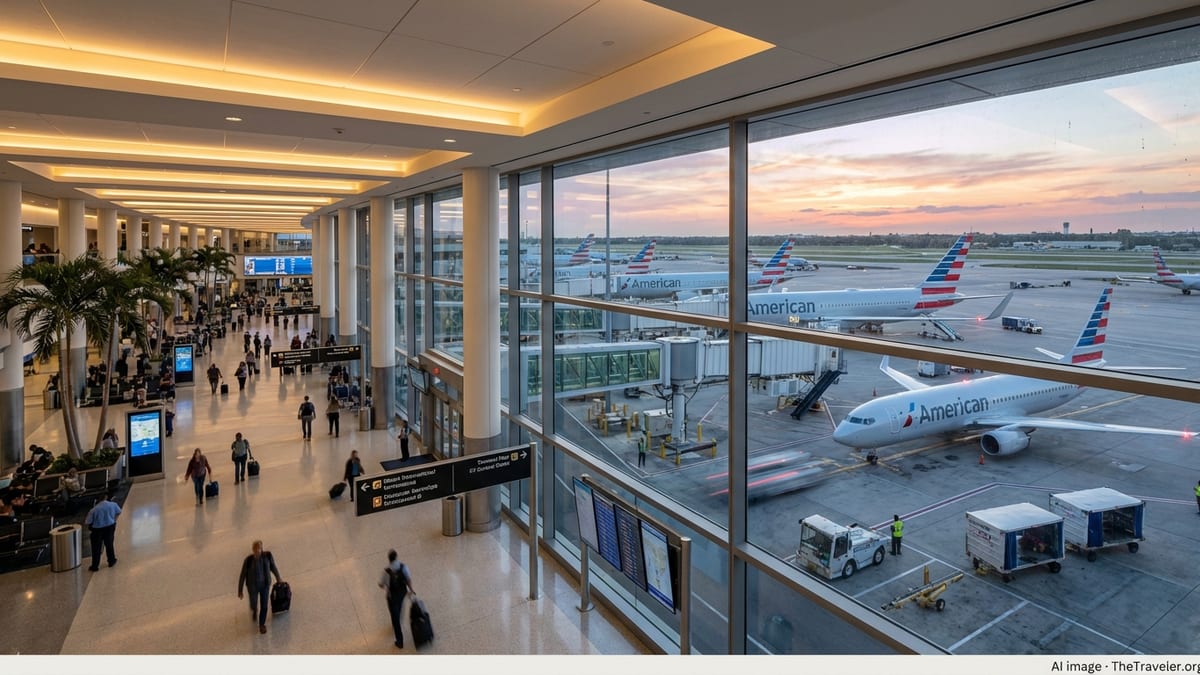
For passengers, the most visible change will be the move from outdoor ramp boarding to enclosed, climate-controlled gate areas with direct jet bridge access. Each of the 17 new gates is being designed to handle larger regional jets and mainline narrowbody aircraft, giving American more flexibility to upgauge capacity on high-demand routes without having to reconfigure its Miami operation around a constrained regional pier.
The new concourse will tie directly into Miami International’s international arrivals infrastructure. Plans call for future-capable access from the third level of the extension straight into the federal customs and border inspection hall on Concourse D, a feature intended to shorten walking distances and streamline the arrival process for inbound international travelers connecting through American’s hub.
Terminal renderings show a brighter, more open environment than the current D60 area, with high ceilings, natural light, indoor palm trees and expanded retail and dining options. Officials say roughly 30,000 square feet will be dedicated to new concessions and a similar amount set aside for premium lounge and passenger amenity space, part of American’s broader push to enhance the ground experience for both leisure and business travelers in Miami.
Behind the scenes, a new baggage handling system will be integrated into the concourse expansion, aimed at improving connection times and reliability for checked bags on tight itineraries. Combined with ongoing investments in self-service technology, biometrics and touchless identity programs, the project is expected to support more consistent performance during peak bank departures that define Miami’s role as a connecting hub.
Miami’s Role as Leading US Gateway to Latin America
American’s investment underscores Miami’s status as the airline’s premier gateway to Latin America and the Caribbean, and one of the most strategically important hubs in its global network. The carrier already operates roughly 400 departures a day from Miami, accounting for more than 60 percent of the airport’s passenger traffic and offering nonstop service to more than 150 destinations across over 40 countries.
In recent seasons, American has used Miami as a launchpad for both regional and long-haul growth, adding routes to European destinations such as Milan while deepening its reach in the Caribbean and key markets in Central and South America. The D60 rebuild is designed to support that dual mission, allowing regional feed from across Florida and the southeastern United States to connect more seamlessly onto long-haul flights.
Local officials describe the concourse expansion as a critical tool for keeping Miami competitive against other fast-growing US hubs courting international traffic. With rival airports investing heavily in new terminals and upgraded premium facilities, American’s Miami project is intended to ensure that the passenger experience, gate capacity and operational resilience at Concourse D match the scale of the hub’s ambitions.
The project also aligns with a wave of major airport infrastructure spending across the United States, as older terminals built for smaller aircraft and lower passenger volumes are reimagined for a new era of global connectivity. In this context, Miami’s bet on Concourse D is as much about future-proofing the hub as it is about relieving today’s pain points at D60.
Economic Lift for Miami-Dade and South Florida
Beyond aviation strategy, the Concourse D expansion is expected to deliver substantial economic benefits to Miami-Dade County and the wider South Florida region. American is already the county’s largest for-profit employer, supporting tens of thousands of jobs directly and indirectly through its operations, suppliers and tourism-driven economic activity.
County leaders say the $1.1 billion project will generate thousands of construction and engineering jobs over its multiyear timeline, alongside permanent positions linked to expanded concession, lounge and customer service footprints. The investment dovetails with Miami’s broader efforts to attract global businesses and major events by highlighting the region’s air connectivity and modern infrastructure.
American has also been working with local educational institutions, including aviation technical colleges and university aviation programs, to build a pipeline of skilled workers who can staff an expanded hub operation. The concourse project is seen as a long-term signal to students and workers that Miami will remain a cornerstone of the airline’s network for decades to come.
For the tourism sector, which relies heavily on reliable and frequent air service, the expansion is being welcomed as a vote of confidence in Miami’s enduring appeal. Hoteliers, cruise operators and meeting planners have long counted on Miami International as a gateway for both leisure and convention travel, and a more efficient Concourse D is expected to help support continued growth in visitor numbers.
Balancing Ambition With a Long Construction Timeline
Even as officials tout the benefits of the Concourse D expansion, they acknowledge that the long construction window through 2030 presents risks and challenges. Miami International is already undergoing a sweeping modernization, and adding a large, complex concourse build in a live operating environment will require meticulous planning to avoid significant disruption to day-to-day flights.
Airport planners are preparing phased work packages designed to keep as many existing gates operational as possible while sections of D60 are closed and rebuilt. Passengers can expect periodic changes to gate assignments, walking routes and amenity locations as construction proceeds, a familiar pattern at major US airports undergoing large-scale terminal upgrades.
Cost pressures are another consideration. With the bulk of funding raised through airport bonds that are repaid via airline fees and charges, any significant inflation in labor or materials could add to the project’s financial complexity. For American and Miami-Dade, the calculus is that the long-term gains in capacity, reliability and revenue potential will outweigh the near-term strains of building such a facility.
Nonetheless, the scale and timing of the expansion highlight the degree of confidence that both the airline and local officials have in Miami’s future as a global hub. By committing roughly $1.1 billion to a single concourse complex, American is sending a clear signal that its Miami operation is central to its long-term growth plans in the United States and beyond.