

More news on this day
U.S. aviation authorities and American Airlines have launched investigations after bullet holes were discovered on a Boeing 737 MAX 8 that landed in Miami following a flight from Medellín, Colombia, raising fresh concerns about airport perimeter security and aircraft safety on popular Latin America routes.
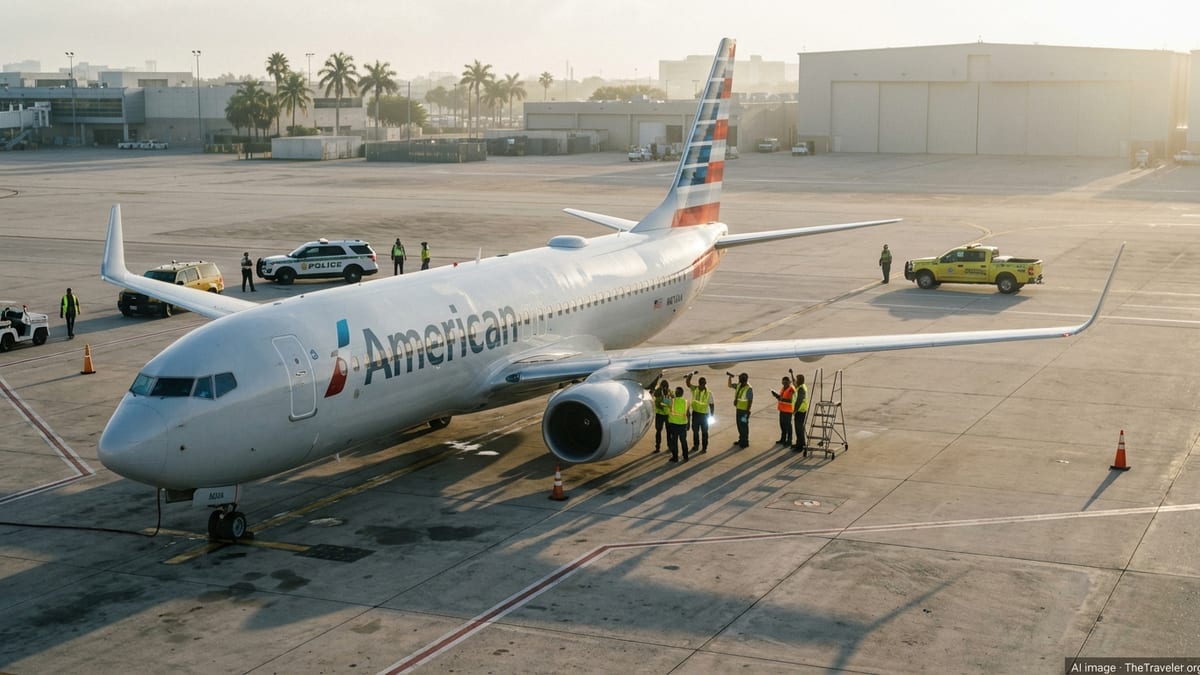
Damage Discovered After Safe Landing in Miami
American Airlines confirmed that one of its Boeing 737 MAX 8 aircraft was removed from service at Miami International Airport after maintenance crews found what appeared to be bullet impacts on part of the right wing assembly. The discovery was made during a routine post flight walk around inspection on February 23, 2026, after the jet completed Flight AA924 from Medellín’s José María Córdova International Airport.
The aircraft, reported by aviation tracking outlets to be registered N342SX, had flown from Miami to Medellín as Flight AA923 on February 22 before operating the return leg the following morning. According to flight data, the aircraft cruised normally at high altitude over the Caribbean and landed safely in Miami with no declared emergency or inflight irregularities reported by the crew.
It was only after passengers had disembarked and the aircraft was being prepared for its next assignment that technicians noticed multiple puncture marks on the right aileron, a key control surface used to manage roll and lateral stability. The pattern and nature of the damage led personnel to suspect projectile impacts consistent with small arms fire.
No injuries were reported among passengers or crew, and the discovery came after the aircraft was already parked at the gate. The finding nevertheless triggered both a technical assessment of the jet and a security review focused on where and when the shots may have been fired.
Investigators Probe Where Gunfire Occurred
Initial attention has centered on whether the damage occurred while the aircraft was on the ground in Colombia, during low altitude phases of flight, or after arrival in Miami. Analysts note that aileron surfaces are located on the trailing edge of the wing, an area that would typically be exposed to possible stray fire when an aircraft is taxiing, taking off or landing, rather than at cruise altitude.
Authorities in both countries are examining surveillance coverage, airport perimeter security and possible reports of gunfire near Medellín’s airport around the time the aircraft was on the ground. Miami International Airport security teams are also reviewing ramp and perimeter footage, though early indications from the flight’s uneventful arrival make ground fire in Florida appear less likely.
Investigators will assess the trajectory, caliber and depth of the punctures, along with any metallic residues recovered from the wing structure, to reconstruct the likely origin of the projectiles. The Federal Aviation Administration and relevant Colombian aviation and security authorities are expected to coordinate, given that any intentional discharge of a firearm at an aircraft would constitute a serious criminal and security offense.
American Airlines has said it is cooperating fully with investigators. While officials have not publicly speculated on motive, aviation security experts point out that stray celebratory gunfire or criminal activity near airport boundaries has historically posed intermittent risks for aircraft operating at some Latin American fields.
Aircraft Ferried to Maintenance Hub and Grounded
Following the discovery of the bullet holes, American Airlines maintenance teams in Miami carried out temporary structural work to stabilize the damaged area and ensure the aircraft could be moved without further stress to the wing. The 737 MAX 8 was then ferried overnight, without passengers, to the carrier’s primary maintenance base at Dallas Fort Worth for a full engineering inspection.
At the facility, structural specialists are assessing the extent of internal damage beyond the visible punctures on the aileron skin. Engineers are examining whether any critical components such as control linkages, wiring bundles or hydraulic elements were struck, and are using non destructive testing methods to check for hidden cracking or deformation.
Any repairs will be carried out under strict manufacturer and regulatory guidelines. Depending on findings, the work could range from local panel replacement to more extensive structural restoration, followed by test flights before the aircraft is cleared to return to commercial service.
The incident has not led to the grounding of other American Airlines 737 MAX 8 aircraft, which continue to operate normally on U.S. domestic and international routes. The airline has stated that safety remains its top priority and that it has robust procedures in place to identify and address damage to its fleet.
Security Questions for Medellín and a Busy U.S.–Latin America Corridor
The discovery of bullet damage on an airliner serving a major Colombia United States route is intensifying scrutiny of ground security and airspace protection at airports across the region. Medellín’s José María Córdova International Airport is a key gateway for business and leisure travelers, including large numbers of U.S. passengers connecting through Miami to the wider American Airlines network.
Security specialists note that while Medellín has significantly improved its safety profile in recent decades, challenges remain in areas surrounding some Colombian transport hubs. A confirmed case of gunfire striking a parked or taxiing jet would likely prompt a review of patrol patterns, fencing integrity, lighting and coordination with local law enforcement near the airfield perimeter.
For Miami, one of the busiest international gateways in the United States and a central hub for flights to Latin America, the incident underscores how reliant carriers are on robust security standards at foreign airports. U.S. authorities regularly audit overseas facilities that host flights to American soil, and an event involving suspected ballistic damage could trigger additional reviews and recommendations.
Passengers may not see immediate visible changes, but behind the scenes, airlines and regulators are expected to revisit risk assessments for routes where airport surroundings expose aircraft to small arms threats during departure and arrival.
MAX 8 Under Spotlight Amid Broader Safety Concerns
Although the bullet hole incident appears unrelated to any design aspect of the Boeing 737 MAX 8, it adds to a string of high profile events involving the model that have kept it under close public and regulatory scrutiny. In recent years, various airlines have reported technical and operational issues on MAX family aircraft, ranging from tire failures on landing to bird strikes and, in separate models, structural problems.
In this case, aviation experts emphasize that the 737 MAX 8 performed as intended, completing its flight safely despite sustaining exterior damage that went undetected until after arrival. Even so, investigators will examine whether the crew had any subtle indications of an abnormality during departure from Medellín, such as unusual sounds or control feel, that might correlate with a projectile impact at low altitude.
For travelers, the incident serves as a reminder of the multiple layers of safety that protect modern commercial aviation. Structural redundancy, rigorous inspections and conservative maintenance standards are designed to catch and correct damage, whether caused by wear and tear, foreign object strikes or, in rare cases, suspected gunfire.
As inquiries progress on both sides of the Caribbean, American Airlines and regulators are expected to release further details on the origin of the shots and any additional security measures to be implemented for flights linking Miami and Colombian cities.