

More news on this day
American Airlines and Google are advancing a data-driven approach to cleaner skies, using artificial intelligence to forecast and avoid the most climate-warming aircraft contrails in a series of trials that industry observers say could reshape how flights are planned worldwide.
Get the latest news straight to your inbox!
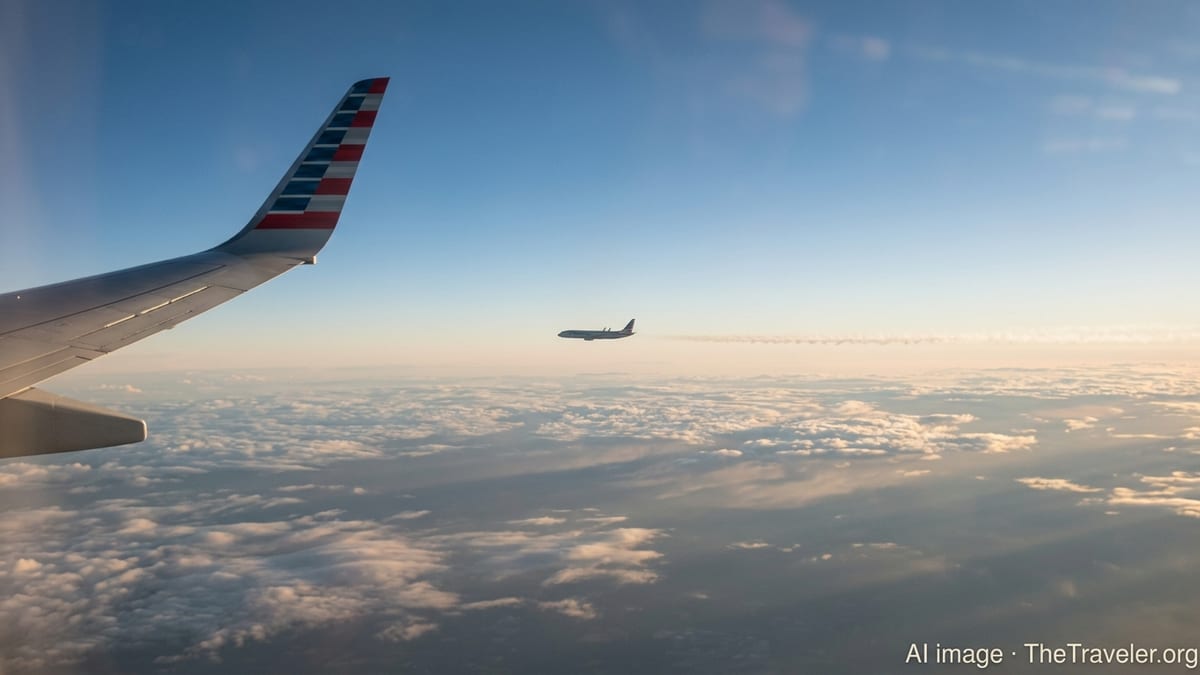
AI Targets One of Aviation’s Hidden Climate Culprits
Contrails, the thin white streaks that often trail high-flying jets, have long been viewed as little more than a visual byproduct of air travel. Scientific research, however, has increasingly linked persistent contrails to a significant share of aviation’s overall warming impact, particularly when they spread into high, thin cirrus clouds that trap heat in the atmosphere.
Publicly available analyses from climate and aviation researchers indicate that these man-made clouds can contribute a climate effect comparable to, or greater than, the carbon dioxide emitted by aircraft engines over the short term. Because contrails form only in specific, humid layers of the upper atmosphere, even small changes in altitude or routing can determine whether a flight leaves a long-lasting trail or nearly invisible exhaust.
That sensitivity has turned contrails into a promising target for artificial intelligence. By learning to identify where and when contrails are most likely to form, AI systems can help pilots and dispatchers adjust flight paths to avoid the most climate-intensive portions of the sky, potentially yielding large warming reductions with relatively small operational changes.
Google’s climate-focused research teams have been developing these tools by combining satellite imagery, weather models and detailed flight data to understand how contrails form and persist. The resulting AI models generate contrail risk maps that can be incorporated into airline decision-making before and during a flight.
American Airlines Trials Show 54 Percent Drop in Contrails
According to information released through American Airlines’ newsroom and Google’s research updates, the two companies, working alongside climate-focused investor Breakthrough Energy, ran a first-of-its-kind operational trial in 2023. Over six months, a group of American pilots flew 70 test flights using AI-generated contrail forecasts to make modest adjustments in cruising altitude and routing.
After the trial, Google’s teams analyzed satellite images to determine how often the test flights produced visible, persistent contrails compared with similar flights that did not use the forecasts. The results, presented in American’s sustainability reporting and Google’s technical publications, indicate a 54 percent reduction in contrail formation by distance on the AI-guided flights.
The outcome is being described in public coverage as an early but important proof point: commercial airliners, operating within normal safety and air traffic constraints, can verifiably cut contrail formation using AI-based guidance. While the trial covered a relatively small number of flights, it offers a concrete data set for regulators, airlines and researchers evaluating whether contrail avoidance can scale.
Separate summaries of the work indicate that the adjustments needed to avoid the highest-risk regions of the atmosphere may involve a modest fuel penalty, estimated in some analyses at a fraction of a percent across an airline’s schedule. Industry observers note that this trade-off could still be attractive from a climate perspective, given the outsized warming potential of persistent contrails.
From Experimental Maps to Everyday Flight Planning
The initial American Airlines–Google trials were largely manual, relying on selected crews, bespoke forecasts and close post-flight analysis. The companies are now looking toward integrating contrail-aware routing into the everyday tools that pilots, dispatchers and operations centers use to plan flights.
American’s most recent environmental communications describe a broader partnership that now includes flight-planning software provider Flightkeys, with further research activities planned to explore how contrail avoidance could be embedded directly into dispatch systems. The goal is for contrail forecasts to appear alongside traditional considerations such as predicted turbulence, wind patterns and airspace restrictions.
Google’s publicly shared project materials outline a growing ecosystem of technical enablers, including vast contrail detection datasets built from geostationary satellite imagery and algorithms capable of attributing individual contrails to specific flights. These datasets are being used to refine machine learning models that can better predict where persistent contrails will likely form hours in advance.
For airlines, the operational challenge lies in turning this information into practical guidance that can be followed consistently across complex global networks. Analysts following the project suggest that automated tools will be essential, allowing dispatchers to weigh the climate benefits of contrail avoidance against fuel use, schedule commitments and the requirements of air traffic control.
Industry Momentum Toward Climate-Smart Skies
The American Airlines–Google collaboration is emerging as part of a broader push within aviation to address non-CO₂ climate impacts. International bodies and research institutions have increasingly highlighted contrails as a near-term lever for reducing aviation’s warming effect while longer-term measures such as sustainable aviation fuels and new aircraft technologies continue to scale.
Reports from industry conferences and academic publications point to growing interest from carriers, technology firms and navigation service providers in standardized contrail forecasting and avoidance methods. The data and algorithms developed in cooperation with American are already being referenced in wider scientific and policy discussions on how contrails should be monitored and managed.
At the same time, experts caution that contrail avoidance is not a replacement for cutting carbon dioxide, but rather a complementary strategy. Because the warming effect of contrails is strongest at night and in certain atmospheric conditions, the most effective programs are expected to target a relatively small subset of flights that produce a large share of contrail-related warming.
According to aviation sustainability briefings, that targeted approach could limit operational costs while still delivering substantial climate benefits. If contrail-aware planning becomes routine, observers argue, it may soon be possible for passengers to board flights that have been optimized not only for time and fuel, but also for their impact on the planet’s heat balance.
Next Steps for AI-Driven Climate Innovation in Aviation
As of early 2026, American Airlines continues to frame contrail avoidance as an integral part of its broader net-zero strategy, which also includes investments in more efficient aircraft, low-carbon fuels and carbon removal projects. The airline’s partnership with Google is frequently cited in public sustainability materials as an example of how digital tools can unlock new climate solutions.
For Google, the project is one of several high-profile efforts to apply artificial intelligence to real-world environmental challenges. Company research pages describe contrail forecasting as a test bed for combining advanced machine learning with large-scale observational data to drive measurable climate outcomes, rather than incremental efficiency gains alone.
Further development is expected to focus on scaling trials beyond selected routes, validating performance under a wider range of weather patterns and integrating contrail avoidance into the regulatory and operational frameworks that govern commercial aviation. Industry analysts anticipate continued collaboration with policymakers, air navigation providers and other airlines as the technology matures.
While many questions remain about how quickly contrail-aware AI can be deployed across global fleets, the American Airlines and Google initiative is being watched closely by carriers and climate advocates alike. The early results suggest that a relatively small shift in how pilots and planners think about the upper atmosphere could yield disproportionately large benefits for the climate, hinting at a future where smarter skies are as important as cleaner engines.