

More news on this day
American Airlines has unveiled a more than $1 billion plan to expand and modernize Concourse D at Miami International Airport starting in 2027, converting the aging Gate D60 area into a three-level complex with 17 new gates designed to handle larger aircraft and significantly enhance international passenger flows.
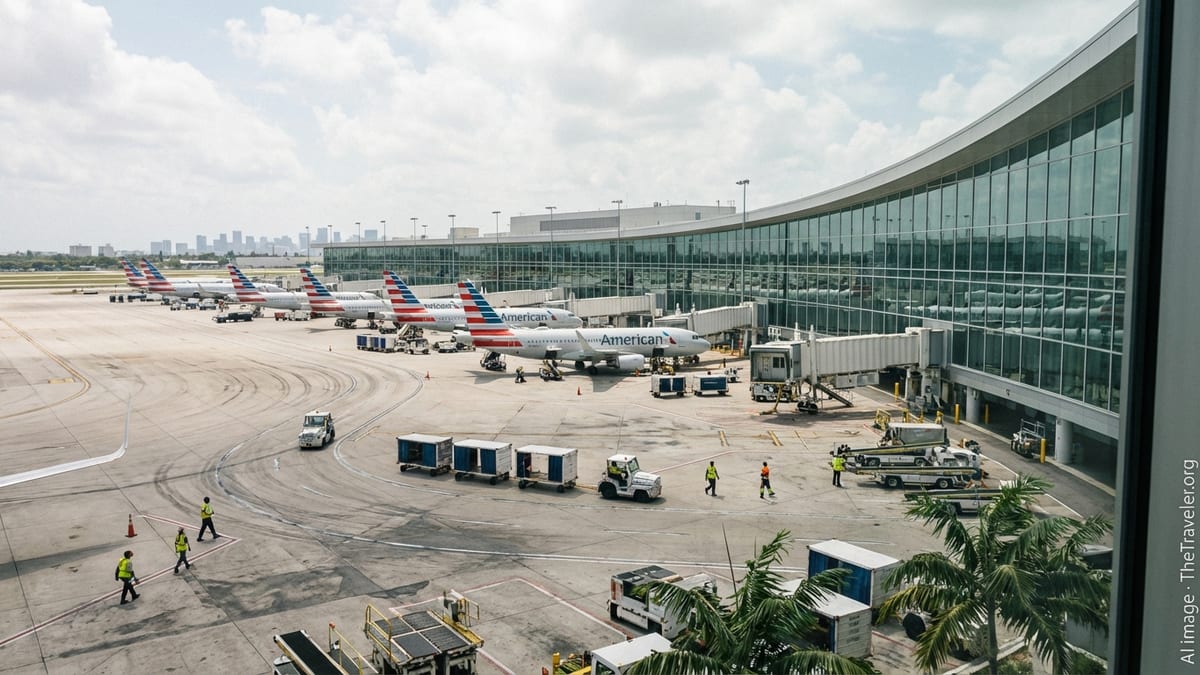
Major Hub Investment to Reshape Miami International Airport
The Concourse D expansion, centered on the D60 gate area, represents American Airlines’ largest single infrastructure investment at Miami International Airport and underscores the carrier’s long-term commitment to the city that serves as its primary U.S. gateway to Latin America and the Caribbean. Officials say the project is scheduled to break ground in 2027 and is expected to be completed by around 2030, aligning with a broader airport-wide modernization program led by Miami-Dade County.
Today, the D60 area functions as a constrained ground-boarding zone, with one shared holding space feeding 17 regional jet positions where passengers must walk outside to board their flights. Under the new plan, that layout will be completely replaced by a purpose-built, three-level concourse extension offering 17 traditional contact gates equipped with jet bridges. The shift is designed to eliminate outdoor boarding, reduce delays linked to weather and ramp congestion, and bring the space up to the standards of a modern international hub.
American Airlines executives describe the project as a transformational upgrade for both customers and employees. The new concourse footprint will expand circulation space, create dedicated boarding zones for each gate, and give the airline more flexibility to schedule larger regional and narrow-body aircraft on key routes where demand has outgrown the current infrastructure.
Seventeen New Gates Aimed at Growing International Connectivity
The upgraded D60 extension will preserve the current count of 17 positions but will redefine their role in Miami’s network strategy. Instead of serving primarily small regional jets at ground level, the new gates will be sized for larger regional and single-aisle aircraft, enabling American to upgauge capacity on high-demand services while still operating within Concourse D on the airport’s north side.
Crucially for international travelers, all 17 gates will connect on the third level directly to Concourse D’s existing U.S. Customs and Border Protection facility. That vertical link is intended to streamline the arrival process for overseas flights, allowing passengers to disembark via jet bridge, move directly into secure corridors, and reach passport control more quickly than under the current configuration.
Miami-Dade County officials have highlighted the project as a cornerstone of efforts to maintain Miami’s status as one of the busiest U.S. gateways for international visitors. With American operating more than 380 peak-day flights in summer schedules and serving over 150 destinations from the airport, the new gates will be positioned to support additional frequencies and new routes across Latin America, the Caribbean, and beyond as demand grows.
The expansion is also expected to improve operational resilience during peak connecting banks, when banks of arriving and departing flights put pressure on limited gate space. By converting remote stands into full contact gates, the airline and airport anticipate smoother turnarounds, fewer towing movements, and a more predictable operation during irregular events such as severe weather.
Passenger Experience and Sustainability at the Core of the Design
Beyond raw capacity, the Concourse D project places a strong emphasis on customer experience. Each of the 17 gates will feature its own enlarged passenger hold room instead of feeding from a single crowded waiting area, giving travelers more seating, clearer sightlines to boarding doors, and additional charging points and amenities. The three-level layout will also allow the airport to separate arriving and departing flows more effectively to ease congestion at peak times.
The new extension is being designed to incorporate a broader mix of dining, retail, and service options adjacent to the gates. Airport planners say the commercial zones will be integrated into the circulation path rather than set off to the side, with the goal of making it easier for passengers to access food and shopping without losing proximity to their boarding doors.
Sustainability targets are built into the project brief. The D60 expansion is being engineered to meet LEED Silver and Envision Verified standards, two of the most widely recognized benchmarks for resilient and environmentally responsible infrastructure. Plans call for high-performance glazing, efficient mechanical systems, water-conserving fixtures, and construction practices intended to minimize waste and reduce lifecycle emissions.
Designers are also working to maximize natural light and outward views of the airfield from the new concourse, while shading strategies and careful material selection aim to keep interior spaces comfortable in Miami’s tropical climate. The result, airport officials say, should be a brighter, more comfortable environment that feels distinct from the low-slung, window-limited space that exists today at D60.
Part of a Wider $9 Billion Modernization Across the Airport
The D60 transformation sits within a sweeping, multiyear capital program known as the M.I.A. Plan, which totals roughly $9 billion in upgrades spread across Miami International Airport. Alongside the American-funded Concourse D expansion, the program includes a new garage, major restroom renovations throughout the terminal, a planned Concourse K expansion later this decade, and a multihundred-million-dollar overhaul of the airport’s aging Central Terminal.
Miami-Dade leaders frame the American Airlines investment as a critical piece of that broader puzzle, both because of its scale and its direct impact on the passenger journey. By concentrating significant capital in one of the airport’s oldest and most congested areas, the project aims to address long-standing pain points in the North Terminal while aligning with other improvements such as upgraded baggage systems and refurbished vertical transportation.
For American, the Miami expansion mirrors a broader network strategy that includes major infrastructure commitments at other hubs, but the airline has underscored that Miami occupies a unique place in its route map. With the airport already handling tens of millions of passengers each year and a large share of U.S. traffic to Latin America, the carrier views the Concourse D project as essential to capturing future growth and maintaining a competitive edge against rivals in South Florida.
Construction phasing plans have not yet been disclosed in full, but airport officials acknowledge that work on such a constrained site will need to be tightly choreographed to minimize disruption. The current ground gates are expected to remain operational until closer to the start of heavy construction, with detailed staging and temporary arrangements to be announced as the 2027 groundbreaking date approaches.
Implications for Travelers and Miami’s Role as a Global Gateway
For travelers using Miami International Airport in the next decade, the Concourse D project promises a noticeable shift in how they experience arrivals and departures, particularly on regional and shorter international routes. Once complete, passengers who previously boarded via stairs and walked across the ramp at D60 will instead use enclosed jet bridges, with more space to wait comfortably and better weather protection during South Florida’s frequent rainstorms.
International passengers should also see benefits in shorter walks and more direct flows from aircraft door to passport control. By tying all 17 gates into the existing customs hall via dedicated third-level connections, the design aims to reduce bottlenecks and give border authorities more flexibility in distributing arriving passengers across inspection lanes.
Local business and tourism groups are watching the development closely, viewing the expansion as a signal that American intends to keep growing its Miami hub even as competition intensifies in the region. Additional gate capacity tailored for larger aircraft could support new nonstop links to secondary cities in Latin America, more frequencies to established markets, and incremental service to Europe and other long-haul destinations.
For now, travelers will not see visible construction at D60 until work begins in 2027, but airport and airline officials are already positioning the project as a defining element of Miami International Airport’s next chapter. As plans advance from renderings to reality, the reimagined Concourse D is set to play a central role in how millions of passengers connect through South Florida in the years ahead.