

More news on this day
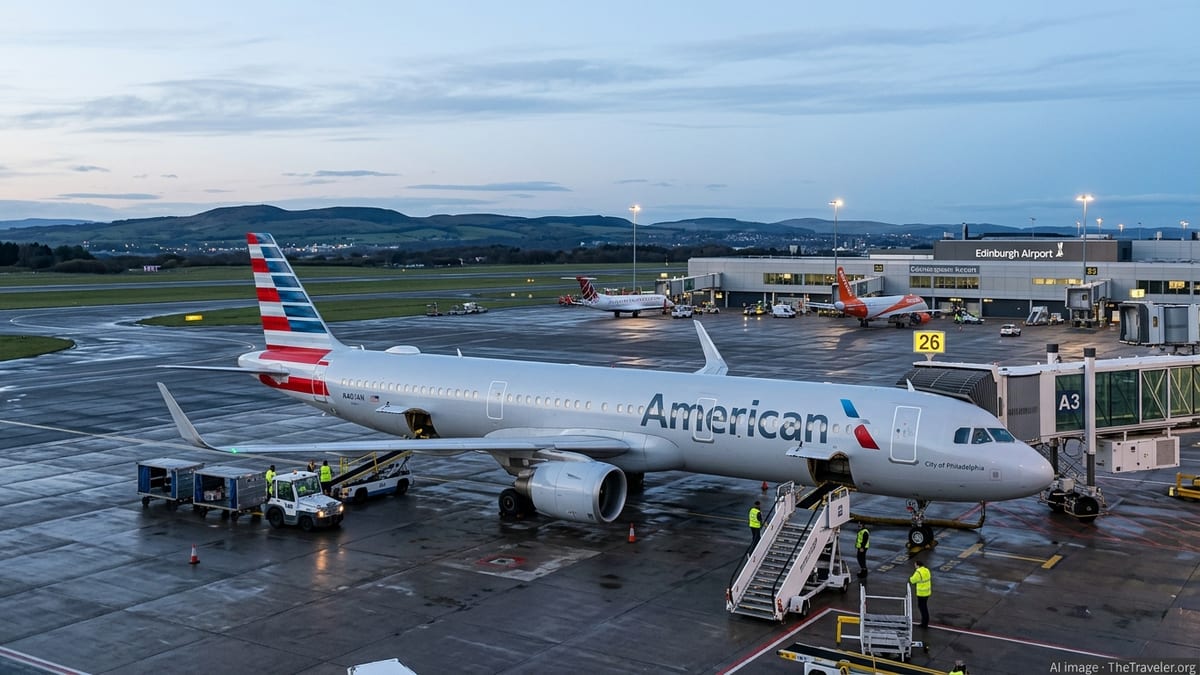
American Airlines’ long-anticipated Airbus A321XLR has entered transatlantic service on the New York–Edinburgh route, a boutique-style deployment that is poised to reshape how U.S. travelers reach Scotland and potentially unlock a new wave of tourism between the two countries.
Get the latest news straight to your inbox!
A Strategic Narrowbody Bridge Between New York and Edinburgh
The A321XLR’s first transatlantic assignment for American Airlines is a seasonal daily service linking New York John F. Kennedy International Airport with Edinburgh, Scotland’s capital. Publicly available schedules indicate the route began operating in early March 2026 and is planned to run through late October, timed to capture Scotland’s crucial spring, summer and early autumn visitor peaks.
Industry coverage describes the service as a “long, thin” route where demand is strong but not always sufficient to justify a widebody aircraft year-round. The A321XLR’s extra-long range and lower operating costs give American the ability to sustain daily frequencies while keeping capacity closely matched to seasonal swings in leisure and business traffic.
Reports also note that this is American’s first international long-haul deployment of the A321XLR, following several months of domestic flying between New York and Los Angeles to familiarize crews and fine-tune onboard service. The airline has framed the New York–Edinburgh corridor as a showcase for how the new jet can open or reinforce niche transatlantic markets that were previously difficult to serve profitably.
For Scotland, a direct link to New York on a daily schedule places the country more firmly on the map for U.S. travelers seeking alternatives to London and other large European gateways. Tourism planners have long highlighted the potential of more point-to-point routes from North America to support regional economies beyond the UK’s southeast.
Premium-Focused Cabin Signals “Boutique” Transatlantic Ambitions
American Airlines has positioned the A321XLR as a premium-heavy aircraft, and the configuration used on the Scotland route reflects that strategy. According to cabin data published by aviation and travel outlets, the jet features 20 Flagship Suite business-class seats with lie-flat beds, 12 Premium Economy recliners and 123 standard economy seats, all supported by high-speed Wi-Fi and individual seatback entertainment with Bluetooth connectivity.
The relatively small overall seat count compared with traditional widebody aircraft, combined with a large share of space devoted to higher-yield cabins, has led some analysts to characterize the operation as a boutique-style transatlantic service. The concept aims to blend the intimacy of a smaller aircraft with the comforts and amenities typically associated with larger long-haul jets.
Observers note that this approach could be particularly attractive on routes like New York–Edinburgh, where demand from affluent leisure travelers, festival-goers and golf tourists runs alongside corporate traffic tied to finance, technology and education. A more exclusive-feeling cabin, without sacrificing daily frequency, offers American a way to compete directly with both European network airlines and low-cost long-haul rivals serving Scotland.
Early commentary from aviation enthusiasts has also focused on the aircraft’s modern interior, including updated lighting, larger overhead bins and redesigned galleys intended to streamline service on overnight and longer daylight crossings. These elements are seen as critical to convincing travelers that a narrowbody jet can deliver a long-haul experience comparable to that of a twin-aisle aircraft.
Scotland Tourism Braces for a Fresh Influx of U.S. Visitors
The new A321XLR link arrives at a time when Scotland’s tourism sector is placing renewed emphasis on high-spending international visitors and dispersing travel beyond the traditional summer peak. Market analyses highlight that, to date, only a small share of nonstop transatlantic capacity into the UK has served Scottish airports, with the bulk funneled through London.
Travel industry reports suggest that additional nonstop options from the United States can have an outsized impact on visitor behavior, encouraging travelers to spend more time in a single country rather than treating it as one stop on a multi-destination European trip. In Scotland’s case, that could translate into longer stays in Edinburgh and Glasgow, as well as increased exploration of the Highlands, islands and smaller historic towns.
The New York–Edinburgh service is expected to complement existing transatlantic offerings from other U.S. carriers and European partners, broadening the mix of price points and schedules available to travelers. With American slotting the A321XLR into this corridor, Scotland gains another direct connection to one of the most important origin markets for inbound tourism.
Local tourism organizations have previously pointed to strong U.S. interest in Scottish heritage, whisky, and golf as enduring drivers of demand. Additional nonstop capacity, especially on an aircraft marketed for comfort, is likely to reinforce those trends and could encourage new tour products, events and regional itineraries specifically tailored to American visitors.
Joint-Business Connectivity Extends Reach Beyond Edinburgh
While the A321XLR flight itself operates between New York and Edinburgh, the broader network picture is key to understanding its tourism impact. Publicly available information on American’s Atlantic Joint Business with British Airways indicates that travelers arriving in Edinburgh will be able to connect onwards to a range of destinations across England, Italy and Spain on partner flights.
This arrangement effectively turns Edinburgh into both a destination and a connecting point for some itineraries, allowing U.S. travelers to combine a stay in Scotland with additional stops in Europe without transiting London. In the opposite direction, Scottish and European passengers gain new one-stop options into New York and onward across American’s domestic network.
Travel trade coverage underscores that the New York–Edinburgh flight is one of several new transatlantic routes feeding into American’s wider European expansion for summer 2026. The A321XLR, with its ability to operate efficiently on medium-demand city pairs, is viewed as a tool for weaving together a more finely grained network of secondary cities on both sides of the Atlantic.
For tourism stakeholders, this connectivity means the benefits of the new route are not limited to Edinburgh alone. Regions across Scotland, from the Highlands to the Borders, can more easily market multi-stop itineraries to U.S. travelers who now have more seamless access via a single transatlantic flight and a short domestic hop.
A Test Case for the Future of Transatlantic Narrowbodies
Analysts tracking fleet strategy see American’s Scotland deployment as an important test case for the broader role of narrowbody aircraft on long-haul routes. The A321XLR’s extended range and fuel efficiency are widely expected to encourage airlines on both sides of the Atlantic to reassess which city pairs can be served profitably with smaller jets.
Commentary in aviation publications points out that, in 2026, American remains the only U.S. carrier with a confirmed A321XLR-operated transatlantic route. That exclusivity has turned industry attention toward the performance of the New York–Edinburgh service, from load factors and yields to customer feedback on comfort and service.
If the Scotland link proves successful, observers anticipate that American could replicate the model on other “long, thin” markets, including additional destinations in the British Isles and continental Europe that lack sufficient demand for year-round widebody flights. Such a shift could redistribute transatlantic traffic away from the largest hubs and toward a wider spread of regional airports.
For now, American’s boutique-style A321XLR connection between New York and Edinburgh serves as a high-profile demonstration of how new aircraft technology, targeted scheduling and joint-business partnerships can combine to ignite fresh tourism flows between Scotland and the United States, while quietly rewriting expectations of what a transatlantic flight can look and feel like.