

More news on this day
Passengers traveling between the United Kingdom and the United States are facing bare-bones inflight service on multiple American Airlines routes after a major catering disruption at London Heathrow forced the carrier to fly in meals from the U.S. and trim offerings across 19 daily departures.
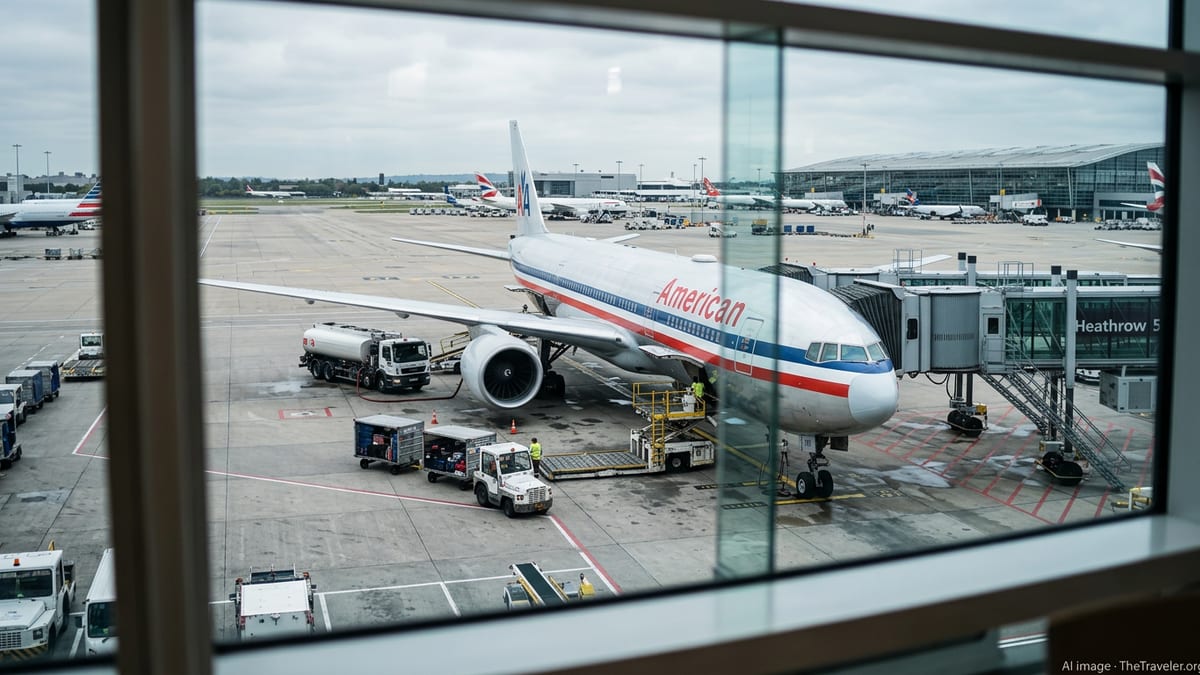
Operational Snag at Key Transatlantic Gateway
American Airlines has confirmed significant changes to how it caters flights out of London Heathrow, its primary European hub, following an abrupt breakdown in local catering provision. The disruption, which surfaced in recent days, is affecting 19 daily departures to cities across the United States, creating knock-on impacts for travelers at one of the world’s busiest transatlantic gateways.
With its normal Heathrow catering pipeline effectively offline, the airline has introduced a temporary double-catering strategy that relies on meals being loaded in the United States and carried to London for the return leg. Industry observers say such arrangements are highly unusual on high-density long haul services and are already resulting in leaner menus, reduced snack offerings and simplified bar service.
The disruption comes at a delicate moment for the carrier, which has been striving to sharpen its premium reputation on flagship routes such as London to New York, Dallas Fort Worth, Miami and Los Angeles. Instead, some of its most valuable customers are now encountering stripped-back meal services that fall short of what is typically expected in business and first class cabins on these marquee flights.
Although the airline has not publicly detailed the root cause, aviation insiders point to turbulence around its local catering contractor at Heathrow, with suggestions of both staffing tensions and a potential change of vendor in the near term.
Double Catering Strategy Brings Bare-Bones Service
Under the stopgap plan, aircraft departing from U.S. gateways such as New York JFK, Dallas Fort Worth, Miami, Chicago and others are being provisioned with enough food and beverage stock to cover both the outbound sector to London and the return flight back to the United States. This approach is constrained by the physical limits of aircraft galleys, which are designed to hold supplies for a single long haul segment, not two.
As a result, American has been forced to simplify its inflight menus on many Heathrow departures. Reports from recent flights describe one-tray meals in premium cabins, minimal side dishes, a “protein or vegetarian” main-course choice instead of the usual broader selection, and a reduction in midflight snacks. Even some signature touches, such as certain desserts and ice cream offerings, have reportedly been withdrawn on select services.
For economy passengers, the impact manifests as fewer options and tighter portions, with crews working to stretch limited stocks while still providing at least one hot main meal on transatlantic sectors. Flight attendants are also facing added workload as they manage reconfigured service routines, extra storage challenges and a higher volume of passenger questions about the curtailed offerings.
The airline has signaled that these measures are temporary, but has not confirmed how long the double-catering regime will remain in place. Industry analysts warn that, given the complexity of switching large-scale catering contracts at a hub like Heathrow, the disruption could extend for days or even weeks.
Passenger Experience and Compensation Efforts
Travelers on affected flights have taken to social media and aviation forums to document the impact of the catering crunch, with some advising fellow passengers to eat in the terminal or bring their own food before boarding. While safety and on-time performance remain intact, expectations for a full-service long haul experience are being tempered across both cabins and loyalty tiers.
Premium customers, in particular, have voiced frustration at paying business or first class fares only to receive service levels more akin to an upgraded economy product. In some cases, airlines in similar situations have provided lounge enhancements or additional ground catering, but Heathrow’s tight turnaround windows and terminal congestion limit how much can be done before boarding.
American has begun offering goodwill gestures on a case-by-case basis, including bonus miles or travel credits to travelers who raise concerns after their flight. However, there is currently no blanket policy for automatic compensation linked specifically to the Heathrow catering issue, and the airline continues to describe the situation as an operational adjustment rather than a formal service failure.
For passengers with imminent itineraries, travel advisors recommend closely monitoring preflight communications from American, checking booking tools for any updated service notes, and planning meal times accordingly, especially on overnight services where inflight dining typically substitutes for a full dinner or breakfast.
Implications for Transatlantic Competition
The catering turbulence at Heathrow lands amid intense competition on UK U.S. routes, where American and its joint venture partner British Airways vie with United Airlines, Delta Air Lines and a growing roster of low cost and boutique carriers. Reliable, high quality onboard dining is a core differentiator in the lucrative corporate and premium leisure segments that these airlines target most aggressively.
While occasional catering disruptions are not uncommon in global aviation, the scale of the current issue, cutting across 19 daily flights, risks denting American’s efforts to position itself as a consistently premium option on the North Atlantic. Competitors will be quick to capitalize, particularly on routes such as London to New York and Los Angeles, where multiple carriers operate comparable schedules and products.
Travel management companies say some corporate clients may temporarily steer volume to alternative carriers if the reduced service at Heathrow persists, especially for senior executives accustomed to full multi course offerings and extensive beverage lists on overnight flights. At the same time, strong demand and limited capacity on peak departures mean seat availability on competing airlines may be tight at short notice.
In the broader market, the episode highlights how dependent major network airlines remain on a handful of large catering providers at global hubs. Any disruption at those facilities can ripple quickly across schedules and geographies, particularly on long haul routes where passengers expect more than a minimal inflight experience.
Prospects for Resolution and Advice to Travelers
American has indicated internally that it is evaluating its Heathrow catering arrangements and working toward a more stable solution, raising the possibility of either a restructured agreement with existing partners or a full transition to a new supplier. Either route involves intricate logistics, from food safety certification and menu design to staff training and delivery timing at tightly controlled airport facilities.
Until a fix is implemented, American’s London based crews and ground teams are focused on preserving core elements of service while managing passenger expectations. The airline continues to operate its full schedule between the United Kingdom and the United States, and there is currently no indication that the catering issue will lead directly to cancellations.
For travelers booked on upcoming American Airlines flights from Heathrow, practical steps can help mitigate inconvenience. Eating a substantial meal in the terminal, bringing snack items that comply with security rules, and planning to rely less on inflight dining will soften the impact of leaner onboard offerings. Passengers in premium cabins may also wish to maximize lounge access where available, as ground catering is currently less affected than inflight service.
With the busy spring and summer travel seasons approaching, American faces pressure to restore full catering at Heathrow swiftly or risk losing ground in one of the world’s most contested long haul markets. For now, anyone flying on one of the 19 daily affected departures should anticipate a more functional, less indulgent inflight experience than the route normally provides.