

More news on this day
Hundreds of passengers across multiple continents are facing missed connections, overnight airport stays and scrapped holidays after American Airlines racked up at least 20 flight cancellations and more than 350 delays on Sunday, cascading across hubs from New York and Buenos Aires to Tokyo, Zurich and Madrid amid severe winter weather and wider congestion in the global air network.
Storm-Struck New York Emerges as the Epicenter
New York’s congested airspace once again became a flashpoint for global aviation disruption on February 22, as a powerful winter system sweeping the US Northeast forced airlines, including American, to pare back operations sharply at John F. Kennedy and LaGuardia airports. With officials warning of whiteout conditions, heavy snow and high winds, carriers have preemptively grounded large portions of their schedules, triggering knock-on effects across their international networks.
American Airlines, which operates a dense web of domestic and long haul services into New York, began cancelling and consolidating flights through the weekend as forecasts deteriorated. Short haul links from key feeder cities such as Washington and Detroit into LaGuardia were among those grounded, while remaining services attempted to depart ahead of the storm’s peak or were held on lengthy delays as ground crews worked in challenging conditions.
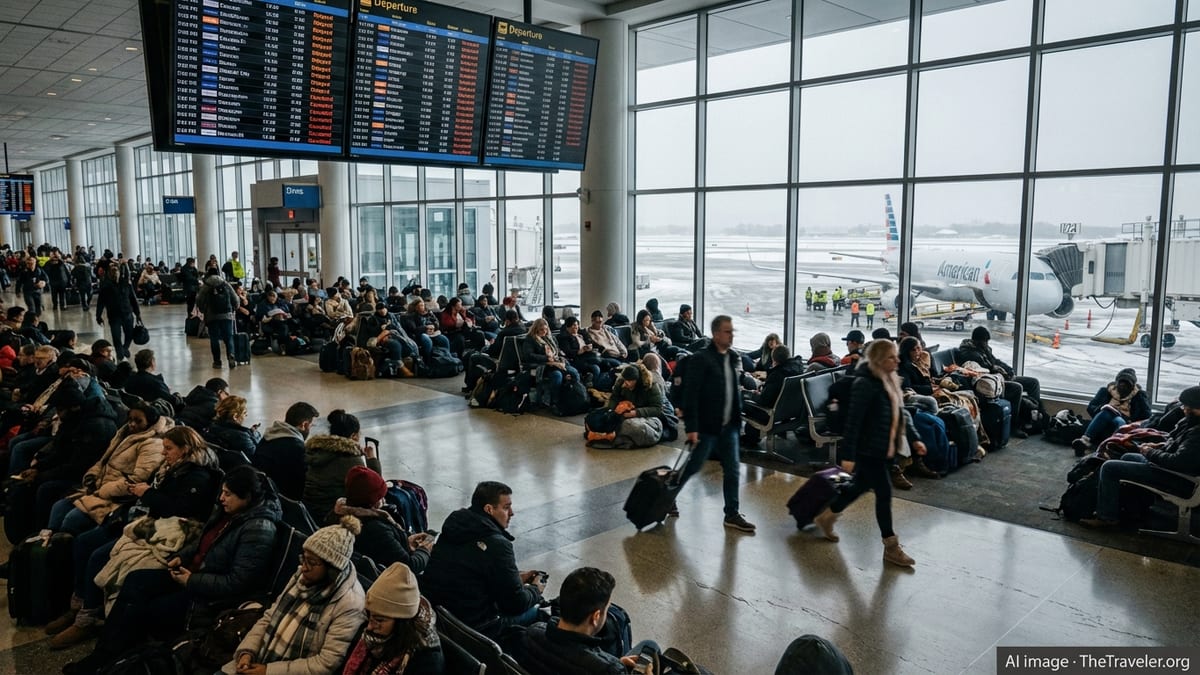
Inside the terminals, departure boards filled with red notices as hours-long waits mounted. Families returning from school holidays, business travellers trying to reach Monday meetings and tourists connecting onward to Europe and South America all found themselves at the mercy of overburdened rebooking systems and limited hotel availability in and around the city.
Although New York is far from the only US gateway affected by winter weather this season, its role as a major transatlantic and transcontinental hub means that any disruption there tends to ripple quickly across time zones, aircraft rotations and crew schedules, amplifying the effect of each individual cancellation.
Cancellations and Delays Ripple Across the United States
The latest chaos at American Airlines comes on the heels of an already difficult winter for US air travel, in which major storms have triggered waves of cancellations and delays across the country. Data compiled over recent weekends show clusters of days where dozens of American flights were cancelled and hundreds more delayed, as carriers juggled aircraft out of position and crews bumping up against duty limits.
On Sunday, American’s operations team focused on keeping core domestic corridors open while selectively trimming frequencies. Routes linking New York to business and political centres such as Chicago, Atlanta, Dallas and Washington saw mixed performance, with some flights operating close to schedule and others scrapped entirely as the storm narrowed safe operating windows.
Secondary airports also felt the strain. Travellers in mid sized cities reported that the cancellation of a single morning departure on American could cascade into a full day’s disruption, eliminating once daily services to major hubs and forcing passengers to accept multi stop routings or travel a day later. For regional communities that rely on those flights for medical appointments, university travel and small business connections, the effect is particularly acute.
Across the airline’s US network, gate agents and call centre staff struggled to keep pace with the volume of changes. Social media platforms filled with images of crowded concourses, long customer service lines and travellers sleeping in waiting areas as they awaited new itineraries or seats on already full alternative flights.
South America: Buenos Aires Feels the Knock-On Effects
The disruption was keenly felt in Argentina, where Buenos Aires serves as one of American Airlines’ principal South American gateways. The carrier’s flagship overnight service between Ezeiza International Airport and New York, a key link for both tourism and business, spent Sunday evening operating on a delayed schedule as the airline attempted to mesh its southbound and northbound rotations with unpredictable conditions in the US Northeast.
Passengers arriving to Ezeiza for late night departures encountered shifting departure times and rolling gate changes, and in some cases were warned that onward connections via New York to other US or European cities were no longer guaranteed. Travellers reported being advised to travel with carry on baggage only if possible, in order to preserve flexibility to be rebooked across different routes and partner carriers at short notice.
For Argentina’s burgeoning outbound tourism market, delays on the Buenos Aires to New York route quickly translated into wider uncertainty. Travellers booked on complex itineraries combining North American city breaks with ski trips in Colorado or business stops in Chicago confronted the possibility of losing prepaid hotel nights and nonrefundable tours. Airlines and travel agents fielded urgent requests for rerouting through Miami or Dallas in a bid to bypass the storm affected New York area.
Inbound tourism also faced disruption. Visitors from the United States and Europe en route to Patagonia, Mendoza’s wine country or Iguazú Falls suddenly found their long awaited holidays shaved by a day or more, as missed connections forced them into extended layovers in Buenos Aires or competing hubs in Brazil and Chile.
Transpacific Schedules Strained in Tokyo
On the other side of the globe, travellers passing through Tokyo saw American’s transpacific operations come under pressure as aircraft, crews and connection banks were affected by delays and cancellations in North America. Long haul flights linking Japan to the US West Coast and to key hubs like Dallas and New York were forced to operate off schedule, limiting the airline’s ability to offer smooth same day onward connections.
Passengers who had timed itineraries carefully to fit tight connection windows between US domestic arrivals and onward flights to Tokyo faced hours of uncertainty as they watched departure times from US gateways creep later into the night. For some, that meant missing the last long haul departure of the day and being involuntarily rerouted via alternative Asian hubs or held over in the United States until the following day.
At Tokyo’s international terminals, the result was a familiar pattern of congestion in transfer areas, with airline staff juggling rebookings onto available seats on partner carriers and scrambling to secure hotel rooms during peak travel season. Business travellers connecting between US financial centres and Tokyo’s corporate districts expressed frustration at losing entire meeting days to weather related disruption half a world away.
Japan’s position as a strategic gateway for itineraries linking North America to Southeast Asia and Australia further compounded the impact. When a large US carrier such as American experiences cascading delays on the North American side, Tokyo’s carefully calibrated wave of arrivals and departures can quickly become misaligned, leaving empty seats on outbound flights and stranded travellers in transit.
Zurich and Madrid Highlight Europe’s Vulnerability to US Weather
In Europe, Zurich and Madrid emerged as key flashpoints for the latest wave of disruption tied to American’s schedules. Both cities play important roles in connecting European travellers to the United States, and both maintain busy long haul links that intersect with the carrier’s storm hit New York operations.
In Zurich, a premium heavy market with strong business and banking ties to the US, passengers booked on American operated or codeshare flights reported delayed departures and missed onward connections. Late arriving aircraft from New York meant tighter turnarounds on the ground and fraught boarding processes as the airline tried to preserve as much of the day’s schedule as possible without compromising safety or crew rest requirements.
Madrid, a crucial Iberian gateway to Latin America and the United States, faced its own share of complications. Long haul flights linking Spain to New York and other US cities had to be rescheduled or consolidated when storm related congestion in the Northeast left limited arrival and departure slots. Travellers with multi leg itineraries spanning Spain, the US and South America found themselves particularly exposed, with one delay in New York often enough to break an entire chain of carefully timed connections.
The turbulence in Zurich and Madrid underscored how closely European schedules remain bound to operational realities in the United States. Even when airports on the European side are operating in clear weather, capacity constraints, crew availability and aircraft rotations tied to storm affected US hubs can send shockwaves through departure boards thousands of kilometres away.
Why a Few Dozen Cancellations Can Disrupt the World
The raw numbers behind American’s latest disruptions, roughly 20 flight cancellations and more than 350 delays over a single day, tell only part of the story. In a tightly interwoven global network, every cancellation represents not just an isolated flight, but also the passengers, aircraft and crews that would have connected onward to other journeys.
A single cancelled morning departure from a regional US city to New York can strand travellers who were due to connect to Buenos Aires, Tokyo, Zurich or Madrid later the same day. Those missed connections then feed back into the system as travellers are rebooked onto other flights, displacing passengers who had already purchased seats and forcing airlines to juggle capacity across multiple routes simultaneously.
Aircraft utilisation patterns compound the problem. Long haul jets that arrive late into a hub such as New York or Dallas may be scheduled to operate another intercontinental flight within hours. If the incoming flight is significantly delayed or cancelled outright, there may simply be no spare aircraft and crew available to operate the next leg on time, especially during peak travel periods when fleets are already stretched.
As airlines seek to run leaner operations with high load factors and minimal slack, that lack of buffer makes the system more vulnerable to external shocks. Severe weather, air traffic control restrictions and even minor technical issues can quickly spiral into systemwide headaches when there are few empty seats or idle aircraft available to absorb the disruption.
Passengers Confront Long Lines, Limited Options and Mounting Costs
For passengers caught up in the latest American Airlines disruptions, the human impact was immediate and tangible. Long lines snaked through terminal concourses as travellers queued to speak with overworked gate agents or customer service staff, often while monitoring app notifications that shifted departure times repeatedly throughout the day.
Hotel rooms near major hubs such as New York, Dallas and Chicago filled rapidly as stranded travellers scrambled for somewhere to sleep. Those who booked last minute accommodation reported steep prices, and some were forced to stay far from the airport, adding ground transport complications to an already stressful journey.
Families travelling with young children or elderly relatives faced particular hardship as unexpected overnight stays and long waits in crowded terminals tested patience and endurance. Some passengers reported difficulty accessing clear information about their rebooking options, especially when multiple airlines and codeshare partners were involved in complex itineraries.
On top of logistical challenges, travellers also confronted financial questions around nonrefundable hotels, prepaid tours and missed events at their final destinations. While airlines frequently issue travel waivers during major weather events, the process of claiming refunds or credits can be time consuming and, for some, confusing, adding an administrative burden that extends well beyond the travel day itself.
Airlines Balance Safety, Operations and Communication
From the airline perspective, the latest disruptions underscore the delicate balance between preserving schedules and prioritising safety in adverse conditions. American Airlines, like its competitors, has stressed that it will cancel or delay flights whenever weather, runway conditions or crew duty limits make it unsafe or impractical to operate as planned.
Operations planners typically begin adjusting schedules days in advance of a major winter storm, trimming frequencies, combining flights and issuing travel waivers that allow passengers to move their trips at no extra cost within a defined window. By reducing the number of flights attempting to operate through heavily impacted hubs such as New York, airlines aim to avoid even more severe congestion and tarmac delays during the storm’s peak.
However, the effectiveness of these measures depends heavily on timely and transparent communication. Travellers interviewed at affected airports described a mixed experience, with some praising proactive text alerts and automatic rebookings, while others said they learned of cancellations only upon reaching the airport. Long waits for assistance at customer service desks fuelled criticism that airlines had not staffed up adequately for a disruption that forecasters had widely flagged days in advance.
The events of the weekend are likely to feed into ongoing debates about airline accountability, passenger rights and the resilience of global air travel infrastructure in the face of increasingly volatile weather patterns. For now, as American Airlines works to untangle its schedules and get passengers moving again, travellers in cities from New York and Buenos Aires to Tokyo, Zurich and Madrid can only hope that clearer skies and calmer operations are on the horizon.