

More news on this day
American Airlines has extended the suspension of its Philadelphia–Doha route until early May and postponed the relaunch of its New York–Tel Aviv service, as a rapidly escalating conflict involving the United States, Israel and Iran disrupts airspace and triggers fresh uncertainty for transatlantic and Middle East travelers.
Get the latest news straight to your inbox!
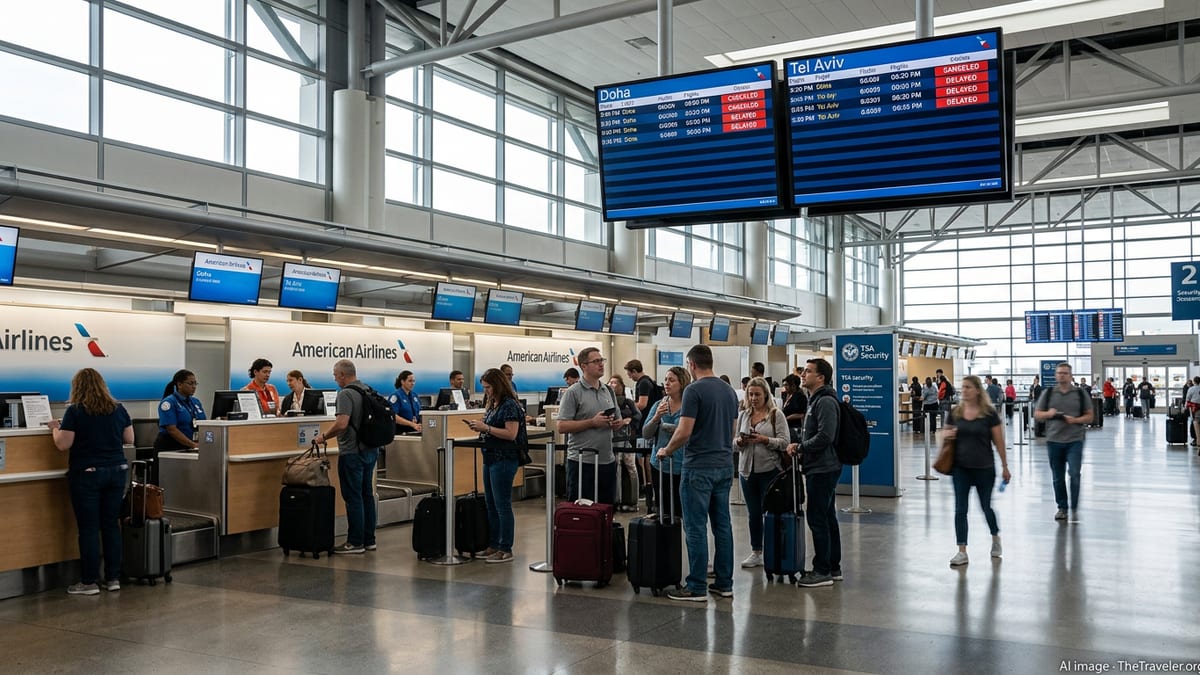
Extended Halt on Philadelphia–Doha Operations
American Airlines confirmed that flights between Philadelphia International Airport and Doha’s Hamad International Airport will remain suspended until at least May 7, 2026, prolonging a pause that was originally expected to be shorter in duration. The carrier had previously halted the service as tensions mounted across the Gulf, but the deepening regional conflict has made a near-term restart operationally and commercially unviable.
The route, launched as part of a broader strategy to connect U.S. hubs with major Gulf gateways, had become a niche but important link for corporate travelers and passengers connecting onto Qatar Airways’ extensive network into Asia and Africa. With Qatar’s own airspace now heavily restricted and many of its flights grounded or operating on limited repatriation corridors, American’s direct access to Doha has become increasingly constrained.
Industry analysts note that the extended suspension underlines how intertwined U.S. airline planning has become with the evolving security situation in the Middle East. For American, the decision impacts not only point-to-point traffic between Philadelphia and Doha but also connecting flows that relied on the Qatari hub to reach destinations beyond the Gulf.
Travel agents in the United States report that affected passengers are being rebooked via alternative European hubs or on partner carriers operating along more southerly routings that avoid closed airspace. However, longer flight times, limited capacity and rapidly changing advisories have combined to make itinerary planning unusually complex.
Tel Aviv Relaunch Pushed Back Amid Renewed Volatility
Alongside the Doha decision, American Airlines has again delayed its long-planned return to Tel Aviv’s Ben Gurion Airport from New York’s John F. Kennedy International Airport. The airline now expects the first flights on the reinstated route to operate no earlier than April 23, 2026, pushing back a restart that had already slipped multiple times since initial plans to return to Israel were floated for early spring.
American last flew to Tel Aviv in 2023 and subsequently maintained one of the longest suspensions among U.S. carriers, even as some competitors attempted cautious resumptions during brief periods of relative calm. The latest round of hostilities and missile exchanges has closed large portions of regional airspace, brought new strikes on key infrastructure and raised the operational risk calculus for airlines seeking to fly into Israel.
For American, the Tel Aviv route was expected to cater to strong demand from business travelers, the technology sector, visiting friends and relatives, and religious tourism. Advance sales for the planned relaunch in March 2026 had reportedly been encouraging, but the deteriorating security environment and the risk of sudden flight bans have forced the carrier to reassess.
Travelers who had booked the early-season Israel flights are being offered refunds or rebooking on later departures, subject to availability, as well as options to reroute via European partners where onward links to Tel Aviv remain technically scheduled. Yet with rolling cancellations across multiple carriers, many passengers are opting to delay or cancel trips to the region altogether.
Regional Airspace Closures Ripple Across Global Networks
The American Airlines moves come against a backdrop of widespread disruption to commercial aviation across the Middle East and beyond. Following joint U.S. and Israeli strikes on Iran in late February and subsequent retaliatory attacks, countries including Israel, Qatar, Iran, Iraq, Kuwait and Bahrain imposed sweeping airspace closures or severe restrictions, effectively severing key east–west corridors for days at a time.
Major Gulf hubs that normally handle tens of thousands of connecting passengers daily have been forced to curtail or temporarily suspend regular operations, running only limited repatriation flights where safe corridors can be negotiated. This has had a cascading impact on carriers in Europe, North America and Asia that rely on Middle Eastern stopovers for long-haul connectivity.
For U.S. airlines, which already had no scheduled flights over Iranian or Iraqi airspace due to long-standing security guidance, the new closures compound existing challenges. Longer diversions around the Arabian Peninsula, congestion on remaining permitted routes and uncertainties over refueling and crew scheduling have all contributed to a reassessment of which routes are sustainable in the current environment.
Industry observers say the Philadelphia–Doha and New York–Tel Aviv decisions by American are emblematic of a broader pattern: airlines pulling back from marginal or geopolitically sensitive markets in favor of core transatlantic and domestic services that are easier to protect from sudden shocks.
Passenger Impact and Travel Policy Response
For travelers, the latest suspensions and delays translate into a familiar pattern of last-minute schedule changes, extended layovers and, in some cases, outright trip cancellations. Passengers with tickets touching Doha or Tel Aviv have been urged to monitor their reservations closely, sign up for airline alerts and work proactively with carriers or travel advisors to secure alternative routings.
American Airlines has issued waivers for affected itineraries, allowing changes without standard fees for travel originally booked to or through the impacted destinations during the current advisory period. However, fare differences can still apply, particularly as remaining seats on alternative routes fill quickly, pushing prices higher on some days.
Consumer advocates in the United States are reminding passengers that when a flight is canceled, travelers are generally entitled to a refund if they choose not to be rebooked, even when the disruption stems from security events rather than operational issues within the airline’s direct control. At the same time, they caution that hotel stays, ground transportation and other incidental costs may not be covered unless mandated by local regulations or specific airline policies.
Corporate travel managers are revising internal guidance, advising employees to avoid non-essential trips to conflict-adjacent destinations and to build additional buffer time into essential journeys. Many are also reviewing travel insurance provisions to clarify coverage for war-related disruptions, evacuations and sudden route closures.
Strategic Implications for U.S.–Gulf and Israel Connectivity
American Airlines’ extended retreat from Doha and delayed return to Tel Aviv highlight how fragile post-pandemic growth plans in the Middle East remain for many Western carriers. Routes that were once touted as strategic bridgeheads into fast-growing markets are now proving vulnerable to recurrent conflict cycles and rapidly shifting security assessments.
While American has emphasized that both the Doha and Tel Aviv decisions are temporary and subject to regular review, the prolonged absence from these markets risks ceding ground to rival airlines that can operate with more flexibility or accept higher levels of geopolitical risk. Gulf and European carriers, in particular, may capture a greater share of connecting traffic between North America, the Middle East and Asia once conditions allow more regular operations.
Aviation analysts suggest that, in the medium term, U.S. airlines may favor partnerships and codeshares over their own metal in volatile regions, leveraging foreign carriers’ local expertise while limiting direct exposure. The experience of repeated suspensions in Israel and now extended disruption in the Gulf could reinforce that strategic tilt.
For now, however, the priority for American Airlines and its peers remains operational resilience and passenger safety. With the security outlook in the region still fluid and governments issuing strong advisories against non-essential travel, carriers are likely to proceed cautiously, adjusting timetables in small increments and signaling that further extensions or changes to Middle East services cannot be ruled out.