

More news on this day
American Airlines flight attendants have reignited their years-long contract fight by renewing protests against chief executive Robert Isom and amplifying their militant “We Are Ready” campaign, signaling deepening labor unrest inside the largest U.S. carrier as it struggles to reassure investors and passengers after a bruising 2025.
Get the latest news straight to your inbox!
Vote of No Confidence Sharpens Focus on CEO
The Association of Professional Flight Attendants, which represents roughly 27,000 crew members at American Airlines, recently issued a unanimous vote of no confidence in Robert Isom, intensifying an internal showdown that has been building since before the pandemic. Publicly available union communications describe the move as a response to what leaders characterize as years of weak financial performance, chaotic operations and stalled progress at the bargaining table.
Reports indicate that the no-confidence vote was closely coordinated with a high-profile protest outside American’s Fort Worth headquarters in mid February 2026, where flight attendants and allied labor groups rallied under banners calling for “real leadership change.” Union statements frame the campaign as an effort to hold executives accountable for what workers see as a growing disconnect between record revenues and frontline pay and conditions.
The latest escalation puts American’s board under fresh scrutiny just as the airline is working to convince Wall Street that a 2025 slump can be reversed. Commentaries in major business publications note that American has lagged rivals on profit margins and investor returns, fueling questions about whether current leadership can execute a credible turnaround while facing open revolt from key employee groups.
‘We Are Ready’ WAR Campaign Returns to Center Stage
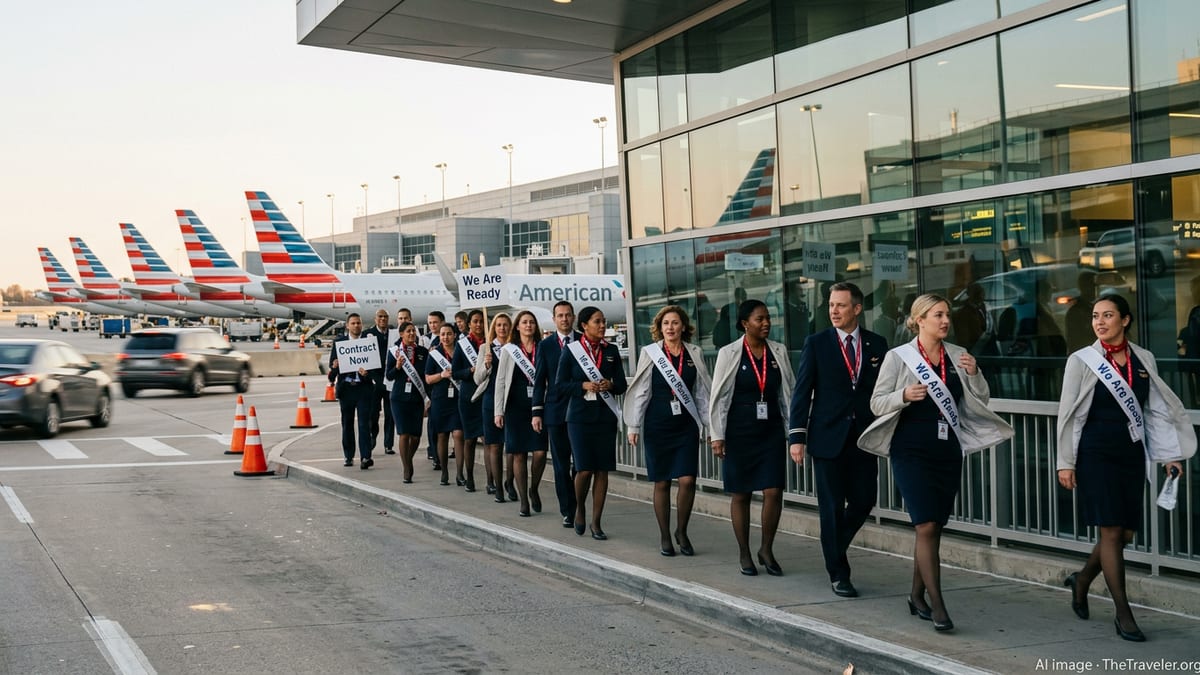
At the heart of the resurgence is the “We Are Ready” initiative, widely known among crews by its acronym and slogan, WAR. The campaign was first rolled out several years ago as a strike-readiness and visibility effort, encouraging flight attendants to wear red lanyards, WAR pins and “Ready to Strike” bag tags, and to appear at coordinated pickets to demonstrate unity during contract talks.
Union educational materials describe WAR as a multi-phase strategy designed to prepare members for every stage of a potential labor confrontation, from informational picketing and media outreach to more aggressive steps should federal mediators eventually allow a strike. While no walkout is currently authorized, the union previously secured overwhelming strike-authorization backing, which it continues to highlight as a signal of how far members are willing to go.
With the new wave of protests, WAR branding has again become ubiquitous in photos and reports from American’s hubs. Flight attendants have been urged to step up visible support on social media and at airports, with the goal of keeping pressure on management in the lead-up to what union leaders hope will be a significantly improved contract offer.
Pay, Staffing and Irregular Operations Drive Discontent
Behind the rhetoric and symbolism, the renewed confrontation reflects a web of unresolved economic and quality-of-life issues that have frustrated crews for years. Flight attendants argue that their pay scales have fallen out of step with inflation, housing costs and recent improvements negotiated by peers at other major airlines, even as American reports record or near-record annual revenues.
Another flashpoint is the handling of mass disruptions, such as the major winter storm that hit American’s network in early 2026. Published coverage and employee commentary describe extended duty days, last-minute reassignments and hotel and scheduling problems that left crews feeling abandoned while trying to manage stranded passengers. Many flight attendants point to those episodes as proof that the company prioritized short-term cost controls over investing in operational resilience and crew support.
Staffing and scheduling are also central grievances. Reports from worker forums and union briefings highlight concerns about insufficient reserve coverage, limited schedule flexibility and fatigue, especially on tightly timed hub turns and overnight sequences. Many crews say the stress has intensified as American has sought to rebuild capacity and capture demand while simultaneously navigating cost pressures and aircraft constraints.
Isom Seeks to Reframe the Narrative
As the WAR campaign gains new momentum, Robert Isom has attempted to counter the narrative of failing leadership. According to published accounts of his recent internal video message to employees, the CEO has emphasized record 2025 revenues, a pipeline of new aircraft and partnerships, and thousands of additional frontline hires in recent years as evidence that the carrier is investing in its people and its product.
Some financial analysts and commentators have argued that American’s challenges are not solely the result of current management, pointing to legacy debt, past buybacks and structural cost disadvantages compared with rivals whose labor contracts were slower to reset. Opinion pieces in business outlets suggest that investors may be underestimating the potential benefits of new credit card partnerships and network adjustments that could support a gradual margin recovery later in the decade.
Yet the persistence and visibility of flight attendant activism complicate any effort to present a simple turnaround story. Every picket line, WAR-branded rally and social-media campaign reminds passengers and markets that a major segment of the airline’s workforce remains unconvinced that the current leadership team can deliver the improvements they seek.
What the Escalating Labor Fight Means for Travelers
For travelers, the renewed clash between American’s flight attendants and its CEO arrives at a time when U.S. flyers are already contending with packed planes, tight schedules and periodic systemwide disruptions. While there is no immediate legal pathway to a strike under current federal mediation rules, seasoned aviation observers note that prolonged labor tension can weigh on morale and customer service long before any formal work stoppage occurs.
In the near term, passengers are likely to see more visible picketing and branded union activity outside terminals at American’s largest hubs, especially during peak travel periods when public attention is highest. These events are typically organized to avoid disrupting security checkpoints or boarding, but they underscore how central the labor dispute has become to the airline’s public image.
How the standoff is resolved will help shape American’s competitive position in the next phase of the U.S. airline cycle. A richer agreement with flight attendants could increase costs but potentially stabilize operations and morale, while a protracted impasse could keep tensions simmering across the network. For now, the relaunch of the WAR campaign and the sharpened focus on Robert Isom’s leadership suggest that the conflict is entering a more intense and unpredictable chapter.