

More news on this day
An American Airlines Boeing 737 MAX 8 that flew from Medellín to Miami is at the center of an international aviation scare after maintenance crews discovered punctures consistent with bullet impacts in a critical wing-control surface, reigniting safety questions along a key Colombia–USA travel corridor closely tied to major hotel brands and tourism operators.
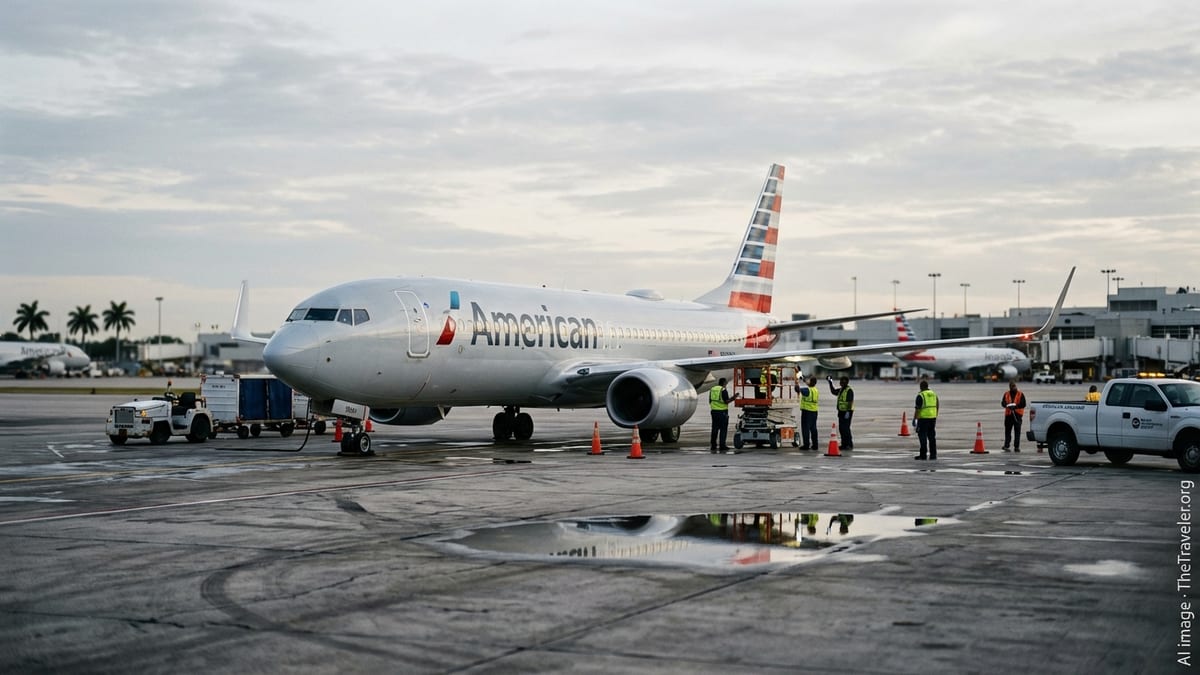
Post-Flight Inspection in Miami Reveals Alarming Wing Damage
According to statements from American Airlines and aviation authorities, the aircraft had just completed a scheduled Medellín to Miami service on Monday when maintenance personnel conducting a routine post-flight inspection spotted puncture marks in the right aileron, a vital control surface that manages the jet’s roll and lateral stability. The flight reportedly operated without any abnormal indications in the cockpit, and passengers disembarked normally before the damage was detected on the ramp.
Images and internal reports reviewed by multiple news organizations describe a small circular entry hole and deformation at a likely exit point, features that investigators say are consistent with a projectile impact. Colombian media and transportation officials have separately confirmed that the jet, operating as American Airlines flight AA923 on the Miami–Medellín leg, had previously been flagged for what appeared to be a similar perforation discovered during ground checks at José María Córdova International Airport.
The aircraft, a Boeing 737 MAX 8 configured to carry around 160 passengers, was immediately pulled from commercial service. Technicians in Miami carried out temporary repairs to stabilize the control surface before the jet was ferried without passengers to American’s primary maintenance base in Dallas–Fort Worth for detailed structural inspections and non-destructive testing.
Neither American Airlines nor investigators have publicly confirmed the precise number of impacts, and officials stress that it remains too early to say exactly when and where the projectile or projectiles struck the airframe. Nonetheless, the incident has triggered parallel inquiries on both sides of the border, focusing on possible small-arms fire in the vicinity of flight paths or airport perimeters.
Colombian and U.S. Authorities Launch Cross-Border Investigations
Colombia’s civil aviation authority, Aerocivil, has opened a formal investigation into the incident, coordinating with airport security at José María Córdova and local law enforcement in the surrounding Antioquia region. Officials are reviewing radar tracks, flight data, airport surveillance video, and any recent reports of gunfire or criminal activity near approach and departure corridors that serve Medellín’s primary international gateway.
In public comments, Aerocivil has emphasized that the aircraft’s crew reported no in-flight anomalies and that there were no injuries to passengers or crew. Early assessments from Colombian regulators have described the physical damage as limited and not immediately flight critical, though experts note that any penetration of a control surface by a bullet represents a serious hazard that could, under different circumstances, degrade handling or cause cascading structural failures.
In the United States, federal aviation and security agencies are liaising with their Colombian counterparts while overseeing the technical teardown of the affected aileron and adjacent structures. Investigators are expected to test metallic fragments and scrape marks to confirm whether a firearm was involved and, if so, what type of weapon and ammunition may have been used. They are also analyzing the aircraft’s recent routing history between Miami, Medellín, and Dallas to narrow the window during which the strike could have occurred.
The case echoes previous episodes in which U.S. airliners were exposed to gunfire in high-risk environments, including several aircraft hit during takeoff or landing in Port-au-Prince in 2024 amid escalating gang violence. While security experts caution against drawing direct parallels, they concede that even a single suspected bullet strike on a routine commercial route between two major tourism markets is likely to sharpen scrutiny of risk assessments for Latin American operations.
Colombia–USA Travel Corridor Faces New Security Scrutiny
The Medellín–Miami axis is one of the busiest passenger corridors between Colombia and the United States, heavily used by leisure travelers, medical tourists, business executives, and members of the Colombian diaspora. American Airlines is a key player on the route, competing alongside low-cost and regional carriers that collectively funnel visitors into South Florida’s hotels, cruise terminals, and convention venues.
Security around Latin American airports has already been under review after a series of high-profile incidents involving firearms, gang activity, and cargo crime in recent years. The apparent projectile damage to the American Airlines 737 MAX 8 is expected to accelerate those efforts, prompting reassessments of how close informal settlements, roadways, or unsecured areas may sit to climb-out paths or final approach tracks.
Industry analysts say U.S. travelers are unlikely to abandon Medellín, which in the last decade has transformed into a digital nomad hub and short-break destination. However, they warn that even perceived security risks can affect booking patterns, particularly among first-time visitors or corporate travel managers who must vet destinations for duty-of-care obligations. Any hint of instability along major air corridors can quickly ripple into tour operators, destination management companies, and, ultimately, hotel occupancies.
For Colombian authorities seeking to position the country as a safe, sophisticated tourism and meetings destination, the investigation’s outcome will be critical. Demonstrating that airport environs and flight paths are secure, and that any security gaps are being aggressively closed, will be central to maintaining confidence among airlines and their most valuable North American customers.
Reverberations for Marriott, Hilton and Hyatt in Key Gateway Cities
Major hotel groups such as Marriott, Hilton and Hyatt derive significant revenue from the very travel flows now under the microscope. Miami serves as both a gateway and a destination, anchoring a network of beach resorts, convention hotels, and airport properties that depend heavily on predictable air connectivity with Latin America. On the Colombian side, international-brand hotels in Medellín, Bogotá and Cartagena have capitalized on growing U.S. arrivals and rising demand for branded lodging.
While one suspected bullet-strike incident is unlikely to reshape long-term strategy, revenue managers and regional executives will be watching booking data closely in the coming weeks. If corporate travel departments temporarily tighten risk guidelines on Colombia routes, or if tour operators shift capacity to alternative destinations in the Caribbean and Central America, upscale and business-focused hotels could see short-term softness in occupancy and average daily rate.
Hospitality analysts note that global hotel chains have already been navigating a more fragile demand environment, especially for international trips where higher airfares and geopolitical uncertainty weigh on discretionary travel. A highly publicized safety scare tied specifically to a core U.S.–Latin America route may add another layer of hesitation for some travelers, even if investigators ultimately determine the risk to be isolated or low.
At the same time, the world’s largest hotel brands are experienced at managing localized shocks, from natural disasters to political unrest. Industry veterans expect Marriott, Hilton and Hyatt to work closely with tourism boards and airline partners to reassure guests, highlight enhanced security protocols, and, if necessary, offer flexible booking policies to keep demand flowing through key hubs like Miami and Medellín.
Airlines and Hotels Move to Reassure Nervous Travelers
American Airlines has reiterated that the flight involved in the Medellín–Miami incident operated normally and that passenger safety was never compromised, underscoring its decision to ground the aircraft and cooperate fully with investigators. The carrier is expected to review security procedures at Colombian stations, including perimeter patrols and coordination with local authorities on potential small-arms threats near flight paths.
Hotel companies are also likely to lean on established crisis communication playbooks. Executives typically emphasize that global brands apply standardized security protocols, conduct regular risk assessments, and maintain close ties with local law enforcement and airport operators. For properties in South Florida and throughout Colombia that rely on two-way travel between the countries, clear messaging that aviation partners and authorities are acting decisively can help temper concerns among guests.
Travel advisors and corporate travel managers say they are already fielding questions from clients about what the incident means for upcoming trips. Most are recommending a measured response: monitor official updates, maintain existing bookings, and consider simple precautions such as registering itineraries and maintaining contact details with employers or family members. For now, airlines, hotels, and tourism boards on both sides of the Colombia–USA corridor appear unified in their message that commercial flights remain safe and that the Medellín–Miami episode, while serious, is being treated as an urgent but manageable security challenge.