

More news on this day
American Airlines pilots have intensified their criticism of the carrier’s leadership, accusing management of strategic and operational failures and signaling that the company’s board of directors could face growing pressure if performance and labor relations do not improve.
Get the latest news straight to your inbox!
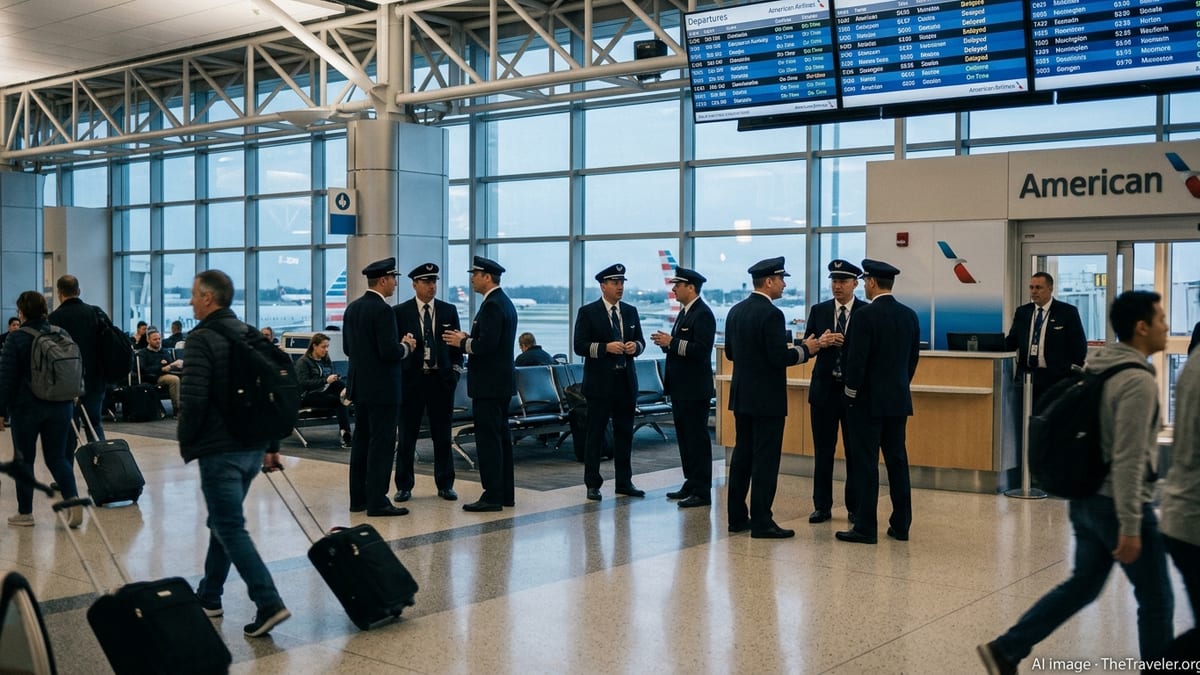
Pilots’ Union Steps Up Public Campaign Against Leadership
The Allied Pilots Association, which represents roughly 16,000 American Airlines pilots, has sharpened its message in recent weeks, using internal communications and public statements to lay out what it describes as a pattern of mismanagement at the largest U.S. carrier by passenger volume. According to published coverage summarizing a recent union presentation, pilots highlighted weak financial results, network retrenchment and strained labor relations as evidence that the current leadership team has failed to deliver on the promise of the airline’s scale.
In a detailed president’s report distributed to members in early February, union leaders contrasted American’s performance with that of key rivals. Publicly available information shows that pilots have been pointing to higher profits and more ambitious growth strategies at competing carriers as an implicit indictment of American’s direction. The message portrays American as lagging behind its peers in profitability and investment while still demanding increasingly intensive flying from crews.
Reports indicate that the relationship between the union and senior executives deteriorated further after the pilots sought a chance to speak directly to American’s board. Instead of a board-level discussion, the airline sent Chief Executive Robert Isom to meet with union representatives, a move pilots saw as a rebuff of their concerns. Commentators following the dispute note that the episode has become a flashpoint in a broader struggle over who sets the long-term vision for the airline.
Union messaging has also emphasized American’s role as a cornerstone of the U.S. air travel system, framing the dispute as more than an internal labor fight. By stressing the potential impact on reliability, competitiveness and the broader network, pilots are attempting to draw attention from investors, corporate customers and frequent flyers to what they see as systemic issues in the company’s strategy.
Board of Directors Drawn Into the Crossfire
While the immediate conflict centers on pay, quality of life and operational decisions, the latest union communications include pointed references to the airline’s board. In the president’s report, pilots link strategic missteps not only to management but also to the board’s oversight role, suggesting that governance has enabled a focus on short-term cost control at the expense of long-term competitiveness.
According to commentary circulating among pilots and aviation analysts, the union’s bid to address the board directly was widely interpreted as a test of the directors’ willingness to confront leadership about lagging results and strained employee relations. When that request did not produce the meeting pilots expected, the tone of subsequent union updates grew more combative, with language that some observers view as a subtle warning that the board itself could become a target of future campaigns.
Published coverage of the dispute notes that pilot leaders have been careful to stay within the bounds of U.S. labor law, avoiding any suggestion of illegal concerted actions, but have nonetheless underscored the leverage they hold in a tight labor market. The implication for the board is that ongoing friction with pilots could complicate efforts to execute the airline’s growth and fleet plans, especially on long-haul international routes that depend on highly experienced crews.
Governance specialists point out that while unions do not directly control board seats at major U.S. carriers, sustained criticism from a key labor group can influence investor sentiment and public perception. In that sense, the latest statements from American’s pilots function as a signal that, unless there is a course correction, the board may face tougher questions about its stewardship of the airline.
Strategic Disputes Over Network, Distribution and Growth
Beneath the sharp rhetoric is a substantive disagreement over how American positions itself in a changing airline marketplace. Reports from industry briefings and union materials indicate that pilots are frustrated with what they see as a retreat from key domestic and international markets, leaving the carrier increasingly concentrated in a handful of hub and leisure-focused routes. They argue that this reduces connectivity for business travelers and weakens the airline’s long-term network relevance.
At the same time, American has been at the forefront of major changes in ticket distribution, including the push toward new digital retailing standards. Executives have framed these moves as essential modernization, but many travel agencies and some corporate customers have complained about complexity and reduced access to fares. Pilots have picked up on that criticism, contending in their communications that management’s focus on distribution experiments has not translated into stronger revenue performance.
Union leaders also question whether American is investing aggressively enough in product and operational resilience compared with its rivals. According to aviation trade reporting, other large carriers have announced multi-year spending programs aimed at upgrading cabins, lounges and technology while also building more slack into their operations to handle weather and air traffic disruptions. Pilots at American argue that the company’s comparatively lean approach has left frontline crews to manage irregular operations with limited resources, eroding passenger confidence and employee morale.
These strategic disputes have direct implications for travelers. Frequent flyers have voiced concerns in public forums about reduced route options, inconsistent onboard experiences and extended delays, particularly during peak disruption periods. The pilots’ campaign amplifies those frustrations, positioning their demands for a different strategic path as aligned with the interests of customers who want a more reliable and expansive network.
Labor Discontent Spreads Beyond the Cockpit
The pilots’ criticism is unfolding alongside visible discontent among American’s other workgroups, raising the stakes for management and the board. In recent weeks, publicly available union communications show that the organization representing the airline’s flight attendants issued a vote of no confidence in the chief executive, citing financial underperformance and dissatisfaction with how the company handled a major winter storm and its aftermath.
Ground staff and maintenance employees have also used public channels and internal discussions to highlight staffing pressures, scheduling challenges and what they describe as inadequate contingency planning for large-scale disruptions. While each group has distinct contract issues, the overall narrative converges on concerns about leadership priorities, preparedness and respect for frontline expertise.
Analysts following the sector note that American is not alone in facing labor tensions, as airlines across the United States negotiate new contracts in an environment of elevated demand and higher costs. However, the combination of multiple restive unions, lagging financial results compared with peers and a high-profile governance dispute gives American’s situation particular urgency. The pilots’ renewed focus on the board amplifies the message that resolving these conflicts will require more than incremental operational fixes.
For travelers, the risk is that unresolved labor issues could translate into more frequent schedule disruptions or slower recovery from storms and infrastructure failures. While no major work stoppages are on the horizon and unions remain bound by contract provisions and federal law, the tone of current communications suggests a willingness by pilot leaders and other unions to keep pressure on management and the board in the months ahead.
Implications for American’s Competitive Position
The confrontation between American’s pilots and its leadership lands at a delicate moment for the airline industry. Competitors are pressing ahead with fleet renewal, cabin upgrades and technology investments, seeking to capture premium demand and corporate travel as global markets stabilize. Against that backdrop, the perception that American is distracted by internal conflict could make it harder to win high-value customers and incremental partnerships.
Market watchers point out that investors and corporate travel buyers monitor labor relations closely as a leading indicator of operational risk. Repeated public statements from American’s pilots about management missteps and board inaction may feed concerns about the carrier’s ability to execute multi-year plans without further disruption. If those concerns deepen, American could face pressure to offer more aggressive pricing or incentives to retain key accounts, squeezing margins in an already competitive environment.
At the same time, some analysts see an opportunity if the board takes the pilots’ warning signs as a catalyst for change. Moves to strengthen governance, refine network strategy and invest more visibly in frontline support could help rebuild trust with employees and customers. Such steps would likely take time to translate into measurable improvements, but they could begin to shift the narrative away from confrontation and toward renewal.
For now, the pilots’ escalation underscores that the conflict is no longer confined to the cockpit. By calling out management’s record and hinting that the board itself may come under sustained scrutiny, the union has made clear that it intends to play a central role in shaping the future of one of the world’s largest airlines, with consequences that will be closely watched across the travel industry.