

More news on this day
American Airlines is deepening its push into digital self-service with a new wave of baggage tools that shift more of the check-in and bag-drop process from crowded airport counters to travelers’ own phones and laptops, promising shorter lines and more control over every suitcase’s journey.
A Major Digital Push Around Checked Baggage
American Airlines has expanded its digital self-service capabilities for checked bags, introducing a suite of features that let customers handle more of the baggage process long before they reach the terminal. The latest update centers on making it easier to pay for, change and tag luggage through the airline’s website and mobile app, reinforcing a broader strategy to modernize the airport experience.
At the heart of the rollout is a redesigned baggage flow that allows customers to add and pay for up to three checked bags at the time of booking rather than waiting until check-in. That move, combined with new automation around changes and refunds, is aimed at cutting the number of travelers who need in-person help at ticket counters and kiosks on busy travel days.
American’s leadership has framed the changes as part of a long-term shift toward self-service, powered by data and artificial intelligence. Executives say the airline is overhauling its digital channels to meet customers where they already spend much of their time, on mobile devices, while building in smarter back-end systems that can keep bags and passengers moving more reliably.
Prepay, Change and Refund Bags Without Visiting a Counter
The most visible change for many travelers is the flexibility around prepaying for checked luggage. Customers can now add and pay for up to three checked bags when they purchase their ticket on American’s website or in the mobile app, eliminating a step that historically had to wait until check-in opened. The goal is to spread out demand on the airline’s systems and reduce pressure on day-of-travel airport staff.
Travelers who prepay online also gain new freedom to adjust their plans without calling an agent. Same-day confirmed changes that would previously have required a phone call or counter visit can now be handled digitally, with prepaid bag selections following the updated itinerary when eligible. By moving these transactions into self-service, American is promising a more consistent and transparent experience while trimming the time travelers spend in queues.
Another significant upgrade is automatic refunds on prepaid baggage when plans change. If a customer cancels a trip, modifies their itinerary or purchases an instant upgrade that alters their baggage allowance, the system can automatically process a refund for eligible prepaid bags. Depending on the fare and payment method, that refund may return to the original form of payment or be issued as a travel credit, without the traveler needing to file a separate request.
American has also opened up more options for using those credits. Customers can now redeem travel credits to buy standalone baggage online, a change that gives frequent flyers and irregular travelers alike more flexibility in how they apply unused value on their accounts. Over time, the airline says this approach will support an expanded set of ancillary purchases, but baggage is the first major test case.
Express Bag Tags Aim to Cut Time at the Airport
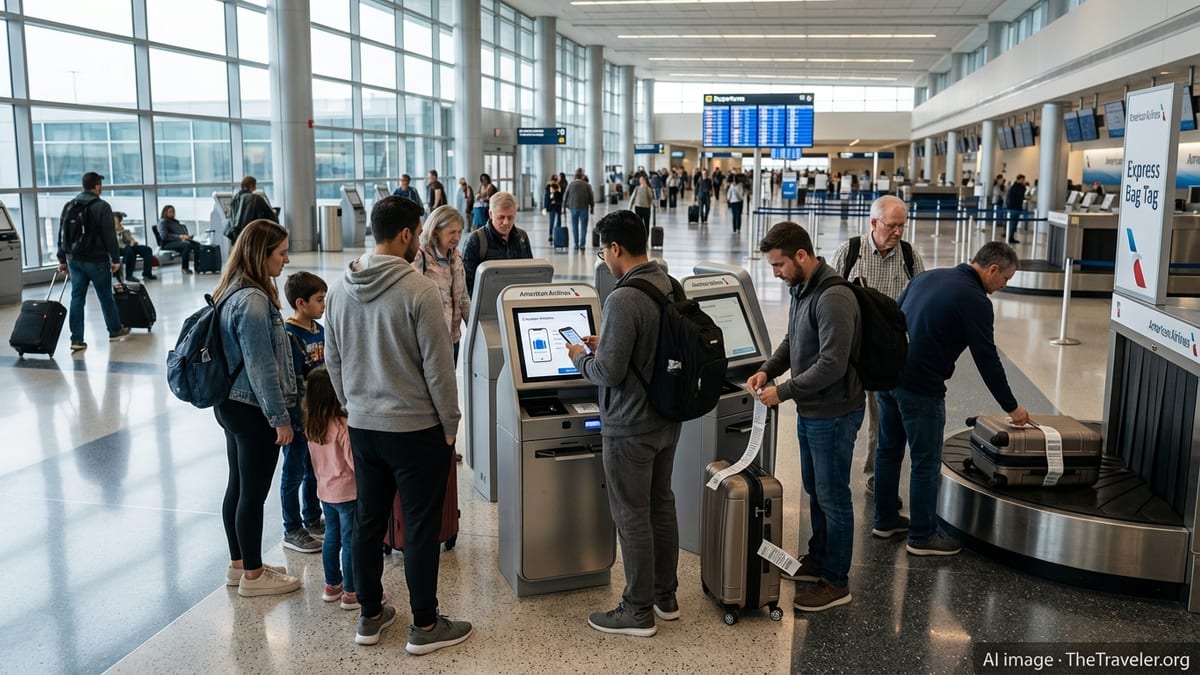
Alongside the new digital payment and refund tools, American is rolling out what it calls Express Bag Tags, designed to speed up the physical handoff of luggage at the airport. Travelers who have prepaid for checked bags can bypass traditional counter lines and head straight to designated self-service stations, where they scan their boarding pass and print bag tags without waiting for an agent.
In the past year, American has installed around 100 new bag kiosks at a growing list of airports to support this model. The kiosks are intended to be intuitive enough for infrequent travelers while still handling the volume of large hubs, creating more capacity during peak travel periods. After tagging their luggage, customers simply drop bags at a staffed or dedicated belt area, reducing the interaction to a brief handover and visual verification.
The airline sees these Express Bag Tag stations as a cornerstone of its digital-first airport concept. Rather than standing in line to accomplish basic tasks, passengers are encouraged to complete as many steps as possible before leaving home, then use kiosks primarily for printing tags. This approach mirrors how self-service check-in has already reshaped boarding pass issuance across the industry and is now extending to baggage.
For premium cabin passengers, the experience is also becoming more streamlined. Many travelers in those cabins can now add their checked bags in advance via the website or app, aligning benefits and allowances with the rest of their digital journey and further reducing friction once at the terminal.
Redesigned Mobile App Puts Bags at the Center of the Journey
The baggage upgrades are arriving in parallel with a broader redesign of American’s mobile app, which the airline began rolling out in recent weeks. The updated app features a more personalized home screen that highlights upcoming trips and AAdvantage status at a glance, along with simplified navigation that aims to feel familiar to users of other everyday apps.
Baggage functions sit squarely within this new experience. Customers can continue to check in, add bags, select seats and access mobile boarding passes, but the refreshed interface is designed to surface these tools more intuitively at each stage of the journey. The app delivers contextually relevant information based on where a traveler is in their trip, from pre-departure reminders to day-of-travel alerts and post-arrival updates.
For iPhone users, Live Activities support means key travel information such as boarding times, gate changes and baggage status can appear on the lock screen in real time. Android users are gaining similar push-based alerts through an updated app experience, removing the need to constantly open and refresh the app to see whether a bag has been checked in, loaded or delivered.
Airport maps, turn-by-turn wayfinding and estimated security wait times in select hubs add another layer of support, helping travelers navigate from curb to gate and baggage claim. Taken together, the enhancements are designed to make the app a single hub for everything from booking to bag pickup, with far less reliance on printed documents or in-person updates.
Smarter Baggage Handling with AI and Automated Tags
Behind the scenes, American is increasingly using artificial intelligence and automation to manage the complex flow of bags through its network. The airline already relies on machine learning models to predict operational factors such as flight times and staffing needs, and is developing baggage-specific tools to better anticipate volumes and reduce mishandling.
One high-visibility example of this strategy is the rollout of automated tags for mobility devices such as wheelchairs. These tags, developed in-house, carry detailed information about each device and its journey, including the customer’s itinerary, delivery points, device weight, battery type and any parts removed for transport. By capturing this data digitally and sharing it across frontline applications, American aims to give staff faster, more accurate information every time a mobility device is handled.
The airline says these efforts have already contributed to measurable improvements in how mobility devices are managed, citing a significant reduction in mishandling over the past year. Investments in specialized equipment, such as wheelchair movers and lifts at busy airports, are paired with hands-on training for ground staff to further reduce the chances of damage during loading and unloading.
These technology-led changes are part of a wider focus on making baggage handling more predictable and transparent. Detailed tagging and tracking do not just benefit customers with mobility devices; the same principles are increasingly being applied to standard luggage, laying the groundwork for more precise status updates in the app and proactive notifications when something goes wrong.
Apple AirTag Integration Extends Tracking Power
For travelers who place Apple AirTags inside their luggage, American’s network now taps into a new layer of digital visibility. The airline is participating in Apple’s enhanced Find My feature that allows customers to securely share the location of an AirTag-equipped bag with airline staff when a suitcase goes missing or is delayed.
Using devices running the latest Apple software, passengers can generate a temporary “Share Item Location” link from the Find My app and provide it to American during a baggage claim. That link gives authorized airline agents access to a live map view of the bag’s last known location, updating automatically as new data comes in from Apple’s device network until the customer is reunited with their property or the link expires.
American joins a growing list of carriers that recognize traveler demand for real-time luggage insight, especially during irregular operations. While traditional baggage systems rely on barcode scans at a series of checkpoints, AirTags supply additional, often more granular location data that can help pinpoint whether a bag was left on an aircraft, misrouted to another carousel or still waiting in a backroom at the origin airport.
The integration does not replace the airline’s own tracking tools, but it complements them by giving agents and travelers a common, real-time reference point. For customers, the ability to share AirTag location data formalizes a practice many had already adopted on their own and folds it into official customer service workflows.
Where and When Travelers Will See the Changes
Many of the new digital baggage features are already visible to customers booking trips today, particularly on American’s website and in the latest version of the mobile app. The ability to prepay for multiple checked bags at booking, make same-day changes without calling an agent and receive automatic refunds for eligible prepaid baggage is rolling out across the network.
Express Bag Tag kiosks have been installed at 16 airports so far, with roughly 100 new machines deployed to date. Travelers at those locations will notice new signage directing them to bag tag stations and dedicated areas for dropping off tagged luggage. As the airline analyzes usage and performance, it is expected to expand the footprint of self-service baggage hardware to additional hubs and high-traffic stations.
Integration with Apple’s AirTag sharing feature is available on flights to and from U.S. airports, giving both domestic and international travelers another tool for locating missing bags. Meanwhile, AI-driven baggage forecasting and automated tagging of mobility devices continue to roll out behind the scenes, improving reliability even for customers who never interact directly with those systems.
For passengers, the most immediate impact will be felt in shorter lines, simpler online flows and more precise information about their checked luggage. For American, the changes represent another step in a multi-year push to digitize every major touchpoint in the travel experience, from ticket purchase through the moment a suitcase arrives on the carousel.