

More news on this day
American Airlines has sharply scaled back inflight catering from London Heathrow, temporarily flying in most food from the United States and offering reduced meal choices after a major disruption to its local catering operation triggered delays and frustration for passengers in one of the carrier’s most important international markets.
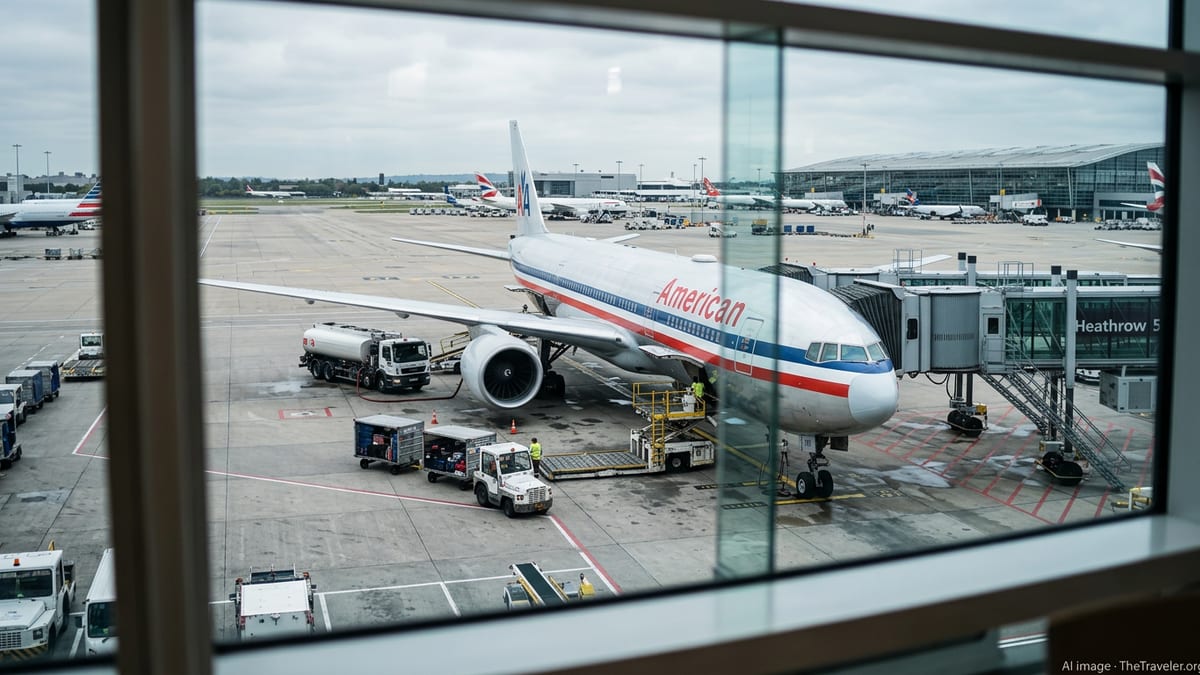
Double-Catered Flights as Heathrow Kitchens Go Quiet
According to internal communications shared with staff and reports from aviation insiders, American Airlines has temporarily stopped relying on its usual catering supply at London Heathrow. Instead, long-haul aircraft are being provisioned with additional meals and beverages in the United States before departing for London, with those supplies then used again on the return leg back to the US. The extraordinary measure is intended to prevent flights from leaving Heathrow without any food at all, but it comes at the cost of reduced variety and more constrained service on both directions of travel.
The Fort Worth based airline operates up to 19 daily flights between Heathrow and nine US cities during peak periods, including Chicago, Dallas Fort Worth, Philadelphia and other hub gateways. With Heathrow serving as American’s largest transatlantic station outside North America, even a short term collapse in local catering capacity has immediate ripple effects across its broader network and premium branding strategy.
In an internal notice described by employees, American told flight attendants that Heathrow currently has no regular catering available for the airline while it evaluates suppliers. The carrier has framed the changes as a temporary operational adjustment, but has not yet issued a detailed public statement outlining how long the disruption might last or what level of service passengers can expect on specific routes.
The unusual step of double provisioning aircraft is logistically complex. Galley space on widebody jets is typically designed for one flight’s worth of meals, beverages and service items. By loading food for two long haul segments, crews are forced to prioritize essentials and strip back much of what passengers have come to associate with full service international travel.
Premium Cabins See Bare Bones Menus
The impact is most visible at the front of the aircraft, where American has been investing heavily in new Flagship Suite cabins and upgraded inflight dining as part of a push to position itself as a more premium global carrier. In recent days, frequent flyers and travel writers departing Heathrow have reported what they describe as “bare minimum” offerings in business and first class, with some of the usual multi course experiences replaced by simplified single tray “dine and rest” service.
Seafood selections and desserts such as ice cream have been removed from outbound Heathrow menus for now, leaving passengers to choose between a single protein based main or a vegetarian alternative. Pre ordered special meals are not consistently available, and in some cases crews have been unable to confirm specific requests until well into the flight. On overnight transatlantic sectors, where many travelers rely on an early, efficient meal service before sleeping, the pared back choices have come as an unwelcome surprise to customers who paid a premium for the experience.
Cabin crew accounts shared on social media describe long delays on the ground at Heathrow while teams waited for whatever catering could be assembled or loaded. One flight attendant recounted an extended departure delay attributed to the “transport of catering,” adding that crew members were at the airport during the hold but not yet on the clock for pay purposes. Passengers, meanwhile, have voiced frustration over the lack of clear advance communication, saying many only learned of the disruptions at the gate or by email after they had already boarded or were en route.
Despite those complaints, American has emphasized internally that safety and regulatory requirements remain fully in place and that potable water and basic provisions are stocked. The airline has encouraged crews to proactively explain the situation, manage expectations and offer service recovery gestures where possible for affected premium cabin customers.
Vendor Transition and Labor Tensions Behind the Scenes
While American has not publicly detailed the root causes of the Heathrow catering disruption, industry sources and internal briefings point to a difficult handover between catering contractors at the airport. The airline has been preparing to switch local providers, a process that typically involves months of coordination on food production standards, logistics, safety checks and unionized staffing. Reports suggest that the outgoing supplier and incoming teams have struggled to maintain continuity, leaving gaps in production at exactly the time American planned to elevate its onboard product.
Commentary from aviation observers also points to labor tensions behind the scenes. Internal messages referenced by airline insiders describe “preparations for a possible work action” involving catering staff, alongside the anticipated vendor change. Any concerted slowdown or dispute among ground catering workers can quickly translate into missing carts, incomplete meal loads or late deliveries, all of which are felt acutely at a hub where tight departure banks are built around peak transatlantic waves.
Such vulnerabilities are not unique to American, but they are particularly sensitive at Heathrow, where airfield congestion, slot restrictions and strict nighttime curfews leave little margin for extended delays. A single late arriving catering truck can jeopardize an aircraft’s departure time, forcing managers to decide between leaving late with a full service or departing on time with reduced or no meal offerings on board.
In recent years, the broader airline industry has struggled with catering transitions in several major markets, revealing how dependent carriers remain on complex third party supply chains. Heathrow, with its mixture of legacy infrastructure and intense operational pressure, is proving to be a difficult arena for any misstep in that chain.
Passenger Experience and Compensation Efforts
For travelers, the immediate question is what to expect on upcoming flights to and from London. Messages sent to some affected passengers in the United States have advised them to take advantage of airport dining options prior to boarding, warning that onboard menus may be limited. On overnight services, where many travelers count on a full meal after takeoff, some frequent flyers have responded by arriving earlier to use airport lounges or nearby restaurants, while others report packing their own snacks and light meals just in case.
On customer channels and online forums, some passengers in premium cabins have reported modest proactive compensation for disrupted catering, including mileage credits issued after arrival. Others say they received apologies from crews but no formal offer from the airline, underscoring what they describe as uneven handling of the issue across flights and routes. Several business class customers departing Heathrow in recent days have criticized what they view as a lack of upfront transparency, noting that they only learned about curtailed service once they were already committed to their travel plans.
Travel advisors and industry commentators are now recommending that passengers with near term bookings on American’s Heathrow routes assume that inflight food and beverage will be scaled back, particularly in economy cabins where catering is more limited even under normal conditions. Those with specific dietary needs are being urged to bring suitable options from the terminal, given the uncertainty around special meal loading and substitution.
While the disruption is centered on Heathrow, the decision to double cater in the United States means knock on effects for kitchens in American’s domestic hubs as they adjust production levels, storage and staffing for the added volume. Ground teams are working to balance those demands with regular operations on other long haul routes that are not affected by the London issue.
Reputational Stakes at a Critical Global Hub
The turmoil comes at a delicate moment for American Airlines leadership. In recent months, executives have outlined plans to “reclaim” the airline’s standing as a leading premium global carrier, highlighting investments in new aircraft cabins, upgraded lounges and enhanced onboard dining as key pillars of that strategy. Heathrow, linking American’s US hubs with one of the world’s most competitive premium travel markets, is central to that ambition.
Service disruptions visible to the airline’s most valuable customers risk undercutting that message, especially when rival carriers and joint venture partners at Heathrow continue to market expansive menus and elevated hospitality in their own premium cabins. Analysts note that while temporary operational problems are an unavoidable part of airline operations, the way they are communicated and resolved often shapes long term perceptions among corporate clients and high value frequent flyers.
American’s joint business partners on transatlantic routes, including British and Iberian carriers, could also feel indirect effects if shared customers begin to question which airline will deliver the most reliable experience on a given itinerary. Even when tickets are sold under a single alliance umbrella, passengers frequently compare notes about cabin quality, catering and service consistency when choosing how to route their travel.
For now, the carrier is focused on stabilizing its Heathrow catering operation and restoring a more typical level of choice and presentation on board. Once local kitchens are reliably supplying flights again, attention is likely to turn to how American rebuilds trust with passengers who experienced reduced service, and how it ensures that any future vendor transitions at critical hubs do not lead to the same visible strain on its inflight product.