

More news on this day
American Airlines is under intense fire from its own cabin crew after what their union describes as a basic, contractual obligation was violated during January’s Winter Storm Fern.
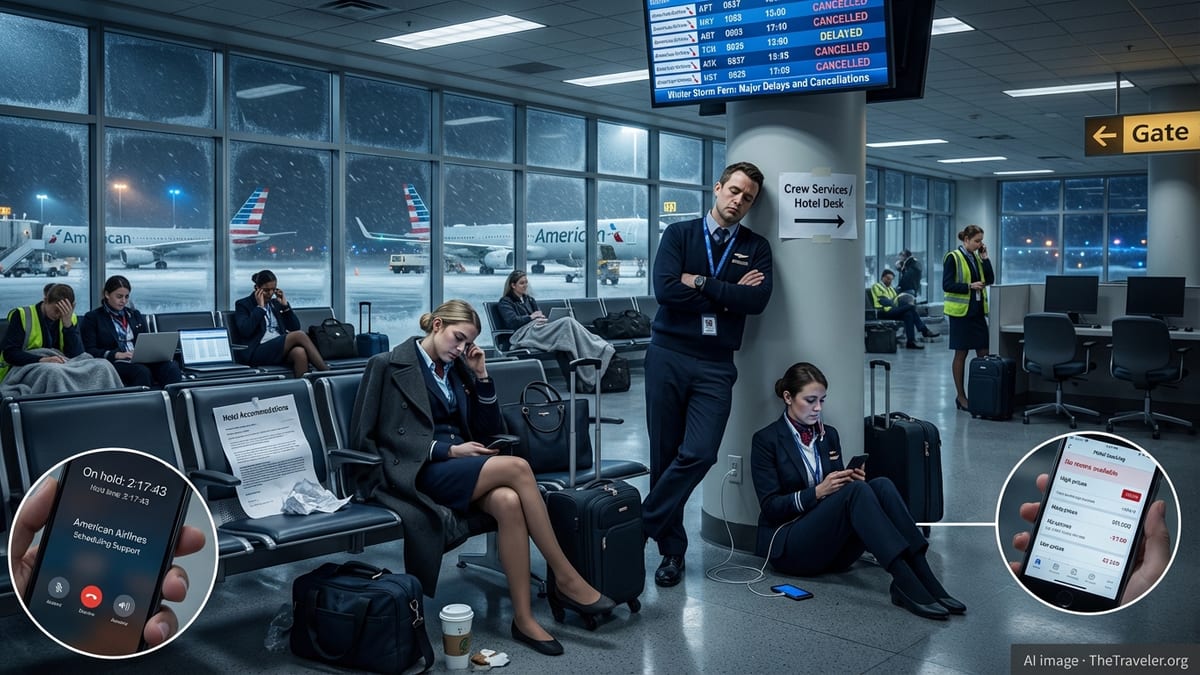
Thousands of flight attendants say they were left scrambling for hotel rooms, stuck on hold for hours and in some cases paying out of pocket for last‑minute accommodation, all while working marathon days in one of the most challenging weather disruptions of the season.
For a work group whose rest rules are directly tied to safety, many see the incident as a clear breach of trust at a highly sensitive moment in labor relations.
More News
- TSA Rolls Out $45 ConfirmID Fee for Travelers Without REAL ID at Security
- Flying Blue Launches February 25% Promo Rewards on Transatlantic and Regional Routes
- United Fast-Tracks Starlink Wi‑Fi Across Fleet, Free for MileagePlus Members
The Basic Rule American Is Accused of Breaking
At the center of the dispute is one of the most fundamental promises airlines make to flight crews: when they are away from base, they will have a hotel room and transportation to reach it. For flight attendants on multi‑day schedules or who misconnect because of weather or operational chaos, this is more than a courtesy. It is written into their collective bargaining agreement, down to the circumstances that trigger a required hotel stay and the quality standards for those layover properties.
During Winter Storm Fern, that system appears to have buckled. According to the Association of Professional Flight Attendants, the union representing roughly 28,000 American Airlines flight attendants, thousands of crew members found themselves stranded in airport terminals or city centers without company‑provided hotel rooms. Many reported fully booked properties, jammed internal phone lines and a lack of clear direction on where they were supposed to sleep between duty periods that can already stretch to regulatory limits.
The union says that, in effect, American failed to uphold a key section of its contract that specifically requires the company to provide hotel accommodations when crew members are displaced or forced into unexpected overnights. That language exists precisely for moments like major weather events, when large numbers of crews are thrown out of their assigned sequences and normal hotel blocking comes under stress.
Stranded Crews, Long Holds and Out‑of‑Pocket Costs
First‑hand accounts shared on social media and in union communications portray a chaotic scene during and after the storm. Flight attendants report holding times of hours with internal scheduling and hotel support lines as they tried to secure rooms, only to be told that properties were sold out or that they would need to arrange their own accommodations and seek reimbursement later.
That instruction is especially galling to many crew members who are already vocal about low starting pay and widespread financial precarity. New hires at major U.S. carriers typically earn modest base salaries and are only paid for time in the air, not for boarding, delays on the ground or commutes to and from the airport. For flight attendants who say they are sleeping in their cars between trips or jockeying for flights just to access onboard meals, the idea of fronting hundreds of dollars for emergency hotel rooms, then waiting weeks or months for reimbursement, has landed as a deep insult.
American Airlines has since begun the process of compensating those who were forced to secure their own lodging, a move the union points to as evidence that the company recognizes it fell short of its contractual obligations. While that reimbursement offers some financial relief, it does little to erase memories of exhausted crews wandering unfamiliar airports late at night, phones pressed to their ears as they waited for someone on the other end to pick up.
Union Outrage and a Rallying Cry for Change
For the Association of Professional Flight Attendants, the storm fiasco has become a powerful symbol of what it describes as chronic underinvestment in both workers and the customer experience. In messages to members, the union said crews were “bearing the brunt” of American’s inability to recover its operation and accused management of failing at the airline’s “most basic obligation” to provide safe, reliable accommodations.
The anger is amplified by the broader context of strained labor relations. In recent months, the union has publicly criticized American’s leadership for lagging financial results compared with competitors and for the carrier’s poor performance in customer satisfaction rankings. Union leaders have called for a “new vision” at the airline, arguing that while rivals pour money into cabins, lounges and technology, American’s frontline employees are left apologizing to passengers for aging interiors and service cutbacks.
The hotel debacle slots neatly into that narrative. To many flight attendants, it demonstrates that when the operation is pushed to its limits, they are the ones left without a safety net. It also hands union negotiators a tangible example of what they cast as management’s failure to plan properly for predictable disruptions, reinforcing their argument that staffing, contingency planning and support systems have been stretched too thin.
Safety, Fatigue and the Stakes for Travelers
Beyond contractual grievances and internal politics, the dispute raises uncomfortable questions about safety and reliability that matter to anyone booking a ticket. Rest requirements for pilots and flight attendants are built into federal regulations and reinforced in union contracts for a reason: tired crews are more likely to make mistakes, and fatigue has been identified as a contributing factor in past aviation incidents.
Hotel standards in those contracts are not about luxury; they specify basic protections like quiet rooms away from elevators and ice machines, adequate transportation to and from the property, and minimum rest periods between duty days. When a large‑scale disruption leaves crews scrambling to find last‑minute accommodation, those safeguards can erode. Even when flight attendants ultimately find a bed, the hours lost to navigating jammed phone systems, searching for vacancies and commuting long distances can eat into already tight rest windows.
For travelers, that reality is mostly invisible. Passengers boarding a 6 a.m. departure may have little sense of whether the crew serving them has just completed a normal overnight at a contract hotel or finally crawled into a backup room after midnight following a multi‑hour ordeal. Flight attendants insist that they remain professional and focused, but they argue that a system that allows the most basic support functions to fail places unnecessary strain on both employees and the safety net that protects the flying public.
American’s Response and a Fragile Relationship
American Airlines has acknowledged the severity of Winter Storm Fern’s impact, noting in a letter to customers that five of its nine hubs, including its massive Dallas Fort Worth operation, were hit hard by record‑setting conditions. The carrier pointed out that the storm disrupted cities not accustomed to significant winter weather, compounding staffing challenges for the airline, its vendors and airport partners.
However, while American has moved to reimburse out‑of‑pocket hotel costs and has publicly thanked employees for their efforts during the storm, it has not fully addressed union claims that it failed to uphold specific contract provisions. Nor has it offered a detailed public explanation of what went wrong inside its crew hotel and tracking systems, leaving questions about whether this was a one‑off failure or a sign of deeper structural issues.
The timing could hardly be more delicate. After years of negotiations and near‑strike scenarios, American’s flight attendants only recently secured a new contract that includes notable improvements in pay and quality‑of‑life provisions. The ink is barely dry on that deal, and both sides have an interest in projecting stability. Yet the hotel fallout risks reopening wounds and reinforcing skepticism among rank‑and‑file crew members who feel that promises made in boardrooms often break down on the front lines.
Service Restorations That Flight Attendants Call “Untenable”
The uproar over hotel accommodations is not occurring in a vacuum. Around the same time, American announced the restoration of a second beverage service on many long‑haul domestic flights and certain international routes, pitching the move as an enhancement for customers. While frequent flyers may welcome the return of an amenity that was scaled back during the pandemic and cost‑cutting waves, many flight attendants say the decision crossed another unwritten line.
In internal communications that later surfaced publicly, the union blasted the additional drink service as “untenable” given current staffing levels and catering practices. Leaders said aircraft are not stocked with enough beverages to support both the restored service and existing demands, and they argue that no additional flight attendants are being assigned to handle the extra workload within tight flight time limits.
For crews who feel burned by the storm and the scramble for hotels, the beverage decision looks like another example of management “demanding more work from fewer flight attendants,” as one union message put it. They contend that the airline is dressing up the move as a customer‑experience improvement without addressing what they see as the real issues: lean staffing, rushed service flows and an onboard product that has, in their view, fallen behind competitors in both economy and premium cabins.
A Window Into a Changing Industry
The turmoil at American offers a revealing snapshot of wider tensions across the airline industry. In North America, flight attendants have become increasingly vocal about being paid only for time in the air, despite spending long hours boarding planes, helping passengers during delays on the ground and navigating crowded airports between flights. As inflation and housing costs have climbed, those unpaid hours have become a flashpoint in contract talks and public opinion campaigns.
Major disruptions, from winter storms to air traffic control meltdowns, expose the fragility of systems designed to run close to capacity. Airlines, under pressure from investors to maximize profits, operate lean schedules with limited spare crews and aircraft. When those finely tuned plans are knocked off balance, the consequences fall heavily on the people who keep the operation moving: pilots, flight attendants, mechanics and ground staff who may suddenly find themselves working marathon days with little margin for error.
In that context, a “basic rule” like guaranteeing a hotel room is more than a line in a contract. It is a test of whether an airline has built real resilience into its operation and a measure of how it values the people who represent its brand at 35,000 feet. American’s flight attendants are making clear that, in their view, the carrier failed that test during Winter Storm Fern, and they are signaling that they will use every future negotiation, media opportunity and regulatory channel to prevent a repeat.
What This Means for Travelers Right Now
For passengers, the immediate impact of the dispute may be subtle. Flights are operating, and the vast majority of customers will never directly encounter the behind‑the‑scenes battles over hotel guarantees, beverage carts or internal phone queues. Those who flew during the storm, however, may have noticed longer delays, more last‑minute crew changes or unusually tired‑looking flight attendants doing their best to keep things calm and orderly on board.
In the medium term, persistent friction between management and crew can shape everything from on‑time performance to in‑flight service. An airline locked in a standoff with its flight attendants may struggle to roll out new products smoothly, and it risks reputational damage when internal conflicts spill into public view. Travelers choosing between carriers, especially on competitive domestic routes, are increasingly aware of labor tensions and may factor stability and service track records into their decisions.
For now, union leaders are pressing American to conduct a full review of what went wrong during Winter Storm Fern and to commit to concrete changes in crew support systems before the next major disruption. Whether the airline responds with transparency and investment, or with more incremental fixes and public‑relations messaging, will help determine whether this episode becomes a turning point in rebuilding trust or just another grievance added to an already long list.
FAQ
Q1. What basic rule do flight attendants say American Airlines broke?
Flight attendants say American violated its basic contractual obligation to provide hotel accommodations when crews are away from base or stranded by irregular operations, leaving thousands without guaranteed rooms during Winter Storm Fern.
Q2. How did Winter Storm Fern affect American Airlines crews?
The storm severely disrupted American’s hub operations, causing widespread delays and cancellations. Many flight attendants were displaced from their original schedules, found normal layover hotels fully booked and spent hours on hold with internal support lines trying to secure rooms.
Q3. Did American Airlines reimburse flight attendants who paid for their own hotels?
Yes. After the incident, American began reimbursing flight attendants who had to arrange and pay for their own hotel rooms, a step the union argues effectively acknowledges that the airline failed to meet its contractual responsibilities.
Q4. Why are flight attendants so upset if they are getting their money back?
Many flight attendants live on tight budgets and say they cannot afford large, unexpected hotel charges. They also stress that reimbursement does not repair the stress, fatigue and sense of abandonment they experienced while trying to secure rest in the middle of an already exhausting disruption.
Q5. How does this dispute relate to safety for passengers?
Rest requirements for flight attendants are directly tied to safety, as fatigue can impair judgment and performance. When hotel and transportation arrangements break down, crews risk shorter rest periods and more stressful layovers, conditions that flight attendants and safety advocates say can undermine the safety margin built into regulations.
Q6. What is the role of the Association of Professional Flight Attendants in this controversy?
The Association of Professional Flight Attendants represents American’s flight attendants and has led the criticism of the airline’s handling of Winter Storm Fern. The union has highlighted contract language on hotels, gathered reports from stranded crews and used the incident to argue for stronger support systems and better planning.
Q7. How does the restored second beverage service factor into crew frustration?
American’s decision to bring back a second beverage service on many flights has been welcomed by some travelers but criticized by flight attendants, who say no extra staffing or catering support was added. They argue this asks them to do more with the same resources, reinforcing their belief that management prioritizes optics over workable service standards.
Q8. Has American Airlines recently improved pay or working conditions for flight attendants?
American’s flight attendants recently ratified a new contract that improves pay and some quality‑of‑life provisions. However, many crew members say the Winter Storm Fern experience shows that policy on paper is not enough and that real‑world support systems must function reliably during major disruptions.
Q9. Should travelers be worried about flying American Airlines because of this dispute?
Regulators and airlines maintain strict safety oversight, and flights continue to operate normally. The dispute is more likely to affect employee morale, service consistency and how quickly the airline recovers from future disruptions than it is to create immediate safety risks for travelers.
Q10. What changes are flight attendants asking American to make after this incident?
Flight attendants want American to strengthen its crew hotel booking systems, ensure adequate room blocks and backup properties during storms, improve staffing in scheduling and tracking departments and be more transparent about how it will prevent crews from being stranded without accommodations in the future.