

More news on this day
American Airlines is quietly reshaping how it charges for core travel services, layering in new and reworked fees that executives say are meant to deliver a more predictable, "definitive" journey for passengers even as advocates warn of higher costs and added complexity.
A Fresh Wave of Revenue-Focused Changes
The latest round of changes at American Airlines revolves around what passengers pay, when they pay it, and how those payments translate into flexibility or rewards. In early 2026, the carrier completed a shift to a tiered baggage pricing model that favors travelers who commit and prepay before reaching the airport, rewarding early decisions with lower fees while pushing last-minute buyers to pay more at the counter.
The airline has already been moving in this direction for several years. In February 2024 it raised checked bag fees and began nudging customers toward purchasing directly from the airline if they want to earn frequent flyer points, making ancillary charges a more central part of its revenue strategy. Those moves are now being reinforced by pricing structures that tie clear, guaranteed outcomes to specific fees, positioning them as tools for certainty as much as profit.
Executives frame these policies as a way to bring order and predictability to a system that often feels opaque to travelers. By formalizing costs for baggage, ticket changes and loyalty benefits, American is effectively codifying what used to be a patchwork of exceptions and waivers, and selling that certainty back to the customer in the form of clearly labeled, fee-based options.
Tiered Baggage and the Push to Pay Early
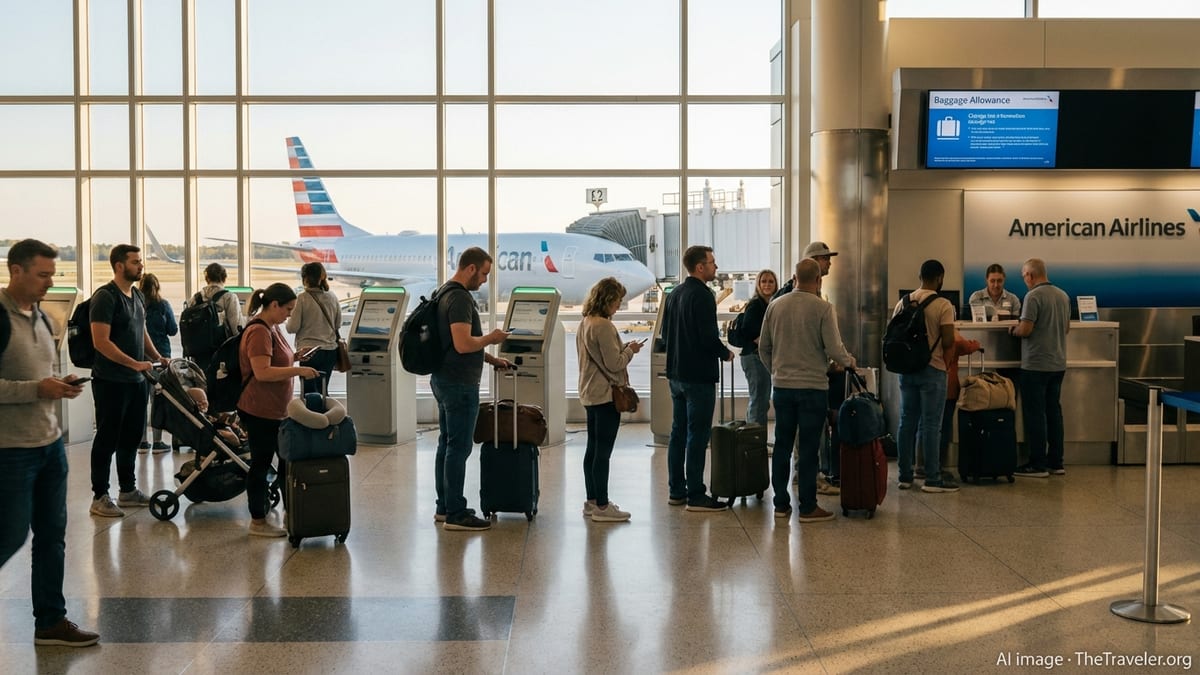
Nowhere is the new model more visible than in baggage pricing. American’s 2026 structure charges different amounts depending on whether customers pay online or at the airport, with first and second checked bags costing less when purchased through the website or app and more when paid at check-in. The gap is small on paper, but it functions as a built-in incentive to lock in travel details early and keep airport lines moving.
The airline has also built on earlier decisions to charge basic economy passengers for checked bags on transoceanic routes, standardizing the expectation that the cheapest tickets will come with the fewest free inclusions. These layered fees, from domestic checked bags to long haul basic economy surcharges, are designed to steer travelers toward clearer trade-offs between fare level and flexibility while ensuring that baggage revenue is both predictable and robust.
Industry analysts say this tiered approach effectively transforms baggage from a simple add-on into a managed revenue stream. By differentiating airport and pre-purchased fees, American is using pricing signals to shape behavior, nudging passengers into digital channels and earlier decisions while positioning the higher walk-up charges as the price of spontaneity.
Basic Economy Loses Its Loyalty Appeal
American’s overhaul of its loyalty program has added another kind of fee, one that is measured in forgone rewards rather than dollars. As of December 2025, customers buying basic economy tickets on the airline no longer earn AAdvantage miles or status-qualifying Loyalty Points, eliminating what had been one of the last substantial perks attached to the lowest fares.
Previously, even the most price-conscious travelers could slowly accumulate miles and progress toward elite status, albeit at a reduced rate. Removing that pathway effectively creates a new cost for choosing basic economy: the lost opportunity to build future value through the AAdvantage program. Travelers seeking what American markets as a more definitive avenue for travel are being subtly directed toward higher fare classes that continue to earn full credit, particularly the main cabin.
For the airline, this shift tightens the link between revenue and rewards. By reserving mileage and status earning for more lucrative tickets and direct bookings, American is hoping to concentrate loyalty benefits among customers who provide the greatest financial return, while presenting the move as a clarifying step for travelers choosing between bare-bones and more flexible options.
Technology, AI and the Promise of Fewer Missed Trips
Alongside the fee changes, American is leaning on technology to argue that it is delivering a more reliable travel experience. The airline has been testing an artificial intelligence system that can decide to hold departing flights briefly so that connecting passengers can make their onward journeys, beginning at Dallas Fort Worth in 2025 and expanding to other hubs including Los Angeles, Charlotte and Miami in early 2026.
This experiment is pitched as a form of operational assurance that complements the new fee environment. Passengers who have paid for bags, seat assignments and other extras expect to actually complete their itineraries, and the AI tool is designed to weigh the cost of a short delay against the disruption of dozens of missed connections. By using data to make those calls, American is trying to reduce the number of travelers stranded after paying a growing list of add-on charges.
The airline has also rolled back some earlier efforts to push all same day changes into apps, restoring gate agent authority to handle standby requests for all passengers in 2025. Combined with its AI experiments, this reflects a hybrid model in which digital tools and human staff are both used to keep paying customers moving through the network, aligning the promise of a definitive trip with the reality at the gate.
Regulators Watch as Fees Become the New Normal
American’s evolving fee structure is taking shape against an unsettled regulatory backdrop. A United States appeals court this month struck down a Department of Transportation rule that would have required airlines to disclose baggage and change fees more prominently at the time of booking, a regulation carriers had argued went beyond the agency’s authority. The decision effectively preserves the industry’s ability to design and present ancillary charges with more flexibility.
Consumer advocates contend that this environment makes it easier for airlines, including American, to rely on complex fee menus that are difficult to compare across carriers. They warn that travelers may struggle to fully understand how much they will ultimately pay for a trip until they are well into the booking process, even as airlines emphasize that clearer, segmented pricing, loyalty rules and technology investments give customers more control.
For now, American Airlines appears committed to a strategy that combines carefully calibrated fees, loyalty restrictions and operational technology under a single narrative: that paying more, earlier and through preferred channels will secure a smoother journey. Whether travelers view that as a welcome, definitive avenue for travel or simply the cost of flying in 2026 will likely be tested in the months ahead.