

More news on this day
American Airlines is rolling out one of its most sweeping baggage overhauls in years, introducing new digital tools and self-service options that promise to shrink airport lines, give travelers unprecedented control over checked bags and quietly redefine what a typical departure looks like in 2026.
What American’s New Baggage Overhaul Actually Changes
American Airlines has begun a broad upgrade of its baggage experience built around digital self-service, automation and closer integration with smartphones. The most visible change for many travelers is the ability to manage nearly every aspect of checked luggage from home, long before arriving at the airport. Officials say the goal is simple: keep people out of queues and move routine transactions onto the airline’s website and app.
Under the new system, customers can now add and prepay for up to three checked bags at the time of booking instead of waiting until check in. The option is available through both American’s website and mobile app on most domestic and short haul international itineraries, covering a large share of the airline’s network. For a carrier that once pushed most baggage transactions to the airport counter, it marks a significant strategic shift.
The overhaul also changes how itinerary adjustments affect luggage. Travelers who have prepaid for baggage can now make confirmed same day changes to their flights and carry their prepaid bag entitlements forward without needing help from an airport agent. American is positioning this as part of a move toward more transparent, rules based automation that reduces surprise fees and last minute desk visits.
New Digital Tools: From Prepaid Bags to Automatic Refunds
One of the most consequential pieces of American’s new baggage program is what happens when travel plans change. Previously, customers who canceled or modified trips often had to chase refunds for prepaid baggage or accept that some fees were sunk costs. Now, American has built automatic handling for many of these scenarios directly into its digital platforms.
When eligible trips are canceled or altered, or when a traveler buys an instant upgrade that changes baggage allowances, prepaid bag purchases are automatically processed for refunds. Depending on fare rules and payment method, the money is either returned to the original form of payment or issued as a travel credit. The airline says this is designed to cut the number of customer service calls and disputes that historically followed schedule changes and cancellations.
Those same travel credits have also become more flexible. Customers can now redeem credits online specifically to purchase standalone checked bags, without needing to attach them immediately to a new ticket. Industry observers note that this may be a test bed for wider use of credits across other add ons in the future, as American gradually modernizes its checkout options for seat selection, boarding priority and other ancillaries.
For premium cabin customers, the digital enhancements bring a different kind of convenience. Most travelers booked into American’s premium cabins can now add their included or extra checked bags in advance using the app or website, aligning the experience more closely with what economy passengers see while preserving cabin specific entitlements. This helps reduce confusion at the counter and allows higher value passengers to head directly to drop off points instead of lining up to clarify allowances.
Express Bag Tags and the Push to Eliminate Check in Queues
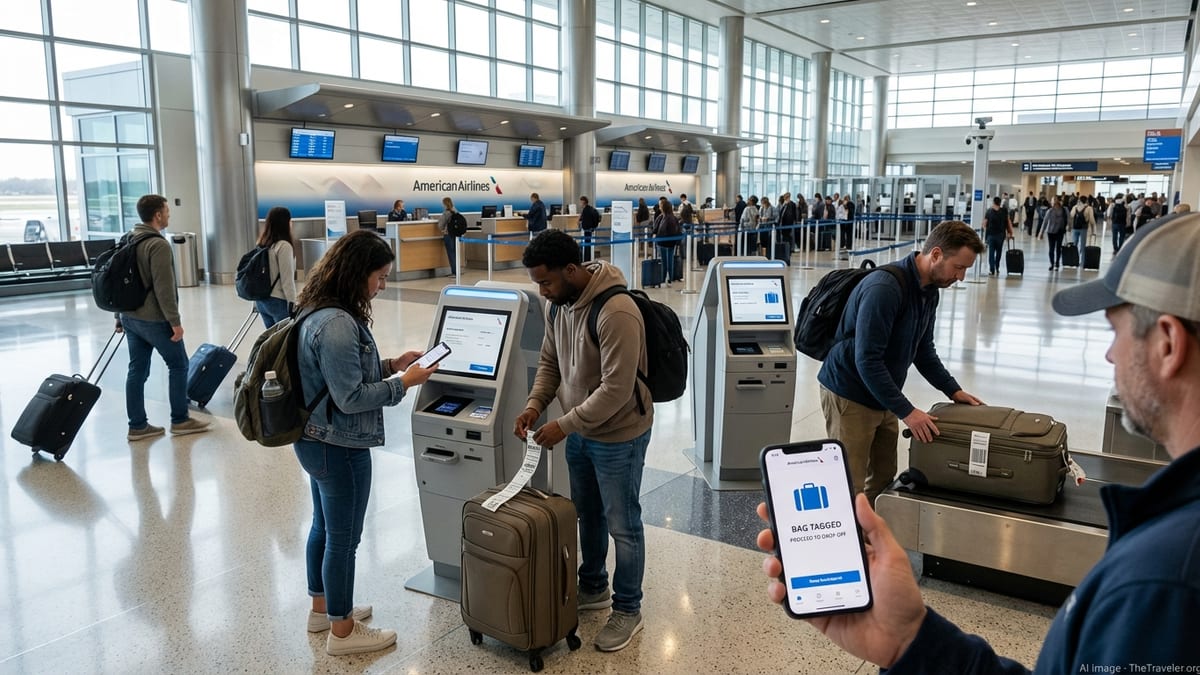
The centerpiece of the in airport experience is a new generation of self service kiosks tied to what the airline calls Express Bag Tags. Once customers have prepaid for their checked luggage, they can bypass traditional counter lines and head straight to kiosks where a quick boarding pass scan generates bag tags in seconds.
American has installed around 100 of these upgraded kiosks at 16 airports over the past year, with more locations expected as the program matures. At hubs that routinely see long morning queues, the airline is betting that a critical mass of travelers will arrive with bags already paid for and drop off largely reduced to a tagging exercise. Agents can then focus on more complex situations such as irregular operations, special items and customers needing extra assistance.
The kiosks are part of a broader trend across the industry toward automated bag drop. While American’s current rollout focuses on tag printing, it builds on earlier trials that used facial recognition technology for touchless bag drop at Dallas Fort Worth. Executives have signaled that the carrier sees self service as central to the future of airport processing, even as it calibrates the pace of biometric expansion to match regulatory comfort and customer expectations.
For passengers, the shift promises a more predictable path through the terminal. Those who have completed check in and bag payment at home can move almost directly from curb to security, stopping only briefly to attach tags and place luggage on the belt. At scale, that could significantly reduce the time buffer many travelers feel compelled to build into their departures.
Pricing, Discounts and What It Means for Your Wallet
American’s baggage overhaul is not purely about technology. It is also reshaping how much customers pay, and when. The airline has introduced a modest financial incentive for travelers to handle baggage online, offering a discount on the first and second checked bags for those who prepay before arriving at the airport. On many domestic and nearby international routes, that discount currently amounts to about five dollars per bag compared with paying at the counter.
At the same time, American has quietly raised the price of a second checked bag when purchased in person for those same itineraries, particularly on flights within the United States and to neighboring regions such as Canada, Mexico, Central America and parts of the Caribbean. The message is clear: manage your bags early through digital channels to lock in lower pricing and avoid last minute surprises at the check in desk.
Travel analysts say this dual approach reflects a broader pattern in airline revenue strategy. By nudging customers toward prepayment, carriers gain earlier visibility into how much luggage will move on a given flight, which helps with loading, staffing and aircraft weight planning. It also shifts part of the transaction out of the constrained airport environment, where queues and limited staffing can generate delays and dissatisfaction.
For infrequent travelers, the new structure may require a closer look at fare details before departure day. Families used to waiting until the airport to decide who checks a bag could face higher charges if they continue that habit. On the other hand, those willing to commit in advance gain not just a small discount but also a faster path through the terminal and clearer expectations around what they will pay.
Smarter Tracking: From Airline Systems to AirTag Integration
Beyond payment and processing, American is also leaning on new technology to change how lost or delayed bags are located. The airline already provides basic bag tracking through its app, allowing customers to see key milestones as luggage moves from check in to loading to carousel. That feature now sits alongside deeper integration with Apple’s Find My ecosystem for travelers who place AirTags or similar devices inside their suitcases.
In partnership with Apple, American supports an iPhone feature that lets customers temporarily share the location of AirTag equipped baggage with airline staff when a bag goes missing. Using the Share Item Location function in the Find My app, travelers can generate a secure link and hand it to baggage agents, often by scanning a QR code at the baggage office. That link allows staff to see the most recent location of the tracker on a map, expiring automatically after the item is recovered or after a set period.
The result is a hybrid tracking environment: the airline’s own systems show where the bag was last scanned by airport equipment, while the passenger’s AirTag provides an independent signal that can confirm whether luggage is still in a departure city, on the ramp at a hub or already circulating in a distant baggage hall. Privacy protections built into the Apple feature limit who inside the airline can view the data and for how long, reflecting growing sensitivities around location sharing.
This layered approach to tracking is becoming more important as travelers grow accustomed to consumer grade devices that often outperform traditional airline tracing tools. By formally embracing AirTag collaboration rather than resisting it, American is acknowledging that many customers will arrive at the counter already knowing approximately where their bag is and expecting the airline to act on that information.
Biometrics and Touchless ID at Key Airport Touchpoints
While the newest baggage changes are largely digital, they intersect with earlier experiments in biometrics that are still being refined. At Dallas Fort Worth and a growing list of other airports, American has worked with federal authorities and technology partners to introduce a Touchless ID experience for eligible travelers enrolled in programs such as TSA PreCheck. The system uses a combination of mobile enrollment and facial recognition cameras at checkpoints to verify identity without requiring a physical ID or boarding pass.
For baggage, the implications are subtle but meaningful. When identity verification moves to a five second facial scan at security, the traditional stop at the check in counter or kiosk to show identification becomes less central. That, in turn, makes self service bag drop more feasible, because airline agents no longer need to perform as many manual ID checks before accepting luggage. The boarding pass and biometrics work together to confirm that the person dropping the bag is the person booked on the reservation.
American’s digital ID work was informed by earlier trials that allowed customers to use facial recognition at bag drop and lounge entrances, avoiding the need to present passports, driver’s licenses or physical membership cards. While privacy advocates continue to scrutinize the expansion of biometrics in travel, the airline maintains that participation is voluntary and that passengers can opt out at any stage in favor of conventional document checks.
As the baggage overhaul rolls out alongside these touchless systems, customers may increasingly find that their journey from curb to gate involves very few paper documents at all. The combination of mobile IDs, self tagged luggage and automated scanning promises a more fluid experience, even if it also raises new questions about data handling and the long term storage of biometric information.
How the Overhaul Will Change Your Airport Routine
For many travelers, the most practical question is how all of this changes what time they need to arrive and what they will actually do once inside the terminal. Under the new model, the ideal American Airlines customer starts the process at home: confirming bags at booking or well before departure, paying online to capture the lower rate and checking in through the mobile app as early as the window allows.
On the day of travel, that same customer can walk into the airport and head directly to a kiosk or bag drop area, scan a boarding pass and print tags without waiting for an agent. If they are flying from a hub with Touchless ID and are enrolled in TSA PreCheck, they may then proceed to a dedicated security lane where a quick facial scan replaces both the boarding pass and physical ID check. Overall, the choreography is designed to keep people moving and reduce the number of separate lines they need to stand in.
Even in cases where a bag goes astray, the experience should increasingly center on digital tools. Customers can initiate bag claims through the app, monitor status updates and, if they use trackers like AirTags, share live location data with baggage offices to help pinpoint where items were last seen. Automatic refund rules for prepaid luggage add another layer of predictability when delays or cancellations force a change of plans.
Not every traveler will immediately adopt the new options. Some will continue to prefer in person interactions, especially those who travel infrequently or are uneasy with facial recognition and data sharing. American says it will maintain traditional counters and manual processes alongside the new tools, but the direction of travel is unambiguous: over time, the airline expects most routine baggage transactions to move to screens rather than desks.
What Travelers Should Watch as the Rollout Expands
As with any large scale operational change, the real test of American’s baggage overhaul will come in peak travel periods, when summer holidays and year end school breaks push airport systems to their limits. Travelers booking flights in the coming months may notice incremental additions as more airports receive new kiosks, improved signage and updated digital options inside the app.
Experts recommend that passengers pay close attention to baggage pricing details at the time of purchase, especially around second bag fees and prepayment deadlines, which on many routes extend until about two hours before departure. Understanding those thresholds can help travelers decide whether to lock in savings early or wait until plans are fully confirmed. Families and groups, in particular, may find it worthwhile to map out who will check bags well in advance to minimize both costs and time spent in lines.
Customers should also stay alert to evolving integrations between airline systems and consumer technology such as smartphone wallets and tracking devices. As operating systems add more tools to monitor flights, airport maps and luggage status from a single interface, American and its peers are looking for ways to plug their own data into those platforms. For travelers, that could mean a future in which one glance at a phone reveals not just a boarding time, but also exactly where a checked bag was last scanned and which carousel it will appear on.
For now, American’s baggage overhaul represents a significant step toward that vision. By tying together pricing incentives, self service infrastructure and new tracking partnerships, the airline is betting that a more convenient and predictable bag journey can become a competitive differentiator. Travelers weighing which carrier to choose may increasingly factor in not only seat comfort and schedules, but also how quickly they can get through the terminal with suitcase in tow.