

More news on this day
American Airlines is quietly testing an unusual inflight health initiative, handing select customers branded T‑shirts with cheeky reminders about hand hygiene, hydration and considerate cabin behavior, effectively turning passengers into walking billboards for safer travel habits at 35,000 feet.
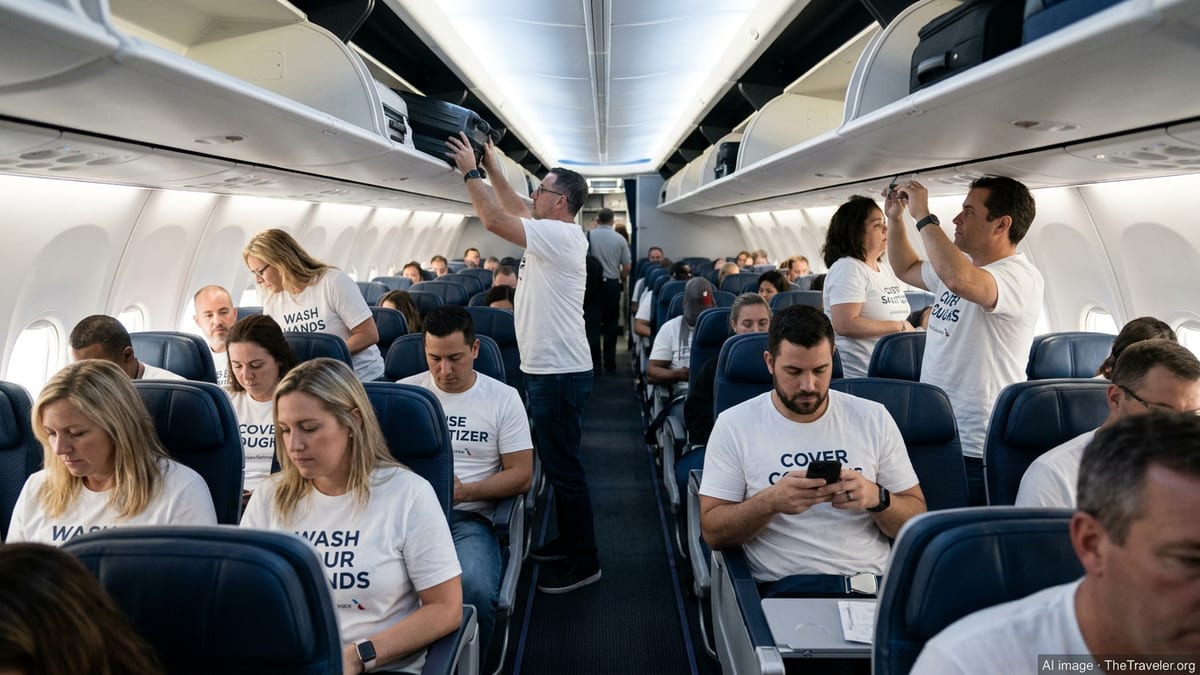
A Soft-Sell Health Campaign at 35,000 Feet
Instead of more leaflets or preflight announcements, American Airlines is experimenting with an unexpected medium for health communication onboard: clothing. On a limited number of recent flights, select passengers have been offered complimentary T‑shirts printed with short, friendly slogans encouraging them to sanitize their hands, stay hydrated and be mindful of coughing and sneezing etiquette while in the air.
The shirts, distributed at the gate or just after boarding, carry lighthearted messages that nod to post‑pandemic travel realities, such as reminders to use hand sanitizer after visiting the lavatory or to use tissues and the crook of the elbow when coughing. The effort appears designed to reinforce long‑standing health guidance without adding more lengthy announcements to an already crowded inflight safety script.
While the airline has not formally announced the program as a permanent feature, crew members on participating flights describe it as a trial centered on “healthy travel habits” and “considerate flying,” aimed at seeing how passengers respond when health messaging is woven into something as simple and familiar as a T‑shirt.
From Masks to Messages: Evolving Health Communication in the Cabin
Airlines dramatically ramped up health and hygiene messaging during the pandemic era, when face coverings, enhanced aircraft cleaning and reduced contact between passengers and crew became standard talking points on nearly every flight. For American Airlines, that period solidified the idea that passengers will generally accept clear health guidance, provided it feels practical and not overly punitive.
In the years since, many of the most visible measures have been scaled back, but passengers remain more attuned to issues such as air quality, water safety and illness transmission in confined spaces. Recent attention on studies examining aircraft drinking water quality, along with recurring respiratory virus seasons, has kept health on the radar for frequent flyers, even as travel volumes have rebounded.
The T‑shirt experiment fits into this new, post‑crisis phase of airline health communications, where the emphasis is less on emergency rules and more on everyday behaviors: washing or sanitizing hands, avoiding unnecessary surface contact in high‑traffic areas of the cabin and being considerate about traveling when feeling unwell. By shifting from authoritative directives to casual, wearable reminders, the airline appears to be testing whether a softer tone can keep health awareness high without adding friction to the journey.
Passenger Reaction: Novelty, Subtle Peer Pressure and Social Media Appeal
Early passenger reaction to the health‑themed shirts has ranged from amused to appreciative, according to travelers posting about the initiative on social platforms and recounting their experiences in airport lounges. For many, the T‑shirt is simply a quirky, useful freebie that doubles as comfortable travel wear on long flights.
For others, the messaging carries a form of gentle peer pressure. Wearing a shirt that references hand hygiene or considerate coughing can encourage not only the wearer but also nearby passengers to think twice before skipping the soap in the lavatory or sneezing without a tissue. In a space as compact and communal as an aircraft cabin, those small behavioral nudges can add up.
The visual nature of the initiative has also lent itself to social media, with photos of the shirts appearing alongside shots of boarding gates and wing views out the window. That organic sharing effectively amplifies the health reminders beyond the cabin, giving American Airlines a secondary marketing benefit while still framing the effort primarily as a customer wellness initiative.
Why Airlines Are Betting on Behavior, Not Just Filtration
Modern jetliners already rely on advanced air filtration systems that refresh cabin air many times per hour, a point airlines including American have repeatedly highlighted in recent years. But experts consistently note that passenger behavior still plays a significant role in the spread of common respiratory illnesses on board, especially in crowded cabins and around high‑touch surfaces.
By focusing on behavior rather than hardware, the T‑shirt campaign acknowledges that health and comfort in flight are shared responsibilities between airline and traveler. Messages around using sanitizer after handling luggage, minimizing movement during service, and keeping personal items from blocking aisles all tie into both public health and operational efficiency, helping crews maintain a smoother, cleaner environment.
For American Airlines, the experiment also dovetails with broader efforts to reassure customers who remain cautious about flying during peak cold and flu seasons. Subtle health cues, embedded in everyday objects like clothing, may help bridge the gap between official policy and individual choices without making passengers feel policed.
What This Could Mean for Future Inflight Wellness Efforts
If the response to the T‑shirt initiative is positive, aviation analysts expect American Airlines and its competitors to explore other low‑friction ways to embed health reminders into the travel experience. That could include refreshed seat‑back card designs with concise wellness tips, more visible sanitizer stations in jet bridges and gate areas, or expanded preflight messaging that spotlights simple steps passengers can take to stay healthy during their trips.
For now, the T‑shirts represent a small but telling experiment: a legacy carrier testing whether humor and design can succeed where rote repetition sometimes falls flat. Instead of one more announcement over the public address system, a cotton T‑shirt may prove to be a more effective, and more memorable, carrier of the message that safe, considerate travel is a shared responsibility.
Whether the shirts become a permanent fixture or remain a limited‑run curiosity, the trial underscores how seriously airlines continue to take onboard health, even as the industry moves beyond its most turbulent years. For passengers finding a health reminder folded on their seat, it is an unexpected addition to the usual inflight amenities, and a sign that small changes in behavior can still play a big role in how safe and comfortable flying feels.