

More news on this day
Fresh rounds of cancellations by American Airlines and Korean Air at South Korea’s Incheon and Jeju airports are disrupting travel plans, constraining capacity on long haul links to Dallas and domestic routes to cities such as Yeosu, and adding new uncertainty for passengers already navigating a volatile aviation landscape.
Get the latest news straight to your inbox!
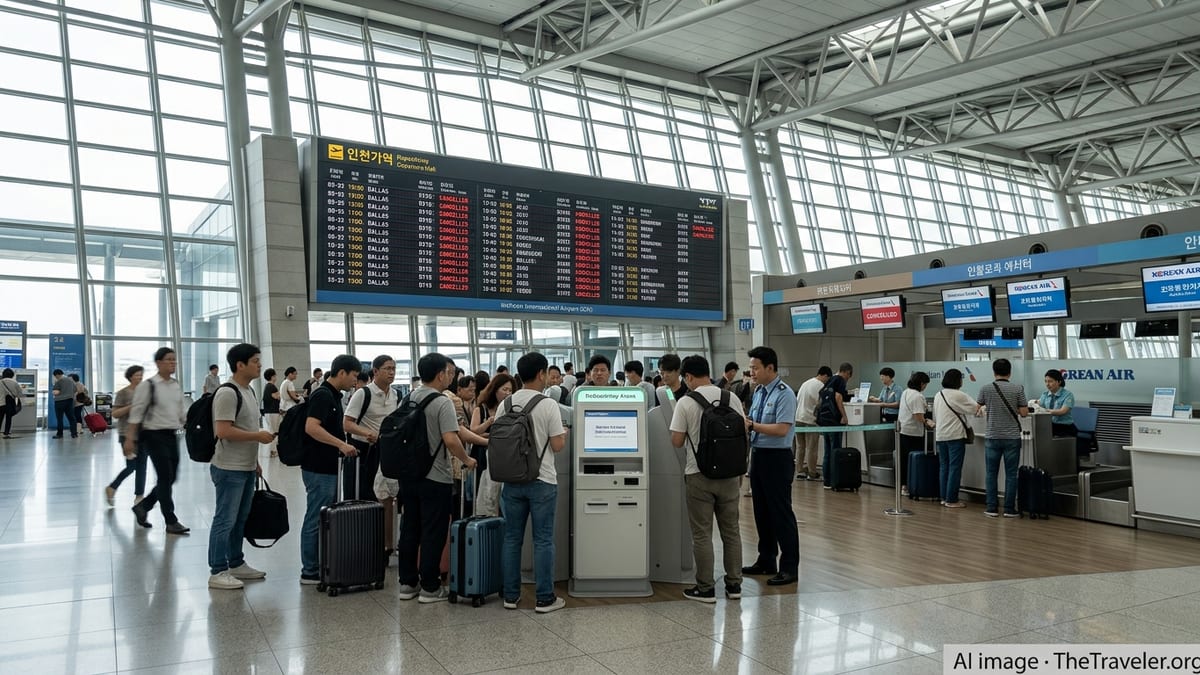
New Wave of Cancellations Hits Incheon and Jeju
Recent operational changes by American Airlines and Korean Air have led to at least three additional flight cancellations affecting services through Incheon International Airport and Jeju International Airport, according to published coverage and live airport schedule data. The latest disruptions are concentrated on American’s Seoul Incheon to Dallas Fort Worth connection and Korean Air’s domestic links through Jeju, a crucial gateway to secondary cities including Yeosu.
Publicly available timetables indicate that American’s nonstop Incheon to Dallas route, already operating on a limited schedule, has seen further cancellations and frequency adjustments. These moves are rippling across the carrier’s transpacific network because Dallas Fort Worth functions as a primary hub for onward connections throughout North America.
At the same time, Korean Air’s activity at Jeju has tightened, with cancellations and aircraft swaps affecting short haul sectors that funnel travelers to and from Jeju and smaller mainland destinations. As Jeju is one of South Korea’s busiest domestic hubs, even a small number of scrubbed flights can quickly translate into longer queues, rebooking bottlenecks and pressure on remaining seats.
While the precise mix of causes varies between flights, industry reporting points to a combination of demand recalibration, network reshuffling and ongoing operational constraints rather than a single weather or safety trigger. The result for travelers, however, is a similar pattern of last minute changes, extended layovers and unexpected overnight stays.
Impact on Routes to Dallas, Yeosu and Regional Hubs
The Incheon to Dallas Fort Worth corridor has become a particular pressure point. As a key link between South Korea and the central United States, any reduction in departures can leave business travelers and long haul leisure passengers with fewer same day alternatives. Rebooking often involves routing through other American hubs or partner airlines with additional stops, lengthening total travel times.
Travelers connecting beyond Dallas are feeling the knock on effects most sharply. When the nonstop leg from Incheon is dropped from the schedule, passengers bound for secondary U.S. cities may see carefully timed itineraries unravel, with missed domestic connections and limited rebooking options on popular departure days.
On the domestic side, cancellations touching Jeju are creating headaches for travelers heading to coastal destinations such as Yeosu, which often rely on a mix of direct flights and connections via Jeju or major mainland hubs. Reduced frequencies on Korean Air services can translate into fewer viable same day itineraries between smaller cities, particularly for those trying to align ferry schedules or regional rail connections with flight times.
Reports from passengers and travel agencies indicate that remaining services on overlapping routes have grown busier, with some departures selling out earlier than usual. Travelers trying to adjust plans at short notice are, in some cases, finding that the only available alternatives involve inconvenient departure times or overnight stays at hub airports.
What Travelers Are Experiencing on the Ground
For many passengers, the practical reality of these cancellations is playing out in the form of long service lines, extended waits for rebooking assistance and a scramble for hotel rooms near airports. When flights from Incheon to Dallas or from Jeju to mainland cities are removed from the schedule close to departure, large numbers of travelers can be funneled into the same limited pool of support desks and call centers.
Social media posts and forum discussions describe confusion as passengers monitor flight status tools, only to see departures shift from delayed to canceled with little advance warning. In several accounts, travelers connecting beyond Dallas report being rebooked on itineraries with lengthy layovers or detours through third country hubs to reach their final destinations.
Domestic travelers navigating Jeju are facing a similar pattern on a smaller scale. Canceled segments can leave visitors stuck on the island for an extra night, while those trying to reach smaller mainland cities have to weigh whether to reroute through Seoul area airports or secure ground transportation alternatives such as express buses and high speed trains.
Travel agencies and online booking platforms are responding by proactively flagging routes with a history of recent schedule volatility. Some agents are advising clients to build in longer connection windows when itineraries rely on American’s Dallas hub or on Korean Air’s Jeju transfers, especially during peak travel periods and weekends.
Why Airlines Are Trimming Flights in South Korea
Industry analysts point to a blend of structural and short term factors behind the latest changes. On long haul routes like Incheon to Dallas, carriers continue to refine post pandemic capacity, adjusting frequencies to match demand patterns that have shifted with the rise of hybrid work and altered corporate travel budgets. A single long haul cancellation can free a wide body aircraft for deployment on routes showing stronger yields.
Operational considerations are also playing a role. Global supply chain constraints have extended maintenance turnaround times for some aircraft types, while persistent staffing imbalances in pilots and technical crews give airlines less flexibility to recover from earlier delays. When disruptions cascade across the network, flights that are more marginal in revenue terms are often the first candidates for cancellation.
Within South Korea’s domestic market, competition from low cost carriers and high speed rail is adding another layer of complexity. Korean Air, like other full service airlines, continues to recalibrate its mix of trunk and regional routes, sometimes favoring higher demand city pairs at the expense of thinner connections routed via hubs like Jeju.
Weather and air traffic constraints can still prompt day of operations cancellations, but the pattern of recent changes across Incheon and Jeju suggests a deliberate reshaping of networks rather than purely reactive decisions. For travelers, that distinction matters less than the practical need to adapt to a more fluid, less predictable schedule environment.
How Passengers Can Navigate the Latest Disruptions
Given the recent cancellations affecting American Airlines and Korean Air services in and out of South Korea, travel planners are emphasizing preparation and flexibility. One widely recommended step is to monitor bookings directly through airline apps or websites rather than relying solely on third party platforms, since schedule changes often appear there first.
For itineraries that depend on American’s connection between Incheon and Dallas, building in additional buffer time before onward domestic departures can reduce the risk of misconnecting if the long haul leg is delayed or retimed. Travelers with critical arrival deadlines may want to compare options via alternative hubs, even when that means an extra stop, to avoid concentrating all risk on a single transpacific departure.
On the domestic side, passengers using Jeju as a connection point to destinations like Yeosu may benefit from planning backup routes via Seoul area airports or considering rail and coach links where available. Publicly available route maps and timetables show that some mainland cities can be reached nearly as quickly by combining short flights with high speed trains, especially when flight options are constrained.
Travel experts also encourage booking accommodation with flexible cancellation policies near major hubs such as Incheon and Jeju, particularly during weekends and holidays when rebooking options are scarcest. As airlines continue to fine tune their networks, the ability to pivot quickly between routes and dates remains one of the most effective tools for minimizing the impact of sudden cancellations.