

More news on this day
Travelers moving through South Korea are facing fresh disruption after two key services operated by American Airlines and Korean Air were cancelled, affecting long-haul links from Seoul Incheon to Dallas Fort Worth and domestic connectivity between Jeju and Yeosu, according to airline schedules and airport information updated in recent days.
Get the latest news straight to your inbox!
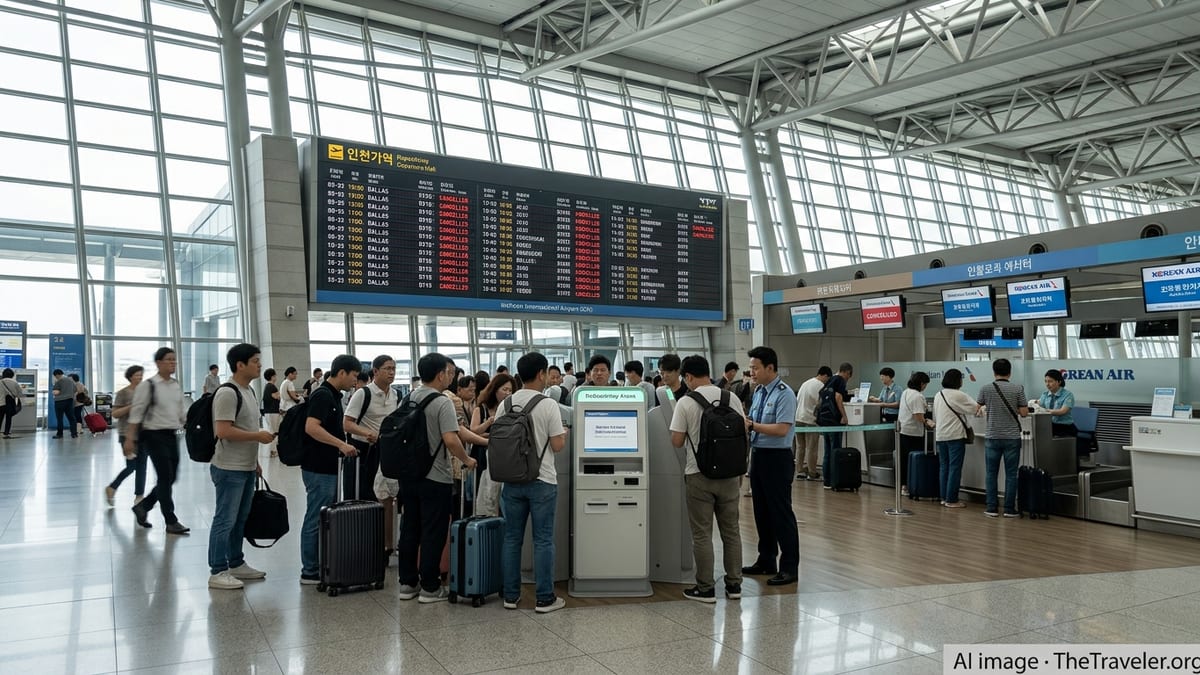
Long-Haul Disruption on the Seoul Incheon to Dallas Fort Worth Corridor
Publicly available flight-tracking data and schedule listings indicate that an American Airlines service between Seoul Incheon and Dallas Fort Worth has been cancelled on select dates, interrupting one of the main nonstop links between South Korea and the central United States. The route is typically used by both business travelers and leisure passengers connecting deeper into North America through Dallas Fort Worth’s extensive domestic network.
Industry data describing Dallas Fort Worth as a major global hub for American Airlines shows that long-haul services into the airport play a central role in connecting Asia with the southern and central United States. When a nonstop such as Seoul Incheon to Dallas Fort Worth is removed from a given day’s schedule, passengers are often rebooked via alternate U.S. gateways or pushed to travel a day earlier or later, lengthening overall journey times.
Reports from traveler forums and aviation monitoring platforms over recent seasons have already highlighted sensitivity on this corridor, with previous instances of extended delays and occasional cancellations between Dallas Fort Worth and Seoul. The latest schedule change reinforces concerns among frequent flyers that transpacific capacity on certain days remains tight, especially around peak travel periods and during aircraft maintenance rotations.
For South Korea–origin passengers, the immediate effect is a narrower set of options for reaching mid-continent U.S. destinations on a single ticket and in one stop. For American Airlines, the cancellation underscores how operational adjustments on a single intercontinental leg can ripple across connecting banks of flights at a key hub.
Korean Air Pullback Hits Jeju–Yeosu Connectivity
In parallel with the transpacific disruption, travelers within South Korea are contending with the cancellation of a Korean Air service linking Jeju and Yeosu, two important coastal tourism and transport nodes. Timetables and airport advisories show that the route, already operating with limited frequencies, has seen key flights withdrawn, reducing direct air options between the island and South Jeolla’s port city.
Jeju has long been one of the country’s busiest leisure destinations, traditionally served by dense schedules from mainland airports such as Seoul’s Gimpo and Busan’s Gimhae. Yeosu, while smaller, functions as a jumping-off point for coastal tourism and regional industry. When services between Jeju and Yeosu are cut back, many passengers must instead route through larger hubs or switch to ferries and ground transport, increasing travel times and complicating itineraries.
Available tourism and transport data for the Jeju region already points to a complex recovery pattern, with some carriers reintroducing routes while others trim or suspend underperforming services. The Korean Air cancellation on the Jeju–Yeosu sector fits into that broader picture of network fine-tuning, where airlines regularly reassess demand, yields, and aircraft availability across domestic routes.
For local tourism businesses that depend on short-haul domestic visitors, fewer direct flights can translate into softer weekend bookings or more volatile demand. Travelers who had planned quick multi-stop itineraries around the southern coast of Korea may now find it harder to fit Jeju and Yeosu into the same trip without backtracking through larger airports.
Passengers Face Rebookings, Indirect Routings and Higher Stress
The combined effect of the American Airlines and Korean Air cancellations is most visible at the passenger level. Travelers relying on the Seoul Incheon to Dallas Fort Worth link are likely to be rebooked via alternative hubs such as Los Angeles, San Francisco or other U.S. gateways used by partner carriers, while Jeju–Yeosu passengers may be redirected onto multi-leg domestic itineraries or advised to use sea and rail connections.
Recent seasons have already seen travelers report prolonged delays and last-minute changes on transpacific services, and the latest disruption reinforces the need for flexible planning. Publicly accessible airline policy documents for 2026 emphasize options such as same-day standby, voluntary date changes and flexible rebooking in certain fare categories, but the practical availability of alternative seats often depends on seasonal demand.
On domestic routes, seat inventory can tighten quickly when a single frequency is dropped. When Korean Air removes a Jeju–Yeosu rotation from the schedule, some passengers may find that remaining services on other carriers are already close to full, especially around weekends and holidays. That dynamic can push travelers to adjust hotel bookings, car rentals and tour reservations at short notice.
Travel advisers monitoring these changes are encouraging passengers to build longer connection buffers, monitor airline apps closely in the 24 to 48 hours before departure, and consider travel insurance products that specifically address missed connections and schedule disruptions, particularly when complex itineraries span both domestic and long-haul legs.
Operational and Market Pressures Behind the Cancellations
Although detailed operational reasons for the specific cancelled flights have not been formally compiled in a single public source, recent coverage of airline operations in the region highlights several recurring pressures. These include aircraft maintenance requirements, fluctuating demand on certain days of the week, ongoing fleet transitions, and the broader competitive landscape shaped by low-cost carriers and alliance partners.
In the case of American Airlines, industry analyses of Dallas Fort Worth emphasize how the carrier continually balances long-haul capacity against domestic demand patterns. Adjustments on a route such as Seoul Incheon can be influenced by aircraft availability, performance of connecting banks, and comparative yields on alternative transpacific markets.
For Korean Air, domestic network decisions are occurring alongside a long-running restructuring of the South Korean airline sector, including consolidation and shifting market shares between full-service and low-cost operators. Public information on domestic traffic trends indicates that low-cost carriers have been steadily increasing their share of international and domestic passengers, prompting major network airlines to reevaluate thinner point-to-point routes.
Industry observers note that when demand is uneven or seasonal on secondary city pairs like Jeju–Yeosu, major carriers may be more inclined to concentrate capacity on trunk routes where load factors are more predictable. In that context, targeted cancellations can be a sign of broader capacity optimization rather than a one-off operational issue.
What Travelers in and out of South Korea Should Do Now
With two notable cancellations affecting both international and domestic movements, travelers planning routes through South Korea in the coming weeks are being advised, based on publicly available guidance, to reconfirm reservations directly through airline websites or apps and to keep an eye on schedule updates from Seoul Incheon, Jeju and Yeosu airports. Same-day changes may be possible for some tickets, but options can narrow quickly once irregular operations begin.
Passengers holding itineraries that rely on the American Airlines Seoul Incheon to Dallas Fort Worth segment may want to look proactively at alternative routings and check whether partner airlines offer comparable timings via other hubs. Those with Jeju–Yeosu plans should map out backup options via larger domestic airports or maritime routes, especially if their trips coincide with weekends, festivals or school holidays when demand is historically strong.
Travelers already in South Korea who are affected by these cancellations can often manage changes more easily if they have local connectivity and can respond quickly to schedule alerts. Having digital copies of all tickets, hotel confirmations and ground transport bookings in one place can also help smooth the process of rearranging plans when flights are moved or removed from the timetable.
For now, the cancellations on the Seoul Incheon to Dallas Fort Worth and Jeju to Yeosu routes serve as another reminder that, even as airlines expand and fine-tune their networks across Asia and beyond, individual departures remain vulnerable to rapid change. Flexible planning, close monitoring of schedules and a clear understanding of ticket conditions remain essential tools for anyone flying into, out of, or within South Korea this season.