

More news on this day
Thousands of passengers were left camping out on terminal floors, queuing at service desks, and scrambling for scarce hotel rooms on Friday after heavy snow and ice largely paralyzed operations at Amsterdam’s Schiphol Airport, triggering 332 delayed flights and 85 cancellations and sending shockwaves through airline networks across Europe.
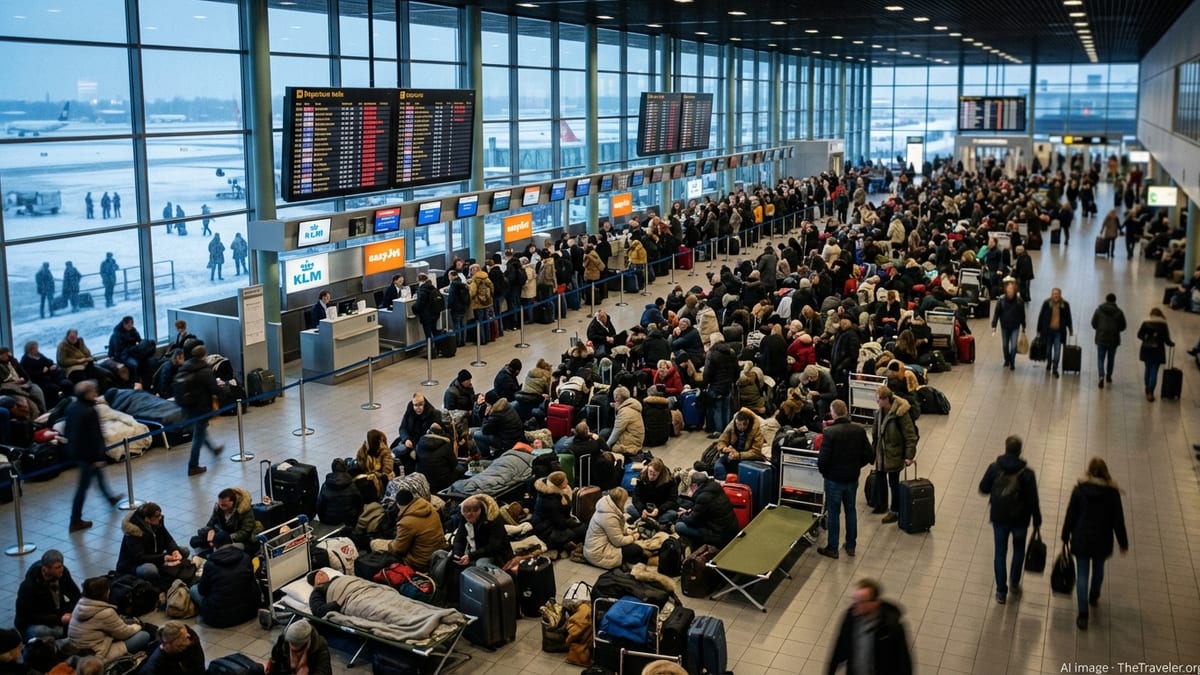
Schiphol Brought to a Standstill by Snow and Ice
Amsterdam’s Schiphol, one of Europe’s busiest hubs and the home base of KLM, was again at the center of a winter-weather meltdown as a fast-moving band of snow and freezing rain swept across the Netherlands. Airport authorities reduced takeoff and landing capacity for safety, forcing airlines to slash schedules and consolidate services. Crews struggled to keep runways clear while ground teams faced repeated pauses in operations as conditions deteriorated.
Within hours, the knock-on effects became visible on departure and arrival boards across the terminals. Flights that initially showed minor delays quickly slipped into multi-hour waits as aircraft and crew rotated late from earlier sectors. By mid-afternoon, Schiphol had logged 85 cancellations and 332 delays, according to aviation data collated from airport and airline sources, effectively paralyzing much of its short and medium-haul operation.
The disruption comes on the heels of an already fraught winter for Schiphol, which has endured a series of weather-related incidents and capacity constraints. Industry analysts say the latest episode underscores just how vulnerable tightly tuned hub operations remain when even a few hours of intense snow and ice hit at peak times, particularly in a season marked by repeated cold snaps.
KLM and easyJet Hit Hard as Schedules Unravel
KLM bore the brunt of the chaos, with many of its European rotations either heavily delayed or scrapped entirely as the carrier grappled with aircraft stuck out of position and de-icing bottlenecks. Short-haul services to neighboring countries, including frequent shuttles to London, Paris, and German business hubs, were among the hardest hit. The airline activated its disruption playbook, opening additional customer service counters, bolstering call centers, and using its app to push rebooking options to stranded passengers.
Low-cost carrier easyJet also suffered extensive disruption, particularly on routes linking Amsterdam with London and other British and German cities. With quick turnaround times forming the backbone of its business model, each delay cascaded into subsequent flights. Ground handlers reported crowded stands and long waits for de-icing, limiting how quickly aircraft could be dispatched back into the network.
Other European carriers were not spared. SAS saw Scandinavia-bound flights disrupted, while Air France, Swiss, and several regional operators struggled to maintain connections through Amsterdam. For many airlines, the decision to cancel flights outright rather than risk rolling delays deep into the night became the lesser of two evils, allowing them to reset operations ahead of the weekend.
Vienna, London, Paris and Oslo Feel the Shockwaves
Because Schiphol functions as a key transfer point for European and intercontinental itineraries, the impact of Friday’s disruption rippled far beyond the Netherlands. In Vienna, passengers on early-morning departures to Amsterdam found their flights repeatedly pushed back as incoming aircraft failed to arrive on schedule. Screens at Vienna International showed multiple KLM and codeshare services listed as delayed or canceled, with staff rerouting passengers onto later connections or alternative routings via Paris and Frankfurt where possible.
In London, both Heathrow and Gatwick reported clusters of disrupted flights tied to the Dutch hub. Morning shuttles to Amsterdam departed late or not at all, leaving business travelers and weekend holidaymakers attempting last-minute rebookings. Airport observers noted growing queues at airline desks as cancellations mounted, even as airports elsewhere in the United Kingdom continued operating under more manageable weather conditions.
Paris Charles de Gaulle, another major European hub and partner airport for KLM through Air France, was forced to absorb additional connecting traffic as disrupted passengers were rerouted away from Amsterdam. While Charles de Gaulle remained open, the extra load placed additional pressure on already busy afternoon waves of departures to North America and Africa. Further north, Oslo Gardermoen saw knock-on delays on Amsterdam-bound services, complicating travel for Scandinavian passengers relying on Schiphol for onward long-haul flights.
Passengers Face Long Queues, Makeshift Beds and Uncertain Plans
For travelers caught in the middle, the statistics translated into long hours of waiting and a scramble for alternatives. Inside Schiphol, lines snaked through departure halls as passengers waited to speak with airline staff or use self-service machines to rebook. Some reported being offered routings that would turn a short hop into a multi-stop odyssey via secondary hubs, often departing the following day or even later.
With evening approaching and more cancellations confirmed, airport staff began distributing refreshments and information leaflets outlining passenger rights under European regulations. Hotels in the vicinity of Schiphol filled quickly, leaving many travelers to bed down on terminal benches and in quiet corners of the concourses. Social media posts showed families improvising sleeping spaces on the floor, surrounded by suitcases and duty-free bags.
The situation was similar at other affected airports. In London and Paris, passengers on disrupted Amsterdam flights reported being handed meal vouchers and rebooking notices, some with overnight stays in airport hotels. Others, especially those on short intra-European trips, opted to abandon their journeys entirely, requesting refunds instead. For business travelers and those connecting to once-a-day long-haul services, the uncertainty around when they could resume their itineraries proved especially costly.
Weather System Exposes Fragility of European Hub Networks
Meteorologists described the weather pattern affecting the Netherlands and neighboring countries as a compact but intense winter system, bringing localized bursts of heavy snow, freezing rain, and gusty winds. While total snowfall amounts were modest compared with major blizzards, the timing and temperature profile created a cocktail of hazards, from slick runways to rapidly forming ice on wings and taxiways. Each of these factors triggers strict safety protocols that slow or halt operations.
For Europe’s highly interconnected hub-and-spoke networks, such conditions pose a particular challenge. Airports like Amsterdam, Paris and Frankfurt juggle tightly choreographed “waves” of arrivals and departures designed to maximize connection opportunities. When a weather system cuts capacity during one of these peak periods, the disruption can take many hours to unwind, often spilling into the following day as aircraft and crews remain out of position.
Aviation analysts noted that Friday’s disruption at Schiphol came on top of a series of weather-related events and infrastructure constraints this winter, raising questions about resilience. Some suggested that European hubs may need to build in more slack during peak winter months, potentially accepting a lower scheduled capacity in exchange for more room to maneuver when storms hit. Others pointed to the need for continued investment in de-icing equipment, runway treatment technology, and real-time decision tools that can help airports adapt more quickly as conditions change.
Airlines Activate Rebooking Policies and Support Measures
As the scale of the disruption became clear, major carriers moved to reassure customers and outline their options. KLM emphasized that safety remained its top priority while acknowledging the significant inconvenience faced by passengers. The airline encouraged affected travelers to use digital channels, including its website and mobile app, to manage rebookings and track real-time flight status, in an effort to ease pressure on airport counters and call centers.
Flexible rebooking policies were rolled out or extended, allowing many passengers to shift travel dates without additional fees, subject to availability in the same cabin. For those who no longer wished to travel, airlines offered refunds in line with European consumer protections. Several carriers also reminded customers that they may be eligible for reimbursement of reasonable expenses such as meals and accommodation when stranded overnight due to cancellations or long delays.
Air France, SAS, Swiss and easyJet all reported deploying extra staff to help process disrupted passengers at key airports, including Amsterdam, Paris, London, Zurich and Oslo. Some carriers adjusted schedules preemptively for the following day, trimming frequencies on routes still affected by crew and aircraft availability in order to stabilize operations and avoid a repeat of Friday’s cascading delays.
Broader Economic and Operational Impact for the Netherlands
The latest wave of disruption adds to mounting costs for airlines and for the Dutch aviation sector more broadly. Schiphol’s status as a major European gateway means that weather-related shutdowns and capacity reductions resonate through cargo operations, business travel and tourism flows. Freight operators reported delays in time-sensitive shipments, while tour operators and travel agents handled a surge in calls from clients seeking alternative plans.
For the Netherlands, which positions itself as a connected hub for global commerce, repeated winter interruptions also carry a reputational risk. Business associations have previously warned that persistent operational bottlenecks and unpredictable disruptions could weaken the country’s competitive edge compared with rival hubs elsewhere in Europe. Each episode that strands thousands of passengers reinforces pressure on airport authorities and policymakers to balance growth ambitions with operational resilience.
Nonetheless, industry insiders stress that safety considerations must remain paramount. As climate patterns shift and episodes of intense winter weather intersect with increasingly busy skies, both airports and airlines are likely to face more frequent tests of their contingency planning. How Schiphol and its partners respond in the coming days, and the lessons they draw from the current crisis, will be closely watched by other hubs confronting similar challenges.
Travelers Urged to Check Flights and Prepare for Ongoing Disruptions
With aircraft and crew scattered around the continent and many rotation patterns still in disarray, airlines warned that ripple effects from the Amsterdam disruption could linger into the weekend. Even as weather conditions improve, residual delays and targeted cancellations remain possible as carriers work to reposition aircraft and restore normal schedules at Schiphol and surrounding hubs.
Travel experts advised passengers with imminent travel plans involving Amsterdam or major European connection points to monitor their flight status closely and allow extra time for check-in and security. Those with flexible itineraries were encouraged to consider rebooking to later dates or alternative routings where feasible, particularly if their trips include tight connections or onward long-haul sectors.
For now, thousands of travelers are still working their way through backlogged queues and disrupted plans, a visible reminder of how a single day of severe winter weather in the Netherlands can reverberate from Vienna to London, Paris, Oslo and beyond. As operations slowly recover, attention is already turning to how Europe’s aviation system can better absorb similar shocks in the winters to come.