

Choosing between Amsterdam and Rotterdam for your first trip to the Netherlands sets the tone for the entire journey. Both cities are vibrant, creative and easy to reach by air and rail, yet they offer strikingly different visions of Dutch urban life: one built on Golden Age canals and world-famous museums, the other on bold postwar architecture, a working port and a forward-looking cultural scene. Deciding where to start is less about which city is "better" and more about which version of the Netherlands you want to meet first.
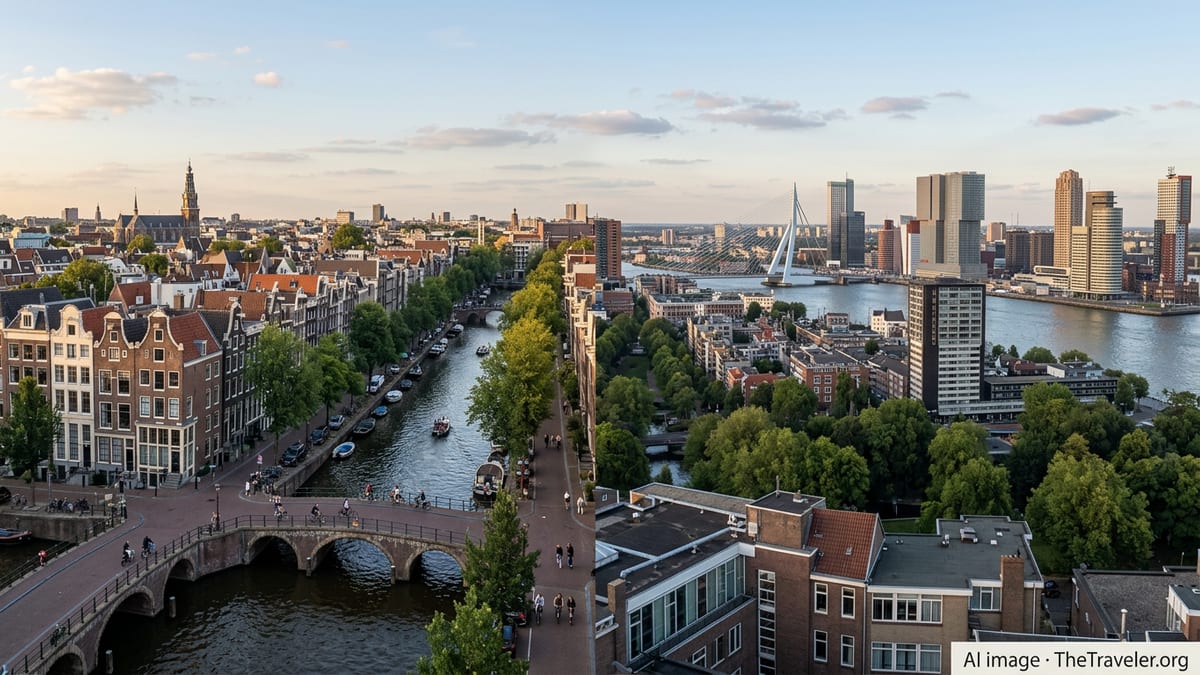
First Impressions: Classic Canals vs Modern Skyline
Amsterdam and Rotterdam feel different from the moment you step out of the station. Amsterdam Centraal deposits you almost directly into postcard Holland: gabled canal houses, criss-crossing tram lines, boats gliding past narrow quays and cyclists everywhere. It is compact, atmospheric and instantly recognisable. Within a few minutes on foot, you are among some of Europe’s most photographed streets, especially around the UNESCO-listed canal belt.
Rotterdam’s central station, by contrast, opens onto a cityscape of glass, steel and daring geometry. Much of Rotterdam’s historic centre was destroyed during the Second World War, and the rebuilding that followed turned it into a showcase of contemporary urban design. The skyline bristles with high-rises and statement buildings such as the Markthal and the Cube Houses, and the Erasmus Bridge arcs over the river like a piece of sculpture. The effect is dynamic, spacious and unapologetically modern.
Both cities are easy to navigate as a first-time visitor. Amsterdam’s centre is denser and more walkable, but also more crowded. Rotterdam spreads out more, with wide boulevards and big river vistas that give it a looser, breezier feel. If you imagine the Netherlands as charming canal scenes and historic houses, Amsterdam aligns perfectly with that picture. If you are drawn instead to innovative design, skyline views and big-port energy, Rotterdam makes the stronger first impression.
In practical terms, Amsterdam’s scenery is concentrated and intense, which is ideal for a short, highly visual city break. Rotterdam’s appeal builds as you roam across different districts and cross the river, which can suit travellers who like to wander without being hemmed in by crowds.
Crowds, Costs and the Reality of Overtourism
Amsterdam has been grappling with the pressures of mass tourism for years. Visitor numbers are high for a relatively small city, with tens of millions of overnight stays and day trips recorded annually. In the historic centre, especially around the Red Light District, Dam Square and the immediate canal ring, the crush of visitors can feel overwhelming at peak times. The city has responded with regulations on party tourism, restrictions on short-term rentals and campaigns that encourage more responsible behaviour.
For first-time visitors, this means that parts of Amsterdam can feel more like an attraction than a lived-in city, particularly in high season and on weekends. On the other hand, the same popularity ensures a polished visitor infrastructure: frequent English-language signage, countless tour options, extensive public transport and a well-developed hotel scene. It is easy to plug into, but you will often be sharing the experience with large tour groups.
Rotterdam sees far fewer visitors overall and rarely feels saturated in the same way. Even in its busiest areas, such as around the Markthal or the waterfront, the balance between locals and tourists feels more even. Many travellers describe it as more relaxed and less performative; you are stepping into a working port city that has layered cultural venues and nightlife onto an existing urban fabric, rather than into a centre that revolves heavily around tourism.
When it comes to costs, Amsterdam is typically more expensive for accommodation and some attractions, simply because of demand. Centrally located hotels are often priced at a premium, and popular museums sell timed tickets that can book out well in advance. Rotterdam’s hotels and restaurants, while by no means cheap, often represent slightly better value, particularly outside big events or fairs. If budget matters and you still want a major-city experience, Rotterdam can be an appealing starting point.
Culture and Museums: Depth vs Breathing Room
If you choose purely on the basis of world-class museums, Amsterdam is difficult to beat. The Rijksmuseum, the Van Gogh Museum and the Anne Frank House are internationally renowned institutions that draw visitors from across the globe. The Rijksmuseum alone welcomes several million visitors annually, placing it among the most visited art museums in Europe. Beyond the big names, there is a dense network of smaller and more specialised museums, from contemporary art spaces in the north to design and photography institutions.
The flip side of this cultural concentration is that the major Amsterdam museums are often crowded. Timed-ticket systems, security lines and busy galleries are part of the experience, especially in popular rooms. For some travellers, standing in front of a Rembrandt or Van Gogh in a bustling hall is still entirely worth it. Others may find that the constant jostling chips away at the enjoyment and prefer quieter venues or less visited city quarters.
Rotterdam’s museum landscape is smaller but increasingly interesting. The city is known for its architecture and design, and that is reflected in its cultural offerings. Flagship institutions focus on modern and contemporary art, photography, maritime history and architecture itself. In many cases, the visitor flow is lighter and the atmosphere more contemplative, allowing more time with individual works and exhibitions. Newer cultural spaces continue to appear in converted docks, warehouses and industrial sites, underscoring Rotterdam’s experimental streak.
For culture-focused travellers, Amsterdam delivers a checklist of global highlights in a compact area, and for many people that is exactly what a first trip to the Netherlands is about. Rotterdam, by contrast, rewards visitors who enjoy seeing how a city’s cultural life integrates with everyday streets, waterfronts and neighbourhood events. Your choice depends on whether you would rather tick off masterpieces or spend more time exploring without queues.
Architecture, Atmosphere and Urban Character
Architecture is where the contrast between Amsterdam and Rotterdam is most dramatic. Amsterdam’s core is a largely intact historic city, with narrow brick townhouses and a canal network dating back centuries. Even newer districts tend to echo the scale and rhythm of the old centre, blending in rather than shouting for attention. Walking or cycling here feels like moving through a continuous piece of urban heritage, where details such as tilting facades, carved gables and tiny bridges invite slow exploration.
Rotterdam, rebuilt after heavy wartime damage, leaned into modernism instead of recreating what was lost. The result is a kind of open-air architecture museum of the twentieth and twenty-first centuries. Distinctive landmarks range from the angled Cube Houses to the sweeping roof of the central station and the horseshoe-shaped Markthal. Residential towers cluster around the riverfront, and the Erasmus Bridge connects the northern and southern banks like a piece of functional sculpture.
Atmospherically, Amsterdam often feels cosy and intimate, especially in neighbourhoods such as the Jordaan and De Pijp, where narrow streets host cafes, independent shops and canal-side terraces. Even with the crowds, the small scale of the buildings and lanes creates a human-level charm that many visitors find irresistible. Rotating street markets, flower stalls and waterside benches all contribute to a sense of lived-in prettiness.
Rotterdam has more open space and bolder lines. Its wide avenues, big intersections and broad river make it feel almost like a northern cousin of major port cities elsewhere in Europe. At night, illuminated bridges and high-rises reflect in the Maas River, giving the city a luminous, slightly industrial romance. If you are fond of photography, both cities are rewarding, but Rotterdam’s lines and structures lend themselves especially well to graphic, modern compositions.
Food, Nightlife and Everyday Local Life
Both Amsterdam and Rotterdam offer a broad range of dining, but they feel different in how food scenes are distributed. Amsterdam’s central areas cater strongly to visitors, which means an abundance of easy, international options alongside genuinely good restaurants and innovative kitchens in the less touristy quarters. In recent years, some of the most interesting food has appeared in redeveloped industrial zones and residential districts a little away from the canal belt. Seek those out and you encounter a more local, contemporary Dutch culinary culture.
Rotterdam has long drawn influences from its role as a major port and from a diverse local population. This shows up in an eclectic mix of eateries ranging from casual neighbourhood spots to ambitious fine dining, often with an international outlook. The Markthal concentrates food vendors under one dramatic roof, but many of the city’s best meals are found in streets such as Witte de Withstraat or around newer development zones by the water, where cafes and bars line promenades used primarily by locals.
Nightlife also contrasts in tone. Amsterdam is globally known for its party scene, which includes late-opening bars, clubs, music venues and, in specific areas, coffee shops and red-light windows. Recent policies have tried to reduce rowdy behaviour and shift the emphasis towards culture and quality of life, but certain districts still feel dominated by party tourism, especially on weekends. If your vision of a first Dutch city involves lively bars and a wide variety of evening entertainment, Amsterdam is equipped to deliver that, for better or worse.
Rotterdam’s nightlife is more concentrated and, in many ways, more local. It has a strong live music and club culture, but visitors are more likely to find themselves surrounded by residents rather than other tourists. For travellers who enjoy feeling part of the everyday life of a city, this can be a major plus. On the whole, Rotterdam’s evenings feel less theatrical and more like a standard big-city weekend, with a good mix of bars, performance venues and late-night food without the same volume of bachelor parties and stag weekends.
Canals, Water and Green Space
Water is central to both Amsterdam and Rotterdam, but it is expressed differently. In Amsterdam, the iconic semi-circular belts of canals define the inner city, creating a patchwork of narrow islands linked by arched bridges. Canal cruises are one of the classic first-time experiences, and even seasoned travellers often remember simple moments like watching the sunset from a quiet quay or hearing bicycles echo over bridges at night.
Rotterdam’s water is wider and more muscular. The Maas River shapes the city, and the port sprawls to the west, one of the largest in the world by cargo volume. Ferries, water taxis and river tours offer views of container terminals, shipyards and striking bridges. It is less about cosy canal scenes and more about the spectacle of a working harbour, with huge ships and industrial structures providing drama on a different scale.
Both cities provide green spaces, but they are again different in character. Amsterdam’s Vondelpark is the best-known urban park, a leafy retreat not far from the museum quarter where locals picnic, jog and cycle. Smaller parks and hidden courtyards are tucked into neighbourhoods across the city, giving you a chance to step briefly away from crowds. Rotterdam’s parks are often connected to its waterfront and residential developments, with broad lawns, sculpture-dotted promenades and landscaped quays that frame long views across the river.
If you want the archetypal Dutch canal experience on your very first trip, Amsterdam is the more obvious choice. If you are intrigued by port landscapes, big water and a sense of the Netherlands as a maritime power still very much at work, Rotterdam paints that picture vividly.
Access, Day Trips and How They Fit Into a Wider Itinerary
From an access perspective, Amsterdam has the advantage of name recognition and direct connections. Amsterdam Airport Schiphol is one of Europe’s major hubs, with frequent flights from North America, Europe and beyond. Fast trains link the airport to Amsterdam Centraal in a short ride, and from there the public transport system of trams, buses and metro lines fans out across the city. For a first-time visitor, it feels seamless and clearly geared toward international arrivals.
Rotterdam is also well connected, though on a slightly smaller scale. It has its own airport focused mainly on regional flights, and it is linked to Schiphol and Amsterdam by high-speed and intercity trains that cover the distance in under an hour. The city’s tram and metro network is efficient, and many major sights are within a short ride or a walk of Rotterdam Centraal. In practice, it is easy to pair the two cities on one trip, using the frequent rail service between them.
In terms of day trips, Amsterdam is ringed by smaller historic towns and villages that fit the picture of classic Holland: places with church spires, old harbours, windmills and narrow streets. Haarlem, Zaanse Schans, Utrecht and other nearby spots are popular excursions, all reachable within about an hour by train, boat or bus. Using Amsterdam as a base for this cluster of destinations is straightforward, especially for first-time visitors who value convenience.
Rotterdam’s surroundings lean more towards maritime and industrial heritage, modern landscaped suburbs and smaller historic cores that survived wartime damage. From here, you can easily visit nearby towns with traditional architecture, or explore parts of the wider port area and coastal zones. For travellers interested in contemporary urban planning and infrastructure, starting in Rotterdam provides context that then carries through to the rest of the country.
Which City Should You Visit First?
When you weigh all of these factors, the decision between Amsterdam and Rotterdam as a first Dutch city comes down to your priorities. If your mental image of the Netherlands is canals, canal houses and masterpieces by Dutch painters, and if you are willing to accept crowds as part of that package, Amsterdam is the logical starting point. It delivers the iconic views, the heavyweight museums and a density of experiences that can fill a short trip with memorable moments right away.
On the other hand, if you have already visited several historic European capitals and feel drawn to something different, Rotterdam can be a refreshing surprise. It offers a sense of the Netherlands as an innovative, forward-looking country, expressed in architecture, waterfront redevelopment and a cultural life that feels embedded in a working port city. For travellers who value a more local ratio in bars, markets and public spaces, Rotterdam may feel more relaxing and authentic as an introduction.
Time and logistics also play a role. With three or four days, Amsterdam alone can easily occupy your itinerary, with perhaps one day trip to a nearby town. With a week or longer, you might start in Amsterdam to see the classics and then shift to Rotterdam for a change of scale and atmosphere. Because the two cities are so well connected by rail, they lend themselves naturally to a combined visit, even on relatively short stays.
Ultimately, there is no wrong answer. The two cities show different faces of the same country, and whichever you choose first will deepen your understanding of the Netherlands in its own way. What matters most is aligning your expectations: Amsterdam as a concentrated, historic and sometimes crowded showcase; Rotterdam as a spacious, modern and less touristed port metropolis.
The Takeaway
If you are planning your very first journey to the Netherlands and crave the archetypal Dutch cityscapes that you have seen in films and travel magazines, Amsterdam should probably be your starting point. It combines history, canals and heavyweight museums in a way that very few cities can match, even if that uniqueness comes with higher prices and heavy visitor traffic.
If, instead, you are drawn to striking architecture, big water views and a more local-feeling nightlife and dining scene, consider starting with Rotterdam. You will encounter a different narrative of the Netherlands, one shaped by rebuilding, experimentation and the constant motion of one of the world’s great ports. For many travellers, pairing both cities within a single trip offers the richest perspective: Amsterdam for heritage and iconography, Rotterdam for innovation and everyday life.
Whichever you choose, both cities reward curiosity. Wander beyond the most photographed corners, linger in neighbourhood cafes, explore parks and waterfronts, and travel at least once by water, whether on a canal boat in Amsterdam or a river taxi in Rotterdam. Do that, and your first Dutch city will almost certainly not be your last.
FAQ
Q1. Is Amsterdam or Rotterdam better for a first-time visitor to the Netherlands?
For a classic introduction with canals and major museums, Amsterdam is usually better. For a modern, less crowded city with bold architecture, Rotterdam is a strong alternative.
Q2. Which city is more budget-friendly, Amsterdam or Rotterdam?
In general, accommodation and some attractions are pricier in Amsterdam due to higher demand, while Rotterdam often offers slightly better value for similar standards.
Q3. Is Rotterdam worth visiting if I already plan to see Amsterdam?
Yes. The two cities feel very different, and adding even one or two days in Rotterdam gives you a complementary view of Dutch urban life.
Q4. Which city has better nightlife?
Amsterdam has a larger, more internationally known nightlife scene, including clubs and late-opening bars. Rotterdam’s nightlife is smaller but often feels more local and less tourist-oriented.
Q5. Where will I encounter fewer crowds, Amsterdam or Rotterdam?
Rotterdam generally has fewer visitors, so most areas feel less crowded. Amsterdam’s centre can be very busy, though quieter neighbourhoods exist away from the main sights.
Q6. Which city is better for architecture lovers?
Amsterdam excels in historic canal houses and traditional streetscapes, while Rotterdam is ideal for fans of contemporary and experimental architecture, skyline views and modern design.
Q7. Is one city easier to get around than the other?
Both are easy to navigate with strong public transport and cycling infrastructure. Amsterdam is more compact; Rotterdam has more space and broad avenues but is still straightforward for visitors.
Q8. Can I visit both Amsterdam and Rotterdam on a short trip?
Yes. Frequent trains link the cities in under an hour, making it realistic to stay in one and day-trip to the other, or split a longer stay between them.
Q9. Which city is better for families with children?
Both offer family-friendly museums, parks and water-based activities. Amsterdam has more headline attractions, while Rotterdam’s extra space and lighter crowds can feel less stressful with kids.
Q10. If I am interested in local everyday life more than tourist sights, which should I choose?
Rotterdam often feels more oriented toward residents and daily routines, while parts of Amsterdam’s centre are heavily focused on tourism. For an everyday city atmosphere, Rotterdam has an edge.