

More news on this day
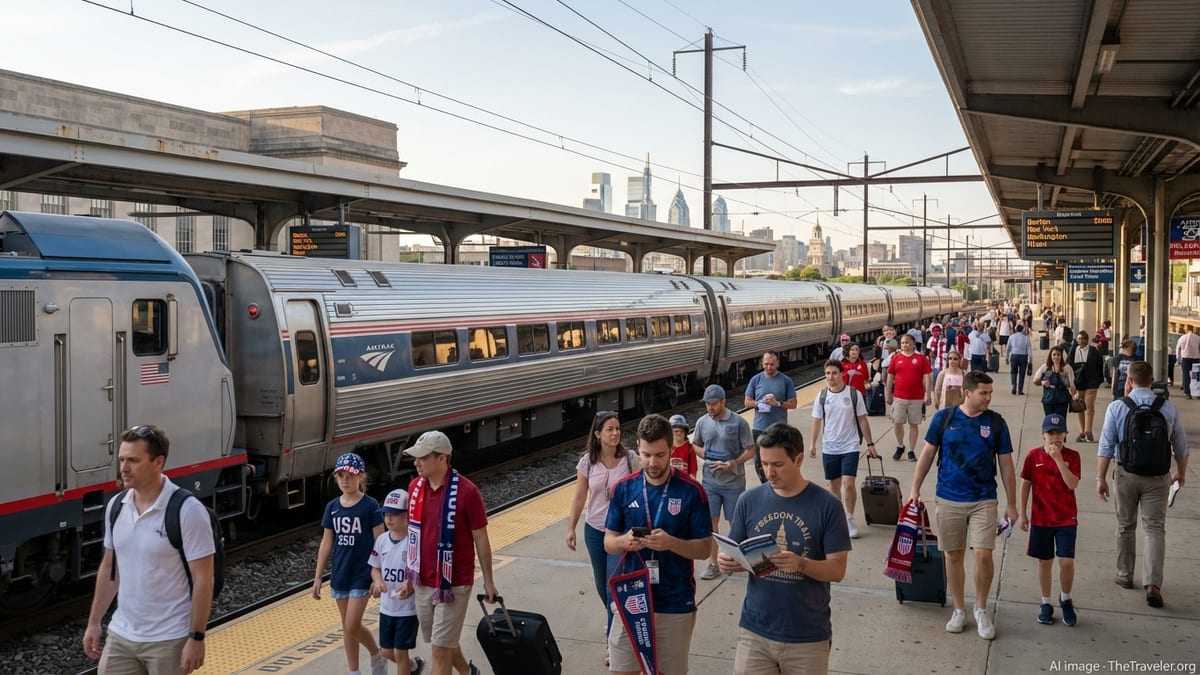
With the 2026 FIFA World Cup and the United States Semiquincentennial converging in the same American summer, the country is preparing for one of the most travel-intensive celebration seasons in its history. As planners in host cities from Seattle to Miami brace for record crowds, Amtrak is positioning intercity rail as a lower-stress, climate-friendlier way for fans and heritage travelers to move between stadiums, historic sites and major anniversary events.
For many visitors, especially international fans flying into one hub and exploring by land, the railroad could become the connective tissue of a once-in-a-generation journey that mixes global football with America’s 250th birthday.
More News
- Caribbean Travel to U.S. Upended by New Visa Freezes and Expanded Bans
- Mexico Restores E-Visas for Brazilians, Paving the Way for Borderless Tourism
- Philippine Airlines Joins Regional Carriers Powering Southeast Asia’s Tourism Boom
Two Mega Events, One Transformative Travel Season
The 2026 FIFA World Cup will run from June 11 to July 19, with 104 matches spread across 16 cities in the United States, Canada and Mexico. Eleven of those host cities are in the United States, including Atlanta, Boston, Dallas, Houston, Kansas City, Los Angeles, Miami, New York and New Jersey, Philadelphia, the San Francisco Bay Area and Seattle. Federal transportation planners are already warning of extraordinary traffic and highway congestion as fans follow their teams across sprawling distances between matches.
Layered on top of the World Cup is America’s Semiquincentennial, the 250th anniversary of the signing of the Declaration of Independence on July 4, 1776. The America 250 coordinating commission and partner states are designing a multi-year program of heritage trails, concerts, parades and cultural exhibitions that will crest in summer 2026. Philadelphia, Boston, New York, Washington and smaller Revolutionary War sites from Virginia to upstate New York are preparing for peak demand that will rival, and in some cases exceed, the Bicentennial crowds of 1976.
For domestic travelers, the overlap means a rare chance to watch group-stage matches in cutting-edge NFL stadiums and, within days, stand on Independence Hall’s cobblestones or walk Boston’s Freedom Trail. For international visitors, many of whom are expected to fly into major coastal hubs and then move internally, the main question is how to do all of it without spending their trip in rental-car queues and traffic jams.
That is where intercity rail, particularly Amtrak’s Northeast Corridor and key long-distance links, is drawing renewed attention from tourism boards and event planners intent on dispersing crowds more evenly and reducing the strain on highways and airports.
Where the Rails Meet the Goals: World Cup Cities on the Amtrak Map
Not every World Cup host city is rail accessible, but several of the most in-demand venues sit near established Amtrak corridors. On the East Coast, New York and New Jersey’s MetLife Stadium, Boston’s Gillette Stadium, Philadelphia’s Lincoln Financial Field and the greater Washington region are all located in the orbit of the Northeast Corridor, the busiest passenger rail line in the Western Hemisphere. High-frequency Northeast Regional and Acela services already link Boston, Providence, New York, Philadelphia, Wilmington, Baltimore and Washington, with additional connections branching to Hartford, Springfield and Harrisburg.
Further south, Miami’s Hard Rock Stadium is reachable via a combination of air, state-backed higher-speed services and Amtrak’s Silver Service trains that run along the Atlantic coast between New York and Florida. In the central and western United States, rail’s reach is more selective but still significant. Amtrak’s Texas Eagle and other services connect Dallas and its surrounding region to cities such as Austin, San Antonio, St. Louis and Chicago, while long-distance western routes offer rail links that may appeal to fans looking to combine match tickets with scenic slow travel.
Rail accessibility varies widely among the eleven U.S. host cities, which stretch from Seattle’s Lumen Field and Santa Clara’s Levi’s Stadium to Houston’s NRG Stadium and Kansas City’s Arrowhead Stadium. Still, tourism officials note that even partial rail coverage can ease regional road congestion by shifting thousands of car trips to trains, particularly on the densely populated East Coast.
While Amtrak has not yet unveiled a dedicated World Cup timetable, the company has begun highlighting its network overlaps with host regions in outreach to tourism agencies and local governments. The message is straightforward: on corridors where tracks already support multiple daily frequencies, adding capacity and adjusting schedules can be a faster, more flexible response to event surges than building new highway lanes or expanding airport terminals.
America 250: Rail as the Backbone of a Heritage Year
The Semiquincentennial will draw a different, but overlapping, crowd from the World Cup. Families tracing ancestral stories, history enthusiasts, school groups and civic organizations are all expected to fan out across the original thirteen colonies and beyond. Many of the marquee America 250 sites sit on, or a short transfer from, Amtrak’s long-established lines.
Philadelphia, which will be central to both the World Cup and the anniversary, is a prime example. Independence Hall, the Liberty Bell and the Museum of the American Revolution sit within a short ride of the city’s main rail hub, itself a busy Northeast Corridor stop. Boston’s colonial core, including Faneuil Hall, the Old State House and key points on the Freedom Trail, is similarly accessible by commuter and local transit from Amtrak-served stations at Back Bay and South Station.
New York’s Revolutionary War story is less visually concentrated but no less significant, stretching from lower Manhattan to sites along the Hudson Valley. Many of these areas are reachable via Amtrak and regional partners, offering visitors the chance to build multi-stop heritage itineraries without driving. In Virginia and the Carolinas, meanwhile, routes that connect Washington and the Mid-Atlantic to the South could see new interest from travelers linking battlefields and historic towns into longer rail journeys.
State tourism departments see an opportunity to package rail-inclusive itineraries that tie World Cup match days to visits at nearby heritage sites. A visitor coming to a group-stage match in the New York and New Jersey area, for example, could book a rail trip to Philadelphia or Boston for Semiquincentennial programming, then return north for another fixture, all on a single multi-city ticket.
Capacity, Coordination and the Federal Push for Multimodal Planning
The scale of the World Cup and the Semiquincentennial has prompted an unusual level of early cooperation among transportation agencies. The Federal Highway Administration has been circulating planning guidance that specifically calls out the 2026 tournament as a nationwide mobility challenge, encouraging states and cities to incorporate transit and intercity rail into their strategies rather than defaulting to road-centric solutions.
For Amtrak, that translates into complex operational questions. Where can existing infrastructure, such as the Northeast Corridor, safely absorb more trains during peak event weeks. Which stations will require temporary crowd-management measures as match days and anniversary events push passenger volumes toward or beyond record levels. How should maintenance windows be adjusted in a summer when service interruptions will be particularly disruptive. These are issues normally handled on a regional basis, but the convergence of events has forced planners to think in terms of a continental calendar.
On the ground, host cities are beginning to sketch out how rail fits into their own plans. Some are considering special event trains on match days, timed to deliver fans several hours before kickoff and depart after final whistles. Others are looking at integrated ticketing, in which a World Cup or America 250 pass might include discounted or bundled rail segments. Security coordination with local police and federal agencies is also under review, with stations in major host cities likely to see stepped-up screening on key dates.
Industry analysts note that while aviation will handle the bulk of long-distance travel across the tri-nation World Cup footprint, rail has a unique role in knitting together clusters of activity in the eastern United States. If Amtrak and its partners can manage crowd surges effectively, the tournament and the anniversary could demonstrate what a more rail-balanced national transport system looks like in practice.
From Stadiums to Historic Squares: Sample Rail-Centric Journeys
Travel planners are already sketching sample itineraries that connect stadium seats with historic streets via Amtrak. A typical Eastern Seaboard journey might begin in Boston, where fans attend a match at Gillette Stadium and spend a day following red-brick markers along the Freedom Trail, then board an evening train to New York to explore immigrant history at Ellis Island or modern cultural districts in Brooklyn.
From there, a short ride south on the Northeast Corridor delivers travelers to Philadelphia, where 1776-focused events will converge around Independence Hall and the surrounding squares. Visitors might time their arrival for a major commemorative ceremony, then stay overnight before continuing south to Washington. The capital is expected to host major national Semiquincentennial events, and separate plans for a high-profile motor race in August 2026 underscore how crowded the city’s calendar will be that year.
Another rail-driven pattern could see fans flying into Miami, combining beach time with group-stage matches, then using long-distance trains as part of a longer vacation up the Atlantic coast toward the Carolinas and Mid-Atlantic battlefields. While schedules on these routes are less frequent than in the Northeast, a growing interest in slow travel and lower-carbon tourism makes overnight or all-day rail segments part of the appeal for some visitors.
Travel advisors caution that such multi-city journeys will require careful advance booking. Summer 2026 will test not only stadium capacities and hotel inventories, but also the resilience of long-distance train services that are already popular with leisure travelers during peak months.
Opportunities and Obstacles: What Travelers Should Expect
For travelers eager to combine football and history, Amtrak’s potential advantages are clear. Trains offer city-center to city-center connections that can bypass congested suburban highways and airport security lines. On the Northeast Corridor in particular, journey times between Boston, New York, Philadelphia and Washington are competitive with flying when ground transfers are factored in, and onboard Wi-Fi and at-seat power make it easier to work or plan the next leg of the trip.
Yet the coming surge will also expose the system’s limitations. Several World Cup host cities, including Kansas City and parts of the Texas network, are served by relatively infrequent trains that share tracks with freight traffic. In the West, the long distances between host cities and the scenic, but slow, character of Amtrak’s long-distance routes mean that rail will be more of a niche choice for those building extended vacations around the tournament rather than a primary shuttle for match-to-match travel.
Infrastructure work along key sections of the Northeast Corridor is another variable, as projects to upgrade bridges, tunnels and signaling continue into the mid-2020s. While most construction is scheduled to minimize disruption, event organizers and passengers alike will be watching closely for any timetable changes as 2026 approaches. For now, Amtrak is signaling that it intends to maintain robust service and work with federal partners to manage demand rather than curtail it.
Traveler behavior may ultimately determine how successful rail is in relieving pressure on roads and airports. If a significant share of fans and heritage visitors opt for trains on at least one leg of their journeys, the cumulative effect could be substantial, especially in East Coast megaregions where short intercity hops are viable substitutes for short-haul flights or long car rentals.
What Amtrak and Cities Are Doing Now
Although detailed 2026 schedules are not yet public, discussions between Amtrak, federal agencies and local governments are well underway. Host cities along the Northeast Corridor are assessing station capacities, looking at temporary wayfinding, multilingual signage and additional staffing to help visitors unfamiliar with the network navigate platforms and connections efficiently during high-pressure match days.
Tourism boards are also exploring how to build rail options into official visitor messaging for both the World Cup and America 250. Early drafts of promotional materials emphasize that stadiums in the Boston, New York, Philadelphia and Washington region are reachable via some combination of regional rail, metro systems and intercity trains. Highlighting these options early may encourage visitors to factor rail into their lodging choices, favoring downtown hotels and neighborhoods with easy station access over car-dependent suburbs.
On the anniversary side, cultural institutions and historic sites are coordinating calendars to avoid overwhelming local infrastructure on any single weekend. Some are considering staggered or extended programming, which would spread visitor numbers more evenly across the summer months. For rail travelers, that could translate into more flexibility when choosing dates to combine museum visits, commemorative events and stadium visits.
Industry observers say that the way Amtrak and its partners frame 2026 could have lasting effects. If rail proves itself as a convenient, reliable backbone for large-scale tourism during a period of extraordinary demand, it may strengthen political and public support for longer-term investments in passenger rail, particularly in regions that currently lack high-frequency service.
FAQ
Q1. Which World Cup 2026 host cities in the United States are best connected by Amtrak?
Boston, New York and New Jersey, Philadelphia and the greater Washington region have the strongest Amtrak links via the Northeast Corridor, with frequent services and multiple daily departures. Miami and Dallas are reachable on longer-distance routes, but with less frequent trains.
Q2. Can I realistically use trains to travel between World Cup matches and Semiquincentennial events?
Yes, especially in the Northeast. It is feasible to attend a match in the New York and New Jersey area, then take Amtrak to Philadelphia or Boston for America 250 events, and continue on to Washington, provided you book tickets and accommodations well in advance.
Q3. Will there be special World Cup or America 250 trains in 2026?
Specific special trains have not yet been formally announced, but transportation planners and host cities are discussing event-focused schedule adjustments and additional capacity on busy days, particularly on the Northeast Corridor.
Q4. How early should I book Amtrak tickets for summer 2026?
While booking windows can vary, travelers should expect high demand and plan to reserve as soon as tickets are released for their desired dates, especially around key match days and the early July Semiquincentennial peak.
Q5. Are all World Cup host stadiums directly accessible by Amtrak?
No. Several U.S. host cities are well served by Amtrak, but others rely more heavily on air and road access. In many cases, rail passengers will need to use local transit, rideshare or shuttles for the final leg from the station to the stadium.
Q6. Is Amtrak planning infrastructure upgrades specifically for the World Cup and America 250?
Infrastructure upgrades on key corridors, including the Northeast Corridor, are already in progress for broader reliability and capacity reasons. These projects are not solely for the events, but their timing means they are being managed with 2026 in mind.
Q7. How does taking Amtrak compare with flying between East Coast host cities?
Between Boston, New York, Philadelphia and Washington, total travel times by train are competitive with air once airport transfers and security are included. Trains also offer downtown-to-downtown convenience, which can be advantageous for accessing both stadiums and historic districts.
Q8. Will Amtrak offer special fares or passes for 2026 travelers?
As of now, there are no official World Cup or America 250 pass products announced. However, Amtrak has a history of promotional fares and multi-ride options, so travelers should monitor fare announcements as 2026 approaches.
Q9. Can international visitors easily purchase and use Amtrak tickets?
Yes. International travelers can buy tickets using major payment cards and can receive e-tickets for use on mobile devices. Onboard conductors are accustomed to assisting visitors unfamiliar with the system.
Q10. What is the best strategy for combining World Cup matches and heritage travel on rail?
The most practical approach is to anchor your itinerary around one or two rail-rich hubs, such as New York and Philadelphia, schedule match days first, and then fill in heritage visits and anniversary events on the surrounding days, using Amtrak for regional hops and booking everything as early as possible.