

More news on this day
Amtrak passengers in California and across parts of the Southeast face a turbulent start to March as extensive track work forces full corridor shutdowns, schedule changes and rolling delays that are disrupting business and leisure travel alike.
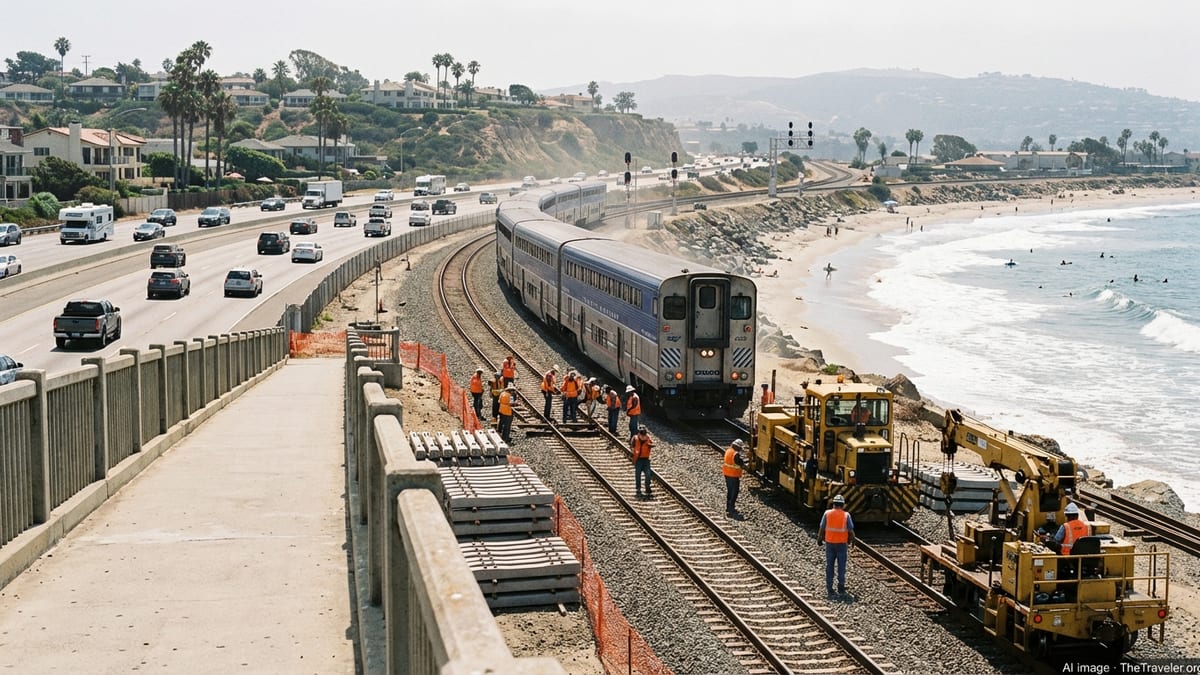
Pacific Surfliner Riders Brace for Complete Weekend Shutdowns
In Southern California, the heavily used Pacific Surfliner corridor will see some of the most acute impacts, with a full suspension of train service on core segments in early March. Notices shared by regional rail advocates indicate that on the weekend of March 7–8, 2026, tracks between San Luis Obispo and Los Angeles, as well as between Laguna Niguel and San Diego, will be completely closed to passenger trains while crews advance multiple construction projects along the coast. No replacement bus service is being provided on those stretches, leaving riders with limited options.
The shutdown affects both Amtrak’s Pacific Surfliner and the long-distance Coast Starlight, which shares portions of the same route. Travelers who typically rely on the train for coastal trips between San Diego, Orange County and Los Angeles, or for longer journeys north to the Central Coast and beyond, are being urged to rebook for alternate dates or seek out driving, intercity bus or air travel instead.
Rail planners and local officials say the concentrated work window will help accelerate a package of double-tracking, bridge replacement and coastal resilience projects intended to protect the fragile right-of-way from erosion and to boost capacity in future years. Critics, however, argue that the all-day, all-line closures show agencies prioritizing cost savings and construction convenience over passenger needs by not spreading the work out into overnight windows or offering robust bus bridges.
Amtrak has advised passengers to check their booking status daily and monitor service alerts closely, as additional adjustments, rolling closures or short-notice cancellations are possible if construction schedules or safety conditions change.
California Construction Push Collides With Growing Rail Demand
The latest round of track work in California lands just as Amtrak and state partners have been working to rebuild and expand service following years of weather-related shutdowns and pandemic-era reductions. Along the coast, the Pacific Surfliner only recently restored its full schedule south of Orange County after a series of landslides and bluff stabilization projects near San Clemente repeatedly severed the line in 2023 and 2024. With full pre-pandemic frequencies restored as of early 2026, demand has been steadily rebounding.
That recovery means this month’s planned outages and cancellations will be felt even more acutely. Business travelers and regular commuters who had come to depend on the train to avoid increasingly congested freeways now face longer journeys by car or must juggle work commitments to travel on unaffected days. Tourism operators along the coast, from beach towns in San Diego County to wine country in San Luis Obispo County, also warn that a lost spring weekend of rail access can ripple through hotel bookings and restaurant traffic.
State rail officials maintain that the construction blitz is necessary to support that very growth, framing the near-term pain as part of a broader modernization push. Ongoing projects include new segments of double track designed to ease bottlenecks, bridge and culvert work aimed at improving resilience to heavy storms, and signal upgrades that will eventually enable more frequent and reliable service. As one transportation planner noted in a recent public meeting, these outages are taking place against a backdrop of long-term federal and state investment, including grants secured to add round trips on the Surfliner corridor over the next several years.
Still, passenger advocates in California say the communication strategy has lagged behind the engineering schedule. Some riders only learned of the March 7–8 shutdown through online forums and social media days before tickets disappeared from the booking system, stoking frustration that official channels and real-time alerts were not more proactive or detailed about alternatives.
Daytime Track Windows Slow Amtrak Trains in the Southeast
While California contends with outright cancellations, passengers in the Southeast face a different kind of disruption as daytime track maintenance windows slow long-distance and regional trains over the next several weeks. In North Carolina and neighboring states, Class I freight railroad CSX is carving out extended work periods on key sections of its main line, prompting Amtrak to temporarily lengthen schedules and warn of substantial delays.
According to an operations bulletin shared with passenger-rail industry outlets, two prominent routes are affected: the Chicago to Florida Floridian and the Carolinian, which links Charlotte and New York. Through at least March 16, both trains are operating on adjusted timetables that add more than two hours to their journeys at some intermediate points, including Raleigh and Charlotte for the Carolinian and Raleigh and Savannah for the Floridian.
Dispatchers are also imposing additional slow orders in a notorious single-track segment between Rocky Mount, North Carolina, and Petersburg, Virginia, a long-standing choke point where freight and passenger traffic converge. Since the revised schedule took effect late last week, the northbound Floridian has at times lost an extra 45 minutes to two hours traversing this corridor, compounding the planned padding and leaving arrival times in major cities highly variable.
Amtrak says mechanical teams have so far managed to turn the trains around quickly at their endpoints, keeping southbound departures close to their published times despite the extended northbound runs. Even so, passengers booking connections in Chicago or the Southeast are being cautioned to allow extra time or consider more flexible itineraries until the maintenance campaign is complete.
Freight Railroad Projects Highlight Passenger Rail Vulnerabilities
The latest disruptions underscore a structural reality of American passenger rail: outside the Northeast Corridor and a handful of state-owned lines, Amtrak operates almost entirely on tracks owned, dispatched and maintained by freight railroads. In California, major construction decisions affecting intercity trains are shaped by a patchwork of local agencies and freight carriers responsible for the coastal right-of-way. In the Southeast, CSX controls the timing and scope of the track work that is now slowing Amtrak services.
For passengers, the effect is the same, whether the issue is a bluff stabilization project along the Pacific or a tie and ballast program on a freight main line in North Carolina. Timetables become fluid, trains are annulled or retimed with little warning, and customer-facing information often lags behind internal operating plans. Travel advisors say this makes it difficult to confidently recommend rail for time-sensitive trips, even as Amtrak and its state partners market trains as a climate-friendly alternative to driving and short-haul flights.
Industry analysts note that the recent wave of federal infrastructure funding, including grants targeting corridor upgrades and freight-passenger conflict points, could eventually alleviate some of these pain points. Dedicated passing tracks, additional double-track sections and modern signaling can provide more flexibility for work windows and reduce the need for wholesale service shutdowns. However, those improvements take years to design, permit and build, leaving passengers to navigate a period of growing but still fragile rail networks.
In the meantime, travel planners recommend that anyone riding Amtrak in affected regions during March build extra time into their itineraries, avoid tight cross-platform connections, and make liberal use of the Amtrak app or text alerts for last-minute changes. For longer journeys traversing multiple railroads, they add, flexibility on travel dates can sometimes be the difference between a smooth trip and a day of cascading delays.
What Travelers Should Expect Over the Coming Weeks
With track work already underway and more closures scheduled, Amtrak customers in both California and the Southeast should anticipate an unsettled service pattern for at least the first half of March. On the Pacific Surfliner, no trains will operate on certain coastal segments during the March 7–8 construction window, and riders on adjacent dates may encounter modified schedules, altered stopping patterns or equipment substitutions as Amtrak repositions trainsets.
In North Carolina and neighboring states, extended running times for the Carolinian and Floridian will remain in place through March 16, with the possibility of additional slow orders if maintenance progress lags or new work zones are added. Travelers boarding at intermediate stations are advised to pay particular attention to revised departure times, which may differ significantly from the schedules printed on station posters or long-standing online timetables.
Customer service staff report a spike in calls and messages from riders seeking clarity on whether their specific departure is running and how far in advance they should arrive. While Amtrak’s reservation systems reflect the current plan, agents caution that further tweaks are common as freight railroads refine their work windows or respond to weather, crew availability and mechanical issues.
For now, the message from rail operators is that the inconvenience is temporary but unavoidable if the national passenger rail network is to emerge more robust. Once the current blitz of track work is complete, they say, travelers in California and the Southeast should see smoother rides, fewer slow orders and a system better prepared to handle both daily commuters and a growing wave of leisure travelers discovering rail.