

More news on this day
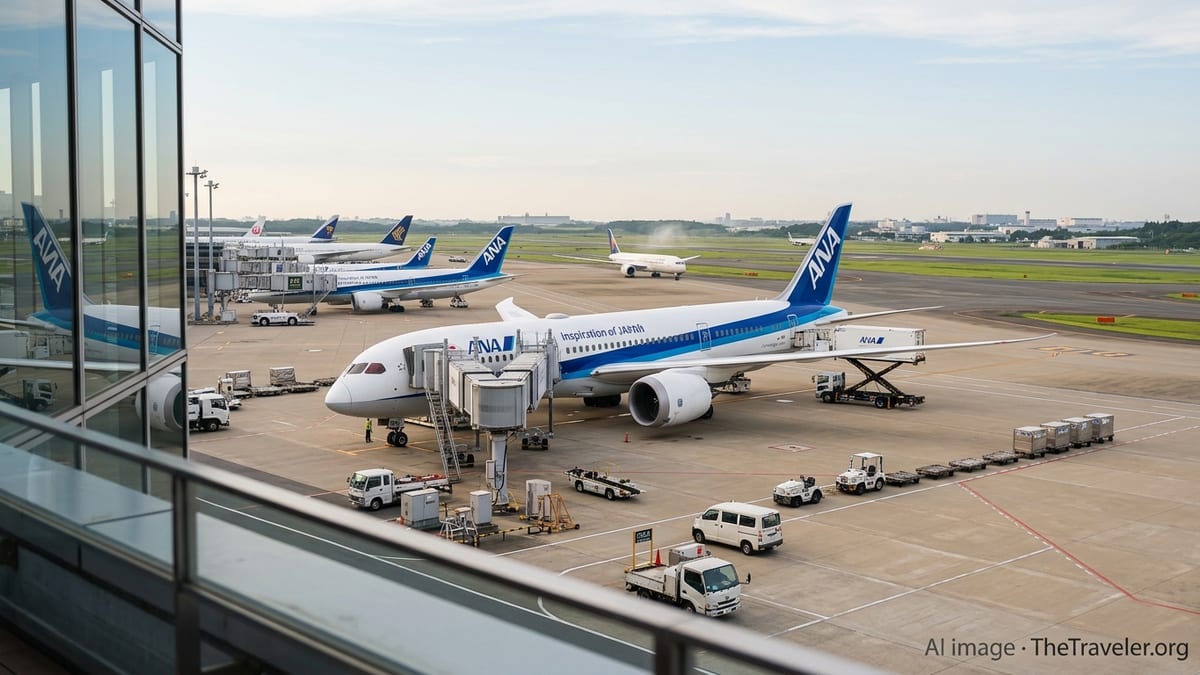
All Nippon Airways is sharpening its Dreamliner strategy with a fresh wave of Boeing 787-9 aircraft, aiming to channel more visitors from South Korea, Taiwan and the United States into Japan’s cities, resorts and regional hubs.
Get the latest news straight to your inbox!
New 787-9 Orders Signal Long-Haul Ambitions
Publicly available filings and airline industry coverage indicate that ANA Holdings has committed to 18 additional Boeing 787-9 aircraft for the ANA brand, part of a wider 77-jet order placed with multiple manufacturers. The new widebodies are earmarked primarily for international routes, particularly on sectors linking Asia and North America, and are scheduled to join the fleet from August 2026.
The 787-9 has long been the backbone of ANA’s international network, balancing range with fuel efficiency on routes where demand does not justify larger twin-aisle aircraft. Company reports describe the latest batch as growth aircraft rather than simple replacements, supporting an objective to increase international capacity significantly by the end of the decade compared with fiscal 2023 levels.
ANA investor materials outline a strategy that hinges on the planned expansion of Tokyo Narita Airport and tighter integration with Tokyo Haneda’s premium business and government traffic. The arrival of new Dreamliners is framed as essential to restoring the group’s pre-pandemic scale and then pushing beyond it, with long-haul services singled out as a major earnings driver.
Industry analysts note that ANA already operates one of the world’s largest Dreamliner fleets, and the new aircraft will deepen that specialization. The airline is positioning the 787-9 as its primary workhorse for new and upgraded international routes, a move that allows more consistent product standards while also simplifying maintenance and crew planning.
More Seats From South Korea and Taiwan Into Japan
While ANA’s headline growth story often focuses on Europe and North America, the airline’s scheduling documents show that short- and medium-haul regional routes are also slated to benefit from additional 787-9 capacity. South Korea and Taiwan sit at the center of this plan, reflecting strong outbound leisure demand for Japan and solid business links with Tokyo and Osaka.
Japan’s tourism authorities have repeatedly highlighted South Korea as one of the country’s largest visitor markets, and airlines across the region have been rebuilding or expanding routes accordingly. Industry data shows robust two-way traffic, with Korean leisure travelers returning in large numbers to Japanese destinations such as Fukuoka, Sapporo and Kyushu, often via Tokyo. ANA’s deployment of higher-capacity jets on select trunk services is designed to accommodate those flows, especially in peak holiday periods.
Taiwan has emerged as another high-potential source market. Travel trade reports indicate rising year-round demand for cultural, culinary and nature-focused trips to Japan, with itineraries that often mix Tokyo with regional cities such as Kanazawa, Nagoya and Hakodate. By shifting some services to 787-9 aircraft and coordinating with domestic connections, ANA is able to feed more Taiwanese travelers into secondary destinations that depend heavily on tourism revenue.
Network planners are also using the new aircraft to smooth capacity between major Asian gateways and Japan’s two primary international hubs. The aim is to create more predictable seat availability and pricing, reducing reliance on last-minute charters or narrowbody aircraft upgauges during seasonal surges from Seoul, Busan and Taipei.
Transpacific Capacity Boost From the United States
On the transpacific front, ANA’s updated medium-term strategy centers on growing capacity to and from the United States as new Dreamliners arrive. Public planning documents reference a target of significantly scaling North America operations from Narita once the airport’s expansion progresses, with 787-9s highlighted as the principal aircraft type for that growth.
Recent schedule adjustments already show a gradual shift from smaller 787-8s to 787-9s on select routes, including services from key US gateways on the West Coast. Aviation data and enthusiast tracking suggest that seat counts on some Tokyo flights have increased as these changes take effect, adding more economy and premium cabin inventory without altering frequencies.
Reports from aviation trade publications point to additional opportunities as ANA looks beyond traditional US strongholds. With competition intensifying from American, Delta, United and various Asian carriers on major transpacific corridors, ANA is expected to use the flexibility of the 787-9 to test new city pairs or seasonal routes, while maintaining strong links to existing hubs that feed corporate and high-yield traffic.
For US travelers, the use of more 787-9s means greater access to Japan’s domestic network via one-stop itineraries through Tokyo. The aircraft’s range and efficiency allow ANA to time arrivals and departures to align with onward flights to Hokkaido, Okinawa and regional cities, an approach that channels long-haul demand directly into local tourism economies.
Cabin Upgrades Aimed at High-Spend Travelers
ANA is pairing its fleet growth with a major onboard product refresh. The airline has announced that 787-9s delivered from fiscal 2026 will feature new cabins in all classes, including an updated business class suite known as THE Room FX, along with revised premium economy and economy seating. The changes are billed as an evolution of the long-haul product designed to compete in a crowded premium travel market.
Industry coverage of ANA’s product plans highlights a focus on privacy, direct aisle access and improved inflight technology for business class, while premium economy is expected to see clearer differentiation from standard economy through enhanced legroom and upgraded service elements. In economy, ANA is working with slimmer yet ergonomically improved seating that preserves passenger comfort while accommodating competitive seat counts.
From the perspective of Japan’s hospitality sector, these cabin enhancements are significant because they target high-spend segments. Business travelers, affluent leisure guests and long-stay visitors from the United States, South Korea and Taiwan tend to favor carriers that offer modern, comfortable cabins, and they are more likely to book higher-category hotel rooms, dine out frequently and participate in paid tours once they arrive.
Travel industry observers suggest that ANA’s investment in the onboard experience is closely aligned with Japan’s wider push for “quality over quantity” in tourism, seeking visitors who stay longer and spend more rather than simply maximizing headcount. By making the long-haul journey more appealing, the airline effectively supports that national objective.
Tailwinds for Japan’s Hotels, Cities and Regions
The broader economic implications of ANA’s Dreamliner pivot are already a subject of discussion among tourism boards, hoteliers and regional governments. More capacity from nearby Asian markets and the United States tends to translate into higher inbound visitor numbers, which in turn supports hotel performance, restaurant revenues and demand for cultural and outdoor attractions.
Urban centers such as Tokyo, Osaka and Fukuoka are expected to capture a large share of the growth, particularly in business and mixed-purpose travel. However, ANA’s hub-and-spoke model means that secondary and tertiary destinations can also benefit as more passengers connect onward from long-haul flights. Regions promoting ski tourism, hot springs, traditional towns and coastal getaways are positioning themselves to attract visitors arriving on expanded ANA services.
Hotel development pipelines in several Japanese cities already reflect confidence in sustained inbound demand. Industry reports detail new openings and major renovations timed around milestones such as airport expansions and airline network growth. Additional ANA capacity from South Korea, Taiwan and the United States adds another layer of support for those investment decisions.
Tour operators and travel agencies are likewise adjusting their offerings in anticipation of a more robust seat supply. Package tours that combine flights on ANA’s 787-9s with stays at upscale ryokan, urban design hotels or resort properties are expected to feature prominently in marketing campaigns targeting Korean, Taiwanese and American travelers. As those itineraries take hold, the airline’s Dreamliner strategy is likely to be felt well beyond airport terminals, reshaping how international visitors experience Japan’s hospitality landscape.