

Passengers on All Nippon Airways flight NH223 endured a marathon “flight to nowhere” on February 17, spending more than 13 hours in the air before their Tokyo to Frankfurt service turned back mid-route and returned to Tokyo over a reported mechanical concern, with the onward departure now rescheduled for the following morning.
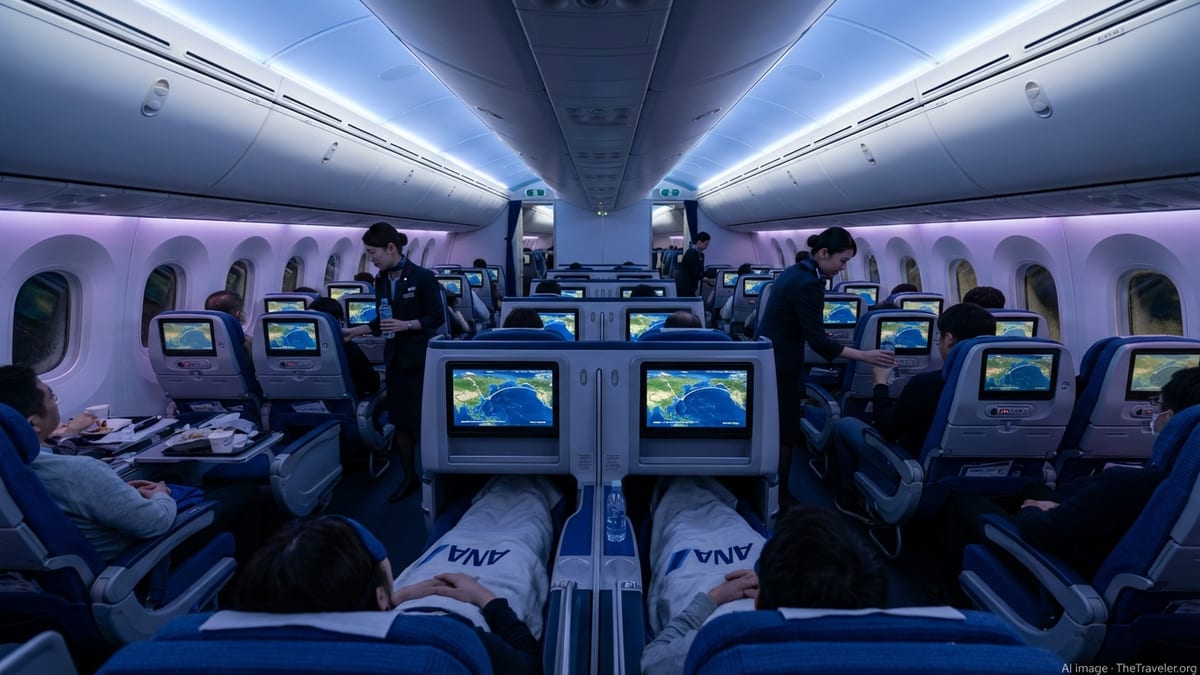
Long-Haul Flight to Europe Becomes a Loop Back to Tokyo
All Nippon Airways flight NH223, operated by a Boeing 787-9 Dreamliner, departed Tokyo Haneda Airport on the morning of February 17 local time, bound for Frankfurt, one of the carrier’s key European gateways. Scheduled to arrive in Germany later the same day, the service instead became an exhausting round trip when the aircraft ultimately returned to its origin after more than 13 hours in the air.
Tracking data shows the flight following its usual trans-polar routing toward Europe, passing north of Alaska en route to the North Atlantic. It was over the Arctic region, several hours into the journey, when the crew identified a maintenance concern and discontinued the westbound crossing. Rather than diverting to an intermediate airport in North America or continuing across the Atlantic, ANA opted to reroute the aircraft all the way back to its base in Tokyo.
By the time the Dreamliner touched down again at Haneda, passengers had effectively completed a long-haul round trip without ever reaching Europe. The flight time, estimated at around 13 hours, is comparable to a typical nonstop sector between Japan and Western Europe, but travelers stepped off the aircraft exactly where they had boarded that morning.
Safety-First Decision Leads to Unusual Arctic Turnback
ANA has not detailed the precise nature of the maintenance concern, but the airline confirmed that the issue required attention from its own technical teams in Tokyo. The decision to make a mid-flight U-turn near the polar region reflects a conservative, safety-first approach that airlines routinely apply in the face of potential mechanical anomalies on long overwater routes.
On ultra-long-haul flights between Asia and Europe, routing often passes near or over the Arctic and remote northern territories, where diversion airports are fewer and weather can be challenging. Should an aircraft divert to a smaller or remote airfield, airlines can face significant logistical hurdles in positioning engineers, spare parts, and a replacement aircraft. Returning to a major hub, even at the cost of a lengthy detour, can offer more predictable options for repairs and passenger reaccommodation.
From an operational perspective, the choice to bring the aircraft back to Haneda meant ANA could handle the problem within its primary maintenance infrastructure. For passengers, however, it converted what was meant to be a straightforward Tokyo–Frankfurt journey into an all-day odyssey with no progress toward their destination and an onward delay extending into the next day.
Rescheduled Departure Adds More Than 20 Hours to Travel Plans
Following the return to Tokyo, ANA moved quickly to reorganize travel plans for the disrupted passengers. The airline scheduled a replacement departure from Haneda to Frankfurt for the morning of February 18, with a new takeoff time shortly after 7 a.m. local time. That rescheduled flight time translates into a delay of roughly 20 and a half hours from the original schedule.
For many travelers, particularly those with onward connections from Frankfurt into the wider European network, the extended delay meant missed meetings, reshuffled itineraries, and urgent calls to hotels and partners to rebook arrangements. Business travelers bound for financial hubs such as Frankfurt, Brussels, and other European capitals were especially affected by the loss of a full day on the ground.
ANA staff at Haneda worked through the evening to assist passengers with hotel accommodations, meal vouchers, and new itineraries. Some travelers were placed on alternative routes via partner airlines and other ANA services where space permitted, while those choosing to wait for the rescheduled NH223 departure were rebooked on the next morning’s flight.
Passenger Frustration After a “Flight to Nowhere”
For those on board, the experience was as disorienting as it was exhausting. After settling into the rhythm of a long-haul flight, many passengers expected to emerge into a European evening in Frankfurt. Instead, they found themselves back in Tokyo after a full day in the air, with body clocks already adjusting to a time zone they never actually reached.
The sense of frustration was compounded by the unusual geography of the turnback. The aircraft had already cleared Japan, Siberia, and the Arctic latitudes north of Alaska when it began its return, retracing thousands of kilometers across the polar route. Travelers accustomed to trans-Eurasian flights rarely expect a scenario where they are closer to the North Pole than to their original departure airport when a decision is made to return home.
Some passengers described the journey as a “flight to nowhere,” pointing out that they had endured virtually the entire duration of a typical Tokyo–Europe service only to disembark in the same terminal where their trip began. While many acknowledged that safety considerations must take precedence, the emotional and physical toll of such a disruption left tempers frayed and patience thin by the time the aircraft’s doors finally opened back at Haneda.
Operational and Financial Implications for ANA
An event of this nature carries significant operational and financial consequences for an airline. The cost of fuel alone for a 13-hour long-haul sector that returns to origin is substantial, and the aircraft in question must be removed from regular rotation until maintenance specialists resolve the underlying issue. That disruption can ripple through the carrier’s schedule, affecting not just the immediate Frankfurt service but also subsequent flights that rely on the same aircraft frame.
Beyond fuel and maintenance, ANA faces obligations to support passengers with accommodation, meals, and rebooking assistance, as well as potential compensation under European and international consumer protection frameworks for those ultimately arriving late into Frankfurt or onward European destinations. While the exact financial impact is difficult to quantify in real time, such operational irregularities can run into hundreds of thousands of dollars once all ancillary expenses are tallied.
From a reputational standpoint, however, the incident also offers ANA an opportunity to emphasize its safety culture. Airlines often highlight that choosing the most conservative option, even at substantial immediate cost and inconvenience, is central to their responsibility to passengers and crew. Clear communication and visible efforts to take care of affected travelers will be key in determining how this particular episode is remembered.
Context: Japan–Europe Travel Demand and Tight Schedules
The disruption to NH223 comes at a time of robust demand between Japan and Europe, with ANA steadily rebuilding and expanding its European network over the past several years. Frankfurt is one of the airline’s primary hubs on the continent, offering both point-to-point service for business and leisure travelers and onward connectivity via partners into Germany and neighboring countries.
On the Tokyo–Frankfurt route, ANA deploys the Boeing 787-9 throughout the schedule, with typical non-stop flight times of around 14 to 15 hours. Schedules are carefully timed to feed both Asian departures from Tokyo and morning and afternoon banks of connecting flights out of Frankfurt. A major irregularity such as this can therefore cascade across multiple itineraries, with missed connections potentially stretching as far as Scandinavia, Southern Europe, and beyond.
As airlines fine-tune schedules to keep aircraft utilization high, there is often limited slack in the system to absorb an event that removes a long-haul aircraft for an extended period. ANA’s ability to put on a rescheduled service the following morning underlines the importance of fleet flexibility and close coordination with ground operations, maintenance, and alliance partners in Europe.
How Rare Are Mid-Route Returns on Long-Haul Flights?
While most long-haul journeys proceed uneventfully, mid-route returns or significant diversions are not unprecedented, particularly on polar or transoceanic routes. Airlines and flight crews are trained to respond decisively to any anomaly that could affect safety or operational reliability, using a combination of onboard diagnostics, consultation with company operations centers, and, where necessary, advice from aircraft and engine manufacturers.
On polar crossings between Asia and Europe, decision-making is further complicated by the remote environment, limited diversion options, and the distances involved. In some scenarios, turning back to a well-equipped hub or major gateway city can offer a more controlled and predictable outcome than diverting to a smaller or distant airport where maintenance resources are limited and passenger handling capabilities are constrained.
Despite their rarity, such incidents tend to capture public attention precisely because they highlight the invisible layers of planning that support modern air travel. For passengers, the experience is deeply inconvenient. For airlines, it is a stark demonstration of the intricate balance between operational efficiency and an unwavering commitment to safety.
What Travelers on Future Long-Haul Flights Should Expect
For current and future travelers on ANA’s Tokyo–Frankfurt route and other long-haul services, the airline is expected to operate upcoming flights as scheduled, once the affected aircraft has been inspected and either returned to service or substituted. Passengers with bookings in the coming days are advised to monitor their flight status closely and ensure that contact details in their reservations are up to date so they can receive notifications of any changes.
More broadly, the incident is a reminder that even in an era of highly reliable aircraft and advanced predictive maintenance, disruption can still strike, especially on complex intercontinental operations. Travel experts often recommend allowing generous connection windows after ultra-long-haul flights and building some flexibility into itineraries, particularly when traveling for high-stakes business commitments or time-sensitive events.
For the passengers of NH223, February 17 will be remembered as an exhausting detour in the skies above the Arctic, one that ended not with an arrival in Europe, but with a late-night return to Tokyo and a fresh boarding pass for the following morning. For ANA and the broader industry, it serves as another case study in how airlines manage rare but consequential operational decisions at altitude.