

More news on this day
Passengers on All Nippon Airways flight NH223 from Frankfurt to Tokyo endured a 13-hour “flight to nowhere” this week after their Boeing 787-9 made an emergency U-turn over Alaska and returned to Japan, forcing a full cancellation of the journey and a rescheduled departure for frustrated travelers.
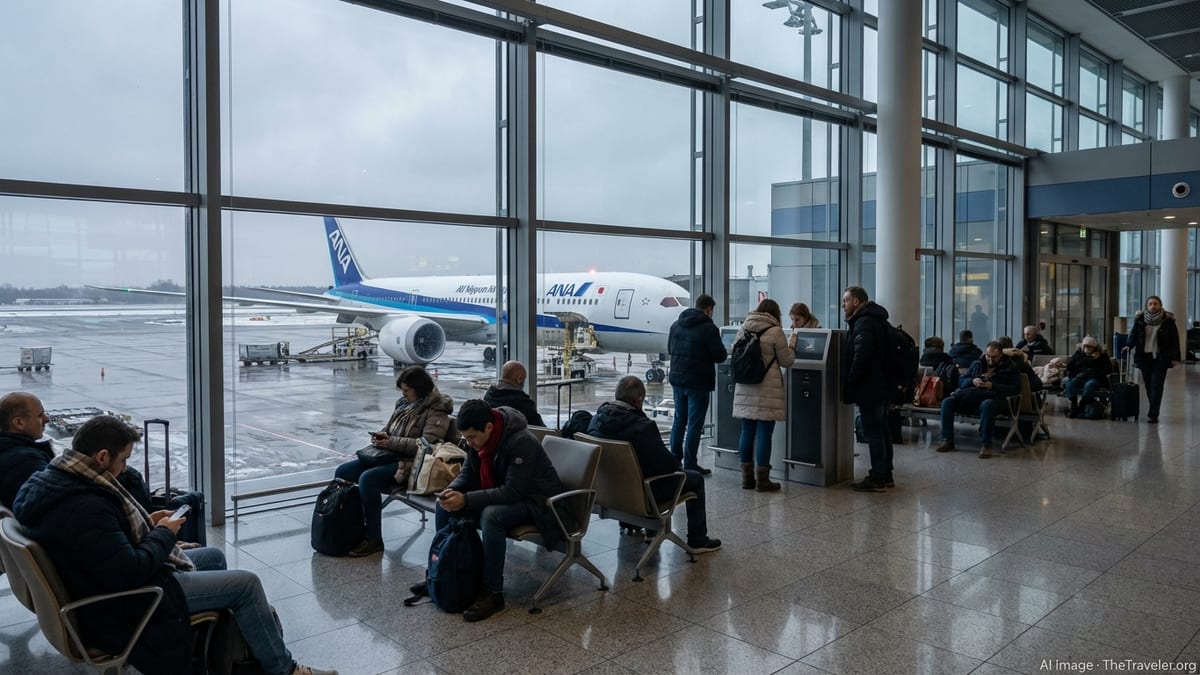
A Long-Haul Journey Cut Short Over the Arctic
All Nippon Airways’ Frankfurt to Tokyo service, flight NH223, turned into a marathon ordeal when a technical concern prompted the crew to abandon the transpolar crossing and head back to Japan rather than continue toward Europe or divert to North America. The aircraft, a Boeing 787-9 Dreamliner, had already been in the air for more than six hours and was cruising over the high latitudes near Alaska when the decision was made.
Tracking data showed the jet following its usual northern route before executing a wide U-turn over the Arctic. By the time the aircraft completed its loop and descended toward Tokyo, passengers had spent in excess of 13 hours flying, only to find themselves back at their point of origin and still no closer to Frankfurt.
The incident unfolded on February 17, 2026, at the height of the busy winter travel period between Europe and Japan, with many passengers booked on onward connections from Frankfurt to other European destinations. What was scheduled to be a single overnight long-haul flight instead became an exhausting odyssey with missed meetings, disrupted holidays, and hurried rebookings.
While no injuries were reported and the flight ultimately landed safely, the scale of the turnaround, the remote location over which it was ordered, and the length of time passengers were trapped onboard have drawn widespread attention among frequent flyers and aviation watchers.
Mechanical Concern Triggers Precautionary Return
According to information released by the airline, the decision to abandon the westbound leg was driven by a maintenance concern detected while the aircraft was well into its Arctic crossing. Although ANA has not specified the exact nature of the problem, it was significant enough that continuing toward Europe or diverting to a North American airport was deemed less desirable than returning the aircraft to its home maintenance base.
For modern long-haul operations, especially on twin-engine widebodies such as the Boeing 787-9, any anomaly involving key systems or components will trigger a detailed in-flight assessment. Senior pilots coordinate with airline operations and maintenance control centers on the ground, weighing options that include continuing the flight, diverting to the nearest suitable airport, or returning to base. In this case, ANA and the flight crew opted for the latter, prioritizing access to the carrier’s own engineers and spare parts inventory in Tokyo.
Aviation analysts note that the decision matrix in these circumstances is complex. Factors typically include the nature of the defect, the range and diversion capabilities of the aircraft type, weather and runway conditions at potential diversion airports, and the availability of qualified maintenance personnel and equipment. Returning to Tokyo meant the airline could handle inspections, potential part replacements, and compliance paperwork on familiar ground.
From a safety standpoint, the move reflects the highly conservative approach major international carriers are expected to take. The aircraft was never reported to be in immediate danger, but the combination of a mechanical alert and the flight’s remote over-water position above the Arctic pushed operators toward the most controlled environment: the airline’s primary engineering hub.
Inside a 13-Hour “Flight to Nowhere”
For those onboard, the experience was both surreal and draining. Passengers had settled in for a standard long-haul from Frankfurt to Tokyo when the crew informed them that the aircraft would instead be returning to Japan. With no opportunity to disembark mid-route, travelers remained strapped into a routine that suddenly lost its endpoint.
The cabin environment reportedly remained calm, with crew providing regular updates and continuing meal, beverage, and in-flight entertainment service as the jet traced its long arc back toward Asia. Yet the psychological impact of watching the flight map switch from westbound progress to an eastbound retrace of the same Arctic expanse was considerable, particularly for those with tight schedules, business appointments, or onward connections from Frankfurt.
Parents traveling with children faced the challenge of keeping young passengers occupied far longer than expected, while older travelers and those in economy class grappled with the physical strain of an extended period in a confined seat. Even passengers in premium cabins described the experience as fatiguing, as circadian rhythms and expectations for arrival melted into uncertainty.
By the time the 787-9 finally touched down back in Tokyo, the flight time had climbed to around 13 hours, matching or exceeding the duration of many non-stop intercontinental journeys. Instead of stepping into Frankfurt’s Terminal 1, passengers found themselves re-entering the familiar surroundings of Tokyo, only this time as disrupted travelers rather than successful arrivals.
Rescheduled Departure and Passenger Rebooking
After landing, ANA moved quickly into recovery mode, canceling the original Frankfurt-bound sector and arranging a new departure for the affected customers. The replacement flight was scheduled for the morning of February 18, creating an overall disruption of more than 20 hours compared to the original itinerary for some passengers.
Ground staff faced the complicated task of rebooking travelers not only onto the rescheduled NH223 service but also onto new onward flights from Frankfurt to final destinations across Europe and beyond. For some, that meant securing alternative routes via partner airlines in other hubs, including connections through cities such as Munich, Vienna, or London, while others opted to delay or cancel segments of their journeys entirely.
In line with common industry practice for irregular operations of this scale, affected passengers were provided with hotel accommodation, meal vouchers, and assistance with visa or entry formalities where necessary. Those based in Japan were offered the option to return home and rejoin the new departure, while international travelers originating in Europe had to weigh whether to proceed or adjust their plans altogether.
Compensation rules varied depending on each passenger’s ticket type, routing, and local consumer protection requirements. While the immediate focus was on moving people to their destinations as smoothly as possible, questions about reimbursement for lost business time and missed events are expected to continue in the days ahead.
Why Airlines Sometimes Choose to Return to Base
A 13-hour turnaround flight captures public attention precisely because it feels counterintuitive. To many travelers, diverting to a closer airport in Alaska, Canada, or the United States might seem the more logical step. However, airline operations experts note that the safest and most efficient decision from an operational perspective is not always obvious from a passenger’s point of view.
Major hubs such as Tokyo offer deep maintenance resources, readily available spare parts, and a full complement of airline engineers who are intimately familiar with specific aircraft and their service history. In contrast, smaller or more remote airports, even in developed countries, may not stock the required components or have contracts in place with local maintenance providers to perform complex inspections or repairs on sophisticated long-haul aircraft like the 787-9.
Additionally, a diversion to a foreign airport can trigger its own cascade of complications, including crew duty-time limits, the need to arrange special ground handling, limited passenger accommodation options, and difficulties securing replacement aircraft. Returning to Tokyo, while painful for passengers already many hours into their journey, allowed ANA to concentrate both technical and customer recovery efforts at a familiar base.
In recent years, airlines worldwide have increasingly emphasized “home base solutions” for borderline technical events on long-haul flights, especially when the aircraft remains fully controllable and safe to operate. While rare, incidents like NH223 illustrate how this strategy can lead to highly unusual outcomes, particularly when they occur over remote stretches of the globe.
Operational Pressures on Long-Haul Networks
The disruption to NH223 comes at a time when Japanese carriers, including ANA, are under significant pressure to maintain reliability on busy intercontinental routes. Tight aircraft availability, ongoing supply-chain challenges for spare parts, and strong demand for travel between Asia and Europe have left little room for schedule slack when technical issues arise.
ANA’s European network is a key pillar of its long-haul strategy, connecting Tokyo with major capitals and financial centers. Daily or near-daily services to cities like Frankfurt play a crucial role not only for point-to-point traffic but also for connecting passengers traveling between Europe and other parts of Asia via Tokyo. When a single flight experiences a major disruption, the ripple effects can extend across multiple routes and partner airlines.
Episodes like the NH223 turnaround highlight how quickly a network can come under strain. With a Boeing 787-9 temporarily removed from its planned schedule for inspection and any necessary repairs, planners must reshuffle aircraft and crews across the system. This can result in tighter turnarounds for other flights, strategic use of spare frames where available, and occasional downgrades or cancellations on lower-demand routes.
For passengers, the visible impact takes the form of schedule changes, substitution of different aircraft types, or, in rare cases, “flight to nowhere” events that become talking points on social media and in travel circles. For airlines, they serve as a reminder that even with modern fleets and sophisticated predictive maintenance, long-haul operations remain vulnerable to single-point technical issues.
Passenger Rights and Expectations in Major Disruptions
Events like the NH223 turnaround also cast a spotlight on passenger rights and the expectations travelers bring to long-haul flights. Customers typically accept that safety must override schedule considerations, but they also look for transparency, timely information, and meaningful gestures of goodwill when their plans are significantly disrupted.
Throughout the ordeal, cabin crew serve as the face of the airline, relaying information from the cockpit and operations teams and managing customer reactions in real time. Clear explanations of the situation, reassurance about safety, and practical details about what will happen after landing can go a long way toward preserving trust, even when the outcome is a lengthy delay.
In markets with strong consumer protection frameworks, passengers may be entitled to compensation or refunds when a flight is canceled or severely delayed, especially if the cause is within the airline’s control. While mechanical issues are sometimes treated differently from weather or air traffic control disruptions, many carriers now adopt a more customer-centric approach, offering goodwill credits, bonus mileage, or partial fare refunds to acknowledge the inconvenience.
For the travelers on NH223, the memory of spending more than half a day in the air only to return to their starting point will likely linger long after they finally arrive in Frankfurt. How ANA handles post-event communication and support may determine whether the incident is viewed as a one-off misfortune handled professionally, or as a failure of customer care.
Broader Implications for Travelers on Polar Routes
The NH223 incident underscores the unique challenges associated with polar and near-polar routes, which have become increasingly common as airlines seek fuel-efficient paths between Asia, Europe, and North America. These trajectories shorten great-circle distances but transit vast stretches of sparsely populated territory with limited diversion options and infrastructure.
From a safety standpoint, modern aircraft and carefully planned routes make these flights routine, but any unexpected technical or medical event requires careful consideration. Diversion airports in the far north may face harsh weather, limited hotel capacity, and fewer specialist maintenance resources, all of which shape the decisions taken by pilots and operations managers.
For travelers, awareness of these realities can help manage expectations. While polar flights are statistically safe and widely used, they leave airlines with fewer convenient options when things go wrong. As seen with NH223, that can sometimes result in dramatic outcomes like a full U-turn back to base rather than a seemingly simpler stop at the nearest runway.
As global air traffic continues to recover and expand, particularly between Asia and Europe, incidents of this scale will remain rare but instructive. Each major disruption informs future decision-making, contingency planning, and communication strategies, ideally reducing the likelihood that another group of passengers will experience their own 13-hour flight to nowhere.