

More news on this day
ANA Group has set out a broad reorganization of its cargo business that consolidates core activities, deepens integration with Nippon Cargo Airlines and refocuses its network strategy, in a bid to strengthen global air freight operations and improve efficiency amid shifting demand on key trade lanes.
Get the latest news straight to your inbox!
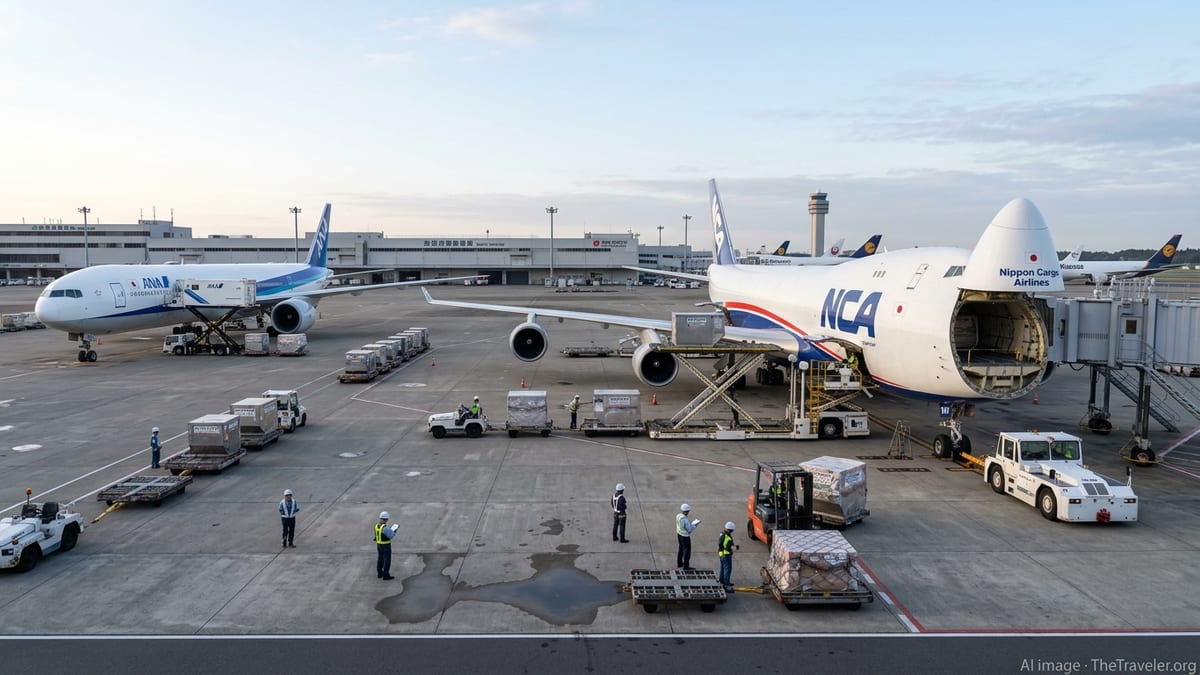
New Cargo Structure Builds on Nippon Cargo Airlines Integration
According to published corporate materials and recent market coverage, the centerpiece of ANA Group’s reorganization is a tighter integration of Nippon Cargo Airlines (NCA) into the wider group cargo platform. ANA Holdings completed the acquisition of NCA in 2025, bringing a dedicated all-cargo fleet and established transpacific and Asia–Europe routes under the same corporate umbrella as All Nippon Airways’ passenger and bellyhold operations.
The redesign of the cargo business seeks to align NCA’s long-haul freighter network with ANA’s existing hubs, schedules and product portfolio. Publicly available information indicates that the group is working toward unified planning of aircraft deployment, harmonized sales channels and coordinated handling standards, with the aim of offering shippers and forwarders a more seamless end-to-end proposition.
By positioning NCA as a specialized long-haul freighter operator within the ANA ecosystem, the group is also attempting to reduce overlap, sharpen route economics and capture scale benefits in areas such as maintenance, ground handling and fuel procurement. Analysts following the Japanese aviation market note that this kind of structural alignment has become increasingly important as dedicated cargo demand normalizes after the pandemic-driven surge.
Network Realignment Centers Freighters on Narita and Key Trade Lanes
ANA Group’s restructuring plan is closely linked to an ongoing realignment of its cargo network. Previous strategy documents and investor materials highlight a move to concentrate freighter operations at Tokyo Narita, positioning the airport as the primary hub for intercontinental cargo flows while shifting Okinawa’s role toward a model that relies more on belly capacity in passenger aircraft.
This hub-focused approach is designed to improve aircraft utilization and reduce operational complexity. Concentrating widebody freighters at a single primary long-haul gateway allows the group to tighten turnaround times, simplify crew and maintenance planning and create more predictable connectivity between Asian origins, Japan and onward destinations in Europe and North America.
The reorganization also reflects changing trade patterns. As e-commerce, high-value manufacturing and time-critical products continue to shape demand, ANA Group appears to be prioritizing trunk lanes that can support higher-yield, scheduled operations over more fragmented point-to-point flying. Market observers suggest that the combined network of ANA and NCA gives the group additional flexibility to adjust capacity across the Pacific and on intra-Asia sectors as macroeconomic conditions evolve.
Operational Efficiency and Digitalization at the Core of the Plan
Beyond fleet and network moves, the cargo business overhaul is framed around efficiency gains and process simplification. Public information from the group’s past annual and strategy reports points to initiatives such as consolidating cargo facilities, standardizing workflows across subsidiaries and expanding automation in warehousing and ground handling.
Digital tools are also expected to play a larger role. Industry commentary on ANA Group’s cargo strategy notes ongoing investment in platforms for online booking, shipment tracking and capacity management, in line with broader air cargo trends. The objective is to reduce manual intervention, shorten booking and documentation cycles and enhance visibility for forwarders and direct shippers, particularly for high-value or temperature-sensitive freight.
These efforts are occurring against a backdrop of moderating freight yields and a gradual return of passenger capacity in key markets, which has increased available bellyhold space. For ANA Group, driving down unit costs in its dedicated cargo arm is seen as essential to preserving profitability while still offering competitive rates to logistics partners.
Multi-Brand Strategy Evolves Around Cargo and Passenger Synergies
The cargo reorganization comes as ANA Group continues to reshape its broader multi-brand strategy in Japan and across the region. Recent announcements about adjustments to long-haul brands and regional operations indicate a push to simplify the portfolio and direct investment toward segments with clearer long-term returns, including cargo.
Within this context, the integration of NCA and the refocusing of cargo operations are intended to complement ANA’s passenger network rather than compete with it. By clearly dividing roles between dedicated freighters and belly capacity, the group aims to maximize load factors across both platforms, using freighters for dense, schedule-driven cargo corridors and passenger aircraft to provide additional lift and access in markets where demand is more variable.
Analysts note that such an approach can also support resilience. In periods of passenger weakness, the cargo arm can be used more actively to support group revenue, while in times of strong travel demand, carefully calibrated use of belly capacity can help maintain service for key freight customers without displacing high-yield passengers.
Competitive Pressure and Outlook for Japan’s Air Freight Sector
ANA Group’s cargo reorganization takes place in a competitive environment where global integrators, Middle Eastern hubs and Chinese carriers have all expanded their presence on major trade lanes relevant to Japan. Reports from industry publications point to intensifying competition on transpacific routes in particular, as new widebody capacity enters the market and some pandemic-era charter activity gives way to more systematic scheduled services.
For Japanese exporters and logistics providers, the consolidation of ANA’s cargo activities offers both opportunities and questions. A more integrated, larger-scale operator with unified commercial and operational management could provide improved connectivity and more stable schedules. At the same time, the emphasis on efficiency and network optimization may lead to adjustments in frequencies or routings on secondary lanes.
Market coverage suggests that, in the medium term, success will depend on how effectively ANA Group can merge corporate cultures between its existing cargo division and NCA, execute facility and process changes without disruption, and continue investing in digital tools that shippers increasingly expect as standard. With global air freight demand still sensitive to manufacturing cycles and consumer spending, the group’s ability to adapt capacity quickly will remain a critical test of the new structure.