

More news on this day
Thousands of visitors converged on Cambodia’s Angkor Wat between March 21 and 23 to witness the Angkor Equinox, a rare sunrise alignment that has become one of the country’s most powerful symbols of cultural heritage and tourism revival.
Get the latest news straight to your inbox!
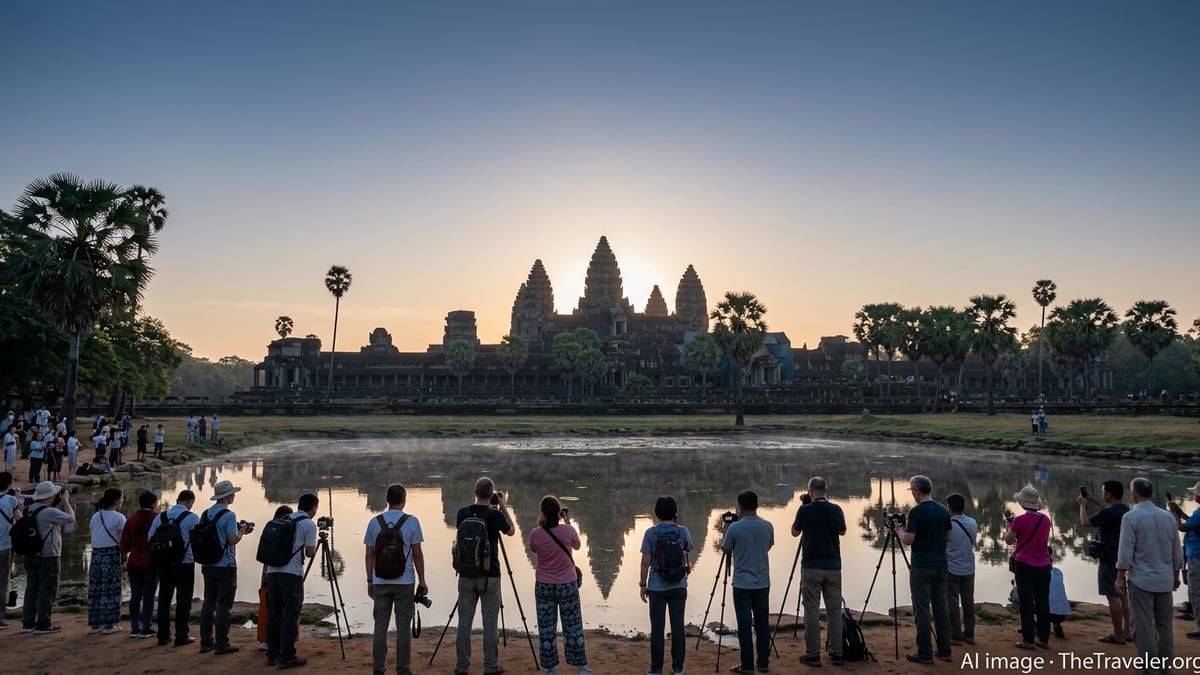
Rare Celestial Alignment Crowns Angkor Wat
During the Angkor Equinox, the rising sun appears to sit directly atop the central tower of Angkor Wat when viewed from the temple’s western entrance, creating a fleeting moment in which architecture and astronomy seem perfectly synchronized. Publicly available information describes this phenomenon as occurring only around the spring and autumn equinoxes, when day and night are nearly equal worldwide and the sun follows a path that intersects precisely with the 12th century temple’s east west axis.
Reports from regional and local media indicate that for several mornings in late March, crowds began gathering well before 5 a.m., lining the sandstone causeway, the edge of the main reflecting pool and nearby vantage points to secure a clear view. As dawn brightened the horizon, the silhouette of Angkor Wat slowly sharpened against a soft orange sky before the sun appeared to “crown” the central sanctuary, prompting a wave of camera shutters and audible gasps across the crowd.
Visuals shared in recent coverage and on social media show dense clusters of visitors packed shoulder to shoulder, phones and tripods raised, while faint mist and lingering morning humidity soften the temple’s outline. Although clouds occasionally obscure the alignment, many travelers and local residents still treat the event as a pilgrimage like experience, returning year after year in hopes of experiencing the exact moment of cosmic symmetry.
Growing Visitor Numbers Signal Tourism Momentum
The Angkor Equinox has evolved from a specialist interest for astronomers and heritage enthusiasts into a mass travel draw that is increasingly important to Cambodia’s tourism economy. Publicly available data from Angkor Enterprise and national tourism updates show that international visits to the Angkor Archaeological Park surpassed one million in 2024, with ticket revenues rebounding sharply from pandemic era lows.
Recent reporting from regional news outlets ahead of the 2026 equinox noted that authorities expected thousands of domestic and international visitors over the three day window, building on earlier years when tens of thousands turned out for both spring and autumn alignments. In previous equinox seasons, single mornings have reportedly seen attendance reach into the tens of thousands, underscoring the event’s expanding profile as a headline attraction in Southeast Asia’s competitive tourism landscape.
Travel industry observers point to the equinox as part of a broader shift in demand toward experiences that combine natural spectacle, cultural meaning and shareable imagery. Sunrise at Angkor has long been a bucket list experience, but the precise equinox alignment appears to be encouraging visitors to time their trips to a specific week in March or September, concentrating hotel bookings, guiding services and transport demand around Siem Reap.
In turn, the concentration of visitors has spurred local businesses to align their offerings with the phenomenon, from pre dawn breakfast services to specialized photography tours that promise the optimal angle on the central tower. The equinox period is increasingly viewed within the local tourism sector as an unofficial peak season within the broader dry season travel window.
Cultural Heritage and Astronomical Knowledge in Focus
The rising global profile of the Angkor Equinox is also drawing renewed attention to the temple’s original design and the scientific knowledge embedded in its layout. Academic studies and heritage publications note that Angkor Wat was conceived not only as a religious monument but also as a cosmological model, with its central sanctuary representing the sacred Mount Meru and its surrounding galleries echoing celestial orbits and time cycles.
Research publicly available through archaeological databases and scholarly work highlights how the temple’s main axis aligns with key solar events, including the equinox sunrise. The precise positioning of walls, towers and causeways suggests that the builders calculated the path of the sun with remarkable accuracy, integrating this knowledge into a monumental stone calendar that could mark turning points in the agricultural and ritual year.
This scientific and spiritual dimension is now an integral part of how the equinox is presented in tourism campaigns, guidebooks and interpretive materials. Visitors are encouraged to see the sunrise not only as a photographic opportunity but also as a window into the worldview of the Khmer Empire, when astronomy, religion and royal power were closely intertwined.
At the same time, Cambodian cultural commentators emphasize that the event still carries contemporary meaning. The shared experience of gathering quietly in the pre dawn darkness, waiting together for the first light to touch the temple stones, is often described as a moment of collective reflection that links past and present on one of the country’s most important sacred landscapes.
Managing Crowds and Protecting a Fragile Site
As the Angkor Equinox gains global visibility, questions about crowd management and heritage protection are coming into sharper focus. Angkor Wat and the surrounding archaeological park are already subject to conservation measures due to the vulnerability of sandstone structures, delicate carvings and centuries old foundations affected by climate and visitor pressure.
Public information from tourism and heritage bodies indicates that visitor flows are increasingly being managed through designated viewing zones around the main reflecting pool and western causeway during the equinox mornings. These arrangements are intended to balance visitor access with the need to prevent trampling of sensitive ground surfaces, damage to low relief carvings and unsafe congestion on stairways and temple platforms.
Local operators and heritage advocates argue that the equinox period can be a test case for sustainable crowd strategies, including timed ticketing, clear wayfinding, and improved visitor education about appropriate behavior at sacred sites. Some analysis suggests that by concentrating most visitors in specific vantage points outside the inner sanctuaries during sunrise, pressure on the most fragile areas may be reduced while still allowing thousands to experience the spectacle.
There is also increasing interest in spreading visitor activity across the wider Angkor complex and nearby temples, encouraging travelers to explore lesser known sites before or after sunrise. This approach, often highlighted in destination marketing and tour itineraries, aims to distribute economic benefits more widely while easing congestion at Angkor Wat itself.
Angkor Equinox as a Regional Symbol of Renewal
The Angkor Equinox now sits alongside events at other ancient sites around the world where solar alignments draw large crowds, but it carries particular significance for Cambodia’s image as a destination of cultural depth and resilience. For many travelers, the spectacle of the sun aligning with Angkor Wat’s central tower has become a shorthand for the country’s blend of spiritual heritage, natural beauty and post pandemic recovery.
Travel publications and regional tourism campaigns increasingly frame the equinox as an invitation to explore Cambodia beyond the classic postcard view. Siem Reap’s growing network of museums, contemporary arts venues, culinary experiences and community based excursions is frequently promoted in tandem with the equinox, encouraging visitors to extend their stays and engage more deeply with local culture.
With demand for meaningful, story rich journeys on the rise, the Angkor Equinox appears poised to remain a focal point on the global travel calendar. As long as crowd management and conservation strategies keep pace with interest, the moment each March when the sun crowns Angkor Wat’s central tower is likely to continue drawing thousands of people from around the world to Cambodia’s most iconic temple, reinforcing its role as both a living sacred space and a cornerstone of the nation’s tourism future.