

More news on this day
Angola is preparing to take a prominent place on the global aviation map, as national carrier TAAG Angola Airlines files plans to launch nonstop flights between Luanda and Guangzhou in March 2026, a move expected to transform air travel between Africa and Asia while deepening tourism, trade, and diplomatic ties with China.
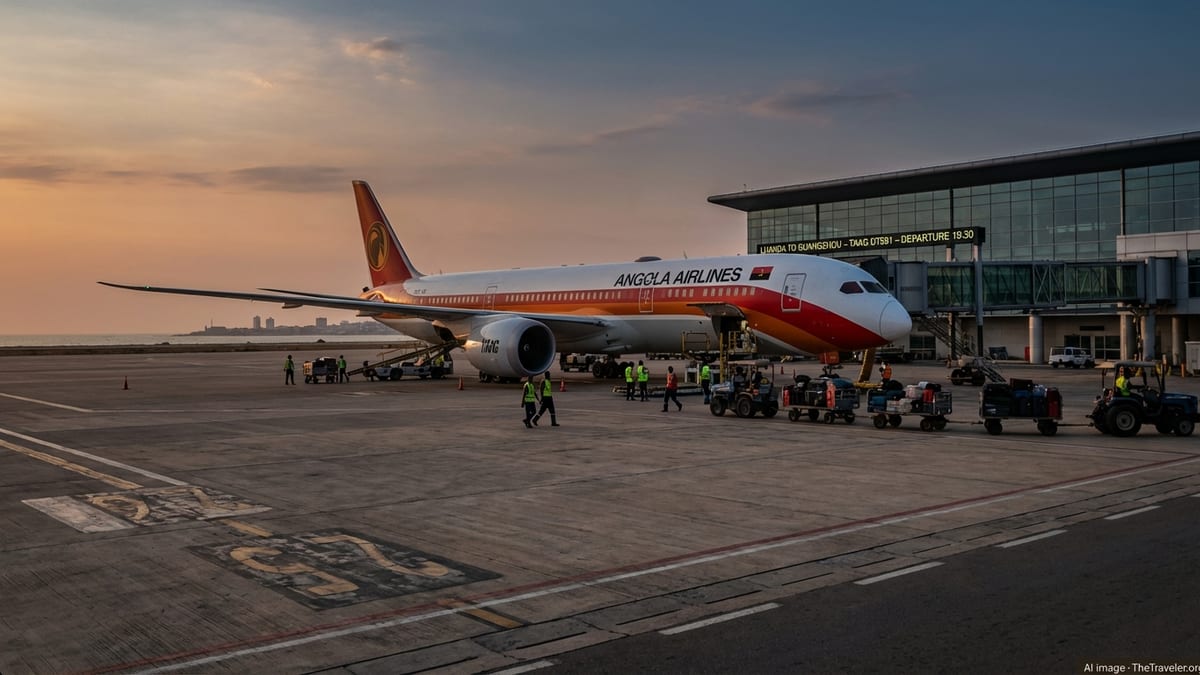
A New Nonstop Bridge Between Luanda and Guangzhou
TAAG Angola Airlines has lodged schedules for a new Luanda–Guangzhou service set to begin at the start of the Northern Hemisphere summer season on March 30, 2026, marking the first nonstop passenger connection between Angola and mainland China. The route will link Dr. Antonio Agostinho Neto International Airport, Luanda’s new hub, with Guangzhou Baiyun International Airport, one of China’s busiest gateways and a key manufacturing and commercial center.
The airline plans to operate three weekly flights using Boeing 787-9 aircraft, reflecting both rising demand and TAAG’s growing long haul capabilities. The projected schedule has late-evening departures from Luanda, arriving in Guangzhou the following evening, with return flights leaving shortly after midnight and landing back in Angola early the same morning. This pattern is designed to provide convenient onward connections on both sides of the route.
Industry analysts view the decision as a strong statement of intent from Luanda and Beijing to cement their partnership through aviation. With current journeys between Angola and China often requiring time-consuming connections in Addis Ababa, Doha, or other hubs, a nonstop option is expected to streamline travel for business travelers, migrant workers, students, and tourists moving between southern Africa and southern China.
Strategic Context: Angola’s Pivot to Asia and China’s African Footprint
The Luanda–Guangzhou launch sits at the intersection of Angola’s diversification strategy and China’s sustained economic outreach across Africa. Angola has long been a major African oil supplier to China, but Luanda is now positioning itself as a broader logistics, services, and tourism hub. A direct air link to southern China, one of the world’s most dynamic manufacturing belts, dovetails with official ambitions to attract investment in infrastructure, industry, and services.
China, for its part, has been steadily strengthening aviation and infrastructure ties with Angola. The new Dr. Antonio Agostinho Neto International Airport was constructed by a Chinese state-owned enterprise and is explicitly designed to function as a regional hub, with capacity for up to 15 million passengers a year. Officials in Luanda have framed the airport as a catalyst for an “airport city,” intended to draw logistics, hospitality, retail, and light manufacturing around the terminal complex.
The nonstop route also reinforces broader China–Africa connectivity trends, where Chinese cities are increasingly linking directly to African capitals rather than relying exclusively on Gulf or European hubs. Guangzhou, already a magnet for African traders, will now have a dedicated link to an emerging southern African hub, creating new patterns of movement that bypass traditional North–South corridors.
Tourism Prospects: From Trade Fairs to Atlantic Beaches
Tourism stakeholders in both countries see the new route as an opportunity to broaden flows beyond business and labor mobility. For Angolan tourism authorities, Guangzhou’s huge population and its role as a gateway to the Pearl River Delta open up a vast outbound market for Angola’s beaches, wildlife, culture, and Portuguese-influenced heritage. The shorter journey and removal of complex connections are expected to make Angola more appealing in a competitive African tourism landscape.
Luanda’s coastal setting, emerging resort developments along the Atlantic, and destinations such as Benguela, Namibe, and the UNESCO-listed city of Mbanza Congo give the country a differentiated offer for Chinese travelers seeking less saturated destinations. The government has been progressively investing in new hotels and upgrading key tourism sites, positioning itself to capture higher-spending visitors arriving on the 787-9 service.
On the Chinese side, Guangzhou and neighboring cities could see growing numbers of Angolan and regional African visitors, especially entrepreneurs, students, and participants in trade fairs. Angola’s growing middle class and business community already maintain commercial ties with Chinese suppliers; a nonstop link could widen that base to include leisure travelers combining business with short tourism stays in southern China’s urban and cultural attractions.
Trade and Cargo: Fast-Tracking Goods Across Continents
Beyond passengers, the Luanda–Guangzhou route is expected to carry significant belly cargo, further knitting together African and Asian supply chains. Angola and China have already experimented with trilateral freight corridors, such as the Changsha–Luanda–Sao Paulo cargo route linking Chinese manufacturers with South American markets via Angolan territory. The new nonstop passenger service will build on that foundation by transporting high-value and time-sensitive goods in the hold of TAAG’s 787-9 fleet.
Officials and industry observers anticipate that exports from Angola and its neighbors could range from minerals and oil-related equipment to agricultural products and perishables. Conversely, imports from China are likely to include machinery, consumer electronics, textiles, and building materials destined not only for Angola but for onward distribution across southern and central Africa. The proximity of Luanda’s new airport to port and highway corridors strengthens the country’s ambitions to become a multimodal logistics platform.
In recent years, TAAG has also scaled up dedicated cargo operations on intra-African routes, handling products such as Kenyan flowers through Luanda to intercontinental markets. Integrating a nonstop connection to Guangzhou gives freight forwarders and exporters another long haul option that could reduce total transport times and improve reliability, especially for goods that must reach Asian factories or distribution centers on tight schedules.
Angola’s New Hub: Dr. Antonio Agostinho Neto International Airport
The Luanda–Guangzhou service will be operated from Dr. Antonio Agostinho Neto International Airport, which has gradually taken over all domestic and international flights from the city’s older Quatro de Fevereiro Airport. The new facility, located about 40 kilometers from central Luanda, was designed from the outset with long haul operations in mind, featuring extended runways, modern passenger processing areas, and expanded cargo handling facilities.
Since its first passenger flights in late 2024, the airport has been ramping up operations and consolidating airlines under one roof. TAAG completed the transfer of its domestic network to the new hub by early 2025, and international services have followed. The airport’s design capacity and newer infrastructure enable more efficient operations, from quicker turnarounds on widebody aircraft to smoother passenger flows through security and immigration.
For travelers connecting to the Guangzhou service, this consolidation means more straightforward transfers between domestic, regional, and intercontinental flights. Angolan authorities have spoken openly about their ambition to see the airport emerge as a southern African transfer point connecting western and central Africa to destinations across the Atlantic and Indian Oceans. The nonstop link to southern China aligns directly with that strategy, adding an Asia-bound pillar to a network that has traditionally looked mainly to Europe and Brazil.
TAAG’s Fleet Renewal and Long Haul Ambitions
Introducing the Luanda–Guangzhou route coincides with a period of accelerated fleet modernization at TAAG. The carrier has been receiving new Airbus A220-300 aircraft to refresh its regional and continental network, while adding Boeing 787-9 widebodies to power long haul services. The 787-9 earmarked for the Guangzhou route features a layout including premium economy and economy cabins, suggesting an emphasis on value-conscious travelers alongside higher-yield business passengers.
The 787 family’s fuel efficiency and range are central to making nonstop flights between southern Africa and southern China commercially viable. Compared with older widebodies, the type offers lower operating costs and improved passenger comfort, including higher cabin humidity, larger windows, and quieter interiors. TAAG has also ordered additional 787 variants, underlining its intention to develop a more expansive long haul network over the coming years.
Regional expansion has gone hand in hand with this long haul push. New intra-African routes to cities such as Nairobi, Brazzaville, and other regional capitals have broadened TAAG’s feed into Luanda, giving the Guangzhou flights a larger catchment area. As more A220s enter service, the airline is expected to deepen connectivity across southern, eastern, and western Africa, ensuring that passengers bound for China can reach Luanda on same-day connections.
Competition, Connectivity, and the Wider Africa–Asia Market
The Luanda–Guangzhou link enters a competitive Africa–Asia market where Ethiopian Airlines, Qatar Airways, Emirates, and others already carry substantial traffic through their hubs. Today, many Angolan and regional travelers to China route via Addis Ababa, Doha, or Middle Eastern airports, often with long layovers. A nonstop alternative will give TAAG a new selling point, although capturing market share will require competitive pricing, schedule reliability, and strong partnerships on the Chinese side.
Nevertheless, analysts note that the new route does not merely redistribute existing traffic; it could stimulate fresh demand. Businesses that previously found the journey too cumbersome may now reconsider investment or sourcing ties, while smaller traders could travel more frequently to attend fairs or manage supply chains. At the same time, the presence of multiple routings between Africa and China can support resilience, ensuring that disruptions at any one hub do not sever the connection.
For China, wider African connectivity supports both trade diversification and people-to-people exchanges. Guangzhou already functions as a meeting point for African traders from numerous countries; adding Luanda as a nonstop node expands that network and reinforces China’s narrative of mutual development and partnership with African states. The route may also eventually tie into broader aviation agreements or code-sharing arrangements with Chinese carriers, further embedding Angola into Asia’s aviation landscape.
Economic Cooperation and Policy Alignment Behind the Route
The decision to launch nonstop services between Luanda and Guangzhou reflects not only commercial calculations but also policy alignment between Angola and China. Over the past decade, the two countries have signed multiple agreements on infrastructure, energy, and trade, with Chinese financing and expertise playing a central role in rebuilding Angolan roads, railways, and airports. Aviation is increasingly seen as a natural extension of this cooperation, turning physical infrastructure into functional connectivity.
Angolan officials have described the new airport and its emerging long haul routes as instruments for economic diversification, reducing overreliance on oil exports by stimulating services, tourism, and manufacturing. A direct pipeline to China’s industrial heartlands could make it easier for Angolan entrepreneurs to source machinery, negotiate joint ventures, and attend training or education programs, while also encouraging Chinese firms to explore opportunities in Angolan agriculture, fisheries, and light industry.
On a diplomatic level, the Luanda–Guangzhou route serves as a visible symbol of the relationship, particularly at a time when global supply chains are being reconfigured and countries are seeking more direct links with key partners. The flight’s launch in 2026 will likely be accompanied by official ceremonies and business delegations, reinforcing its status as more than just another entry on an airline schedule.
Outlook: From Single Route to Broader Corridor
Looking ahead, aviation experts suggest that the Luanda–Guangzhou service could be a precursor to a wider corridor linking southern Africa and East Asia. If load factors and yields prove robust, TAAG could consider increasing frequencies or exploring additional Chinese destinations, especially those with strong Angolan investment or diaspora connections. Secondary African cities feeding through Luanda might also see upgraded schedules to match banked connections with the Guangzhou flights.
The route’s success will depend on several variables, including visa facilitation, marketing efforts in both markets, and the reliability of ground infrastructure supporting passengers and cargo. However, the alignment of a modern, Chinese-built hub airport in Luanda, a renewed TAAG long haul fleet, and sustained demand for Africa–Asia trade gives the project a strong structural foundation. For travelers and businesses alike, the 2026 launch marks the opening chapter of a new, more direct era in air travel between Angola and China.