

More news on this day
Romanian airline AnimaWings is preparing to launch six weekly flights between London Gatwick and Bucharest from March 22, 2026, a capacity boost that analysts say could strengthen UK–Romania travel flows and support rising hotel demand around Gatwick Airport.
Get the latest news straight to your inbox!
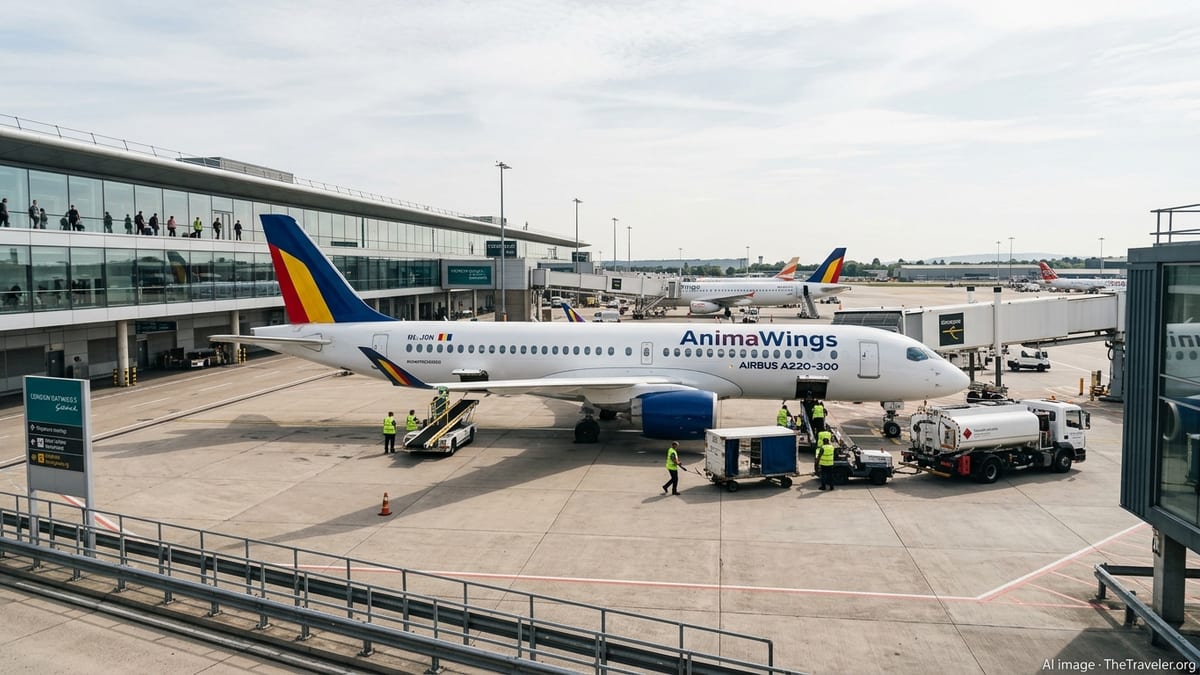
Six-Weekly A220 Service Brings Romanian Carrier Back to London
Publicly available information shows that AnimaWings, a 100 percent Romanian-owned carrier, will enter the UK market with direct Bucharest–London Gatwick services operating six times a week from March 22, 2026. The route will run every day except Saturday, restoring a Romanian-operated connection to London for the first time since Romania’s state carrier withdrew from Heathrow in October 2024.
Industry schedule data indicates that the flights will be operated by Airbus A220-300 aircraft configured with business, premium economy and economy cabins. The use of a modern narrowbody jet is expected to give the airline flexibility to target both leisure and corporate travellers while keeping operating costs and fuel burn relatively low on the roughly three-hour sector.
Reports from aviation outlets note that AnimaWings has been steadily expanding its European footprint, adding routes from Bucharest to cities such as Munich, Dublin, Prague and Sofia, alongside new domestic links within Romania. The Gatwick launch is seen as a flagship move in this wider strategy to position the carrier as a full-service alternative on key European business and migrant corridors.
According to published coverage of the announcement, introductory one-way fares from Bucharest are advertised from under 70 euros, including cabin baggage, seat selection, hot meals and both online and airport check-in. Those inclusions are likely to differentiate the product in a UK–Romania market dominated by low-cost competitors that typically unbundle such services.
Boost for UK–Romania Tourism and VFR Travel
Tourism analysts point out that the UK is one of the largest outbound markets for Romania, with city breaks to Bucharest and access to Carpathian mountain and Black Sea destinations already popular among British travellers. Direct flights into Gatwick, which has strong rail and coach links to central London and southern England, are expected to make short breaks and longer holidays more straightforward for UK visitors.
The route is also likely to serve substantial visiting friends and relatives traffic. Romania has a significant diaspora in the UK, and increased capacity on a full-service airline may appeal to travellers who prioritise schedule reliability, baggage allowances and onboard comfort over the bare-minimum offering of some ultra-low-cost carriers. Travel trade commentators suggest this could encourage more frequent trips in both directions, especially outside peak summer months.
In addition, easier access to Bucharest via a centrally located London airport may stimulate niche segments such as stag and hen weekends, cultural tourism focused on Romania’s historic cities and castles, and organised tours combining the capital with wine regions and nature reserves. Package operators and online travel agencies are likely to monitor booking trends closely once the Gatwick schedule opens.
Romanian inbound tourism may also see an indirect benefit. AnimaWings’ network growth from Bucharest means UK travellers arriving at Gatwick could connect through the Romanian capital onward to other regional cities on the same carrier, potentially raising awareness of secondary destinations that have historically seen less international traffic.
Gatwick Hotels and Local Economy Eye Increased Demand
The arrival of AnimaWings adds to a growing list of new carriers and routes at Gatwick for the 2026 summer season, a pattern that airport-focused publications say is pushing passenger numbers toward record levels. Every additional high-frequency route typically creates incremental overnight demand from travellers who choose to stay near the airport before early departures or after late-night arrivals.
Given that the Bucharest flights are expected to include morning and evening operations, hotel analysts believe the pattern will favour both pre-flight and post-flight stays. Properties clustered around Gatwick’s North and South terminals, as well as budget and midscale hotels in nearby towns such as Crawley and Horley, are anticipated to benefit from higher occupancy, particularly on the six operating days each week.
Gatwick’s role as a base for tour operators and coach companies could amplify this effect. When new routes open, ground transport providers often adjust timetables to capture connecting passengers, which in turn supports ancillary spending on food, retail and parking. Observers of the local market say that a consistent six-times-weekly operation, rather than a limited seasonal or charter schedule, gives businesses more confidence to plan staffing and capacity increases.
Local tourism boards and destination marketing organisations in the South East of England are expected to highlight the new connection in campaigns aimed at Central and Eastern European visitors. Easier access to London, Brighton, the South Downs and coastal resorts via Gatwick may encourage Romanian travellers to extend their stays or explore beyond the capital, further dispersing tourism spend across the region.
Competitive Pressures and Market Dynamics on the UK–Romania Corridor
Industry observers note that the UK–Romania market has been shaped in recent years by aggressive growth from low-cost carriers operating into London’s multi-airport system. Gatwick already sees significant point-to-point traffic to Central and Eastern Europe, and the entry of a Romanian full-service airline on the Bucharest route adds another layer of competition on price, schedule and onboard experience.
While low-cost operators may retain a cost advantage, AnimaWings’ bundled services and cabin segmentation could appeal to corporate accounts, small and medium-sized enterprises, and travellers booking through traditional travel agencies. Business-class seating on a Romanian-operated flight to London also represents a symbolic return for a product that disappeared when the state airline exited its Heathrow service.
Aviation market commentary suggests that Gatwick’s wider expansion, including new links to the Middle East, China and other European hubs, is steadily reinforcing the airport’s position as a multi-network gateway rather than purely a leisure base. In that context, the Bucharest connection may help airlines tap into one-stop flows between Romania and long-haul destinations served from Gatwick, increasing overall route resilience.
Regulatory and operational planning documents highlight that both Gatwick and Bucharest Otopeni are working through airspace and infrastructure improvements ahead of the mid-2020s traffic peak. Additional frequencies such as AnimaWings’ six-weekly operation will test how efficiently those upgrades translate into on-time performance, a factor that UK and Romanian business travellers in particular are likely to watch closely.
Signals of a Broader AnimaWings Expansion Strategy
The Gatwick launch is widely seen as part of a broader growth strategy by AnimaWings, which has been investing in a young Airbus A220 fleet and adding new European and domestic routes at pace. Company announcements over the past two years show a focus on connecting Bucharest to key business, mobility and diaspora destinations, from Munich and Dublin to Stockholm and multiple cities within Romania.
By selecting Gatwick as its UK entry point, the airline aligns itself with an airport that is increasingly courting a mix of leisure and higher-yield traffic. Sector analysts say that success on the Bucharest–Gatwick route could encourage further capacity or additional UK points, such as regional cities with strong Romanian communities or universities attracting Romanian students.
For now, the six-weekly schedule from March 2026 positions AnimaWings as a new competitor in a busy London market while restoring a Romanian flag presence on flights to the UK capital. If demand materialises as expected, the route could become a cornerstone in the airline’s international network and a meaningful contributor to tourism and hospitality revenues on both sides of the continent.