

More news on this day
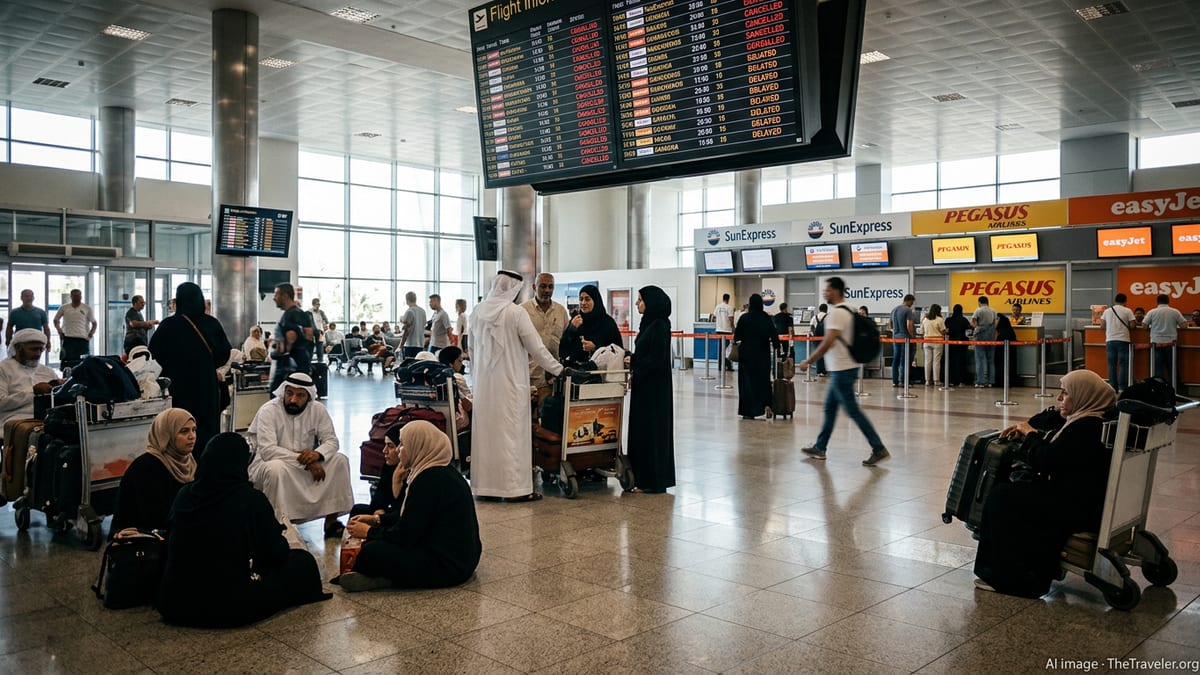
Hundreds of travelers from Saudi Arabia, the United Arab Emirates and Kuwait were left in limbo at Antalya Airport on Saturday after four flights were canceled and at least seven more delayed, as regional airspace restrictions rippled across one of Turkey’s busiest holiday gateways.
Regional Turbulence Hits a Popular Holiday Hub
The disruption at Antalya Airport comes as Turkey extends suspensions and restrictions on flights across parts of the Middle East, forcing carriers to reroute or ground services on short notice. Turkish authorities have confirmed that airlines including SunExpress, Pegasus Airlines and other Turkish carriers have curtailed or modified operations to destinations in Iran, Iraq, Syria, Lebanon and Jordan, while flights involving Gulf airspace are being tightly managed for safety.
Although Antalya is primarily a leisure destination on Turkey’s Mediterranean coast, it is heavily dependent on complex regional air corridors that connect it to major hubs in the Gulf. When those corridors are restricted or closed, even flights that are not headed directly into conflict zones can face cascading delays, equipment changes or outright cancellations.
Saturday’s problems centered on several departures and arrivals involving passengers originating in or connecting from Saudi Arabia, the UAE and Kuwait. Many were visiting Antalya on package holidays, and some only learned of cancellations after clearing security, leading to crowded scenes at departure gates and airline service desks.
Airport sources said ground handlers and airline staff were working to rebook affected customers, but warned that limited spare capacity and shifting airspace conditions meant that not every traveler could be accommodated on the same day.
SunExpress, Pegasus and easyJet Among Affected Carriers
Domestic and European low cost carriers were among the first to feel the strain. SunExpress, the joint venture between Turkish Airlines and Lufthansa that operates a dense Antalya network, confirmed that several departures had been canceled or significantly delayed as aircraft and crew were repositioned to work around restricted airspace in the wider region.
Pegasus Airlines, another major Turkish low cost carrier with extensive Antalya operations, also faced knock on effects. While many of its point to point routes continue to operate, rotations that normally rely on aircraft coming in from or heading toward affected Middle Eastern airspace have been disrupted, resulting in schedule gaps and rolling delays through the day.
easyJet, which flies seasonal and regular routes linking Antalya with key European markets, has not been immune either. A combination of crew duty time limitations, earlier diversions and the need to avoid closed corridors has meant that some Antalya flights cannot depart on time or at all, even when weather and local conditions in Turkey appear normal.
Collectively, the three carriers account for a large share of Antalya’s international leisure traffic. When several of their flights fail to operate as planned, the impact spreads quickly through tour operators, hotel transfers and connecting journeys that rely on predictable arrival and departure times.
Stranded Gulf Passengers Face Long Waits and Limited Options
Travelers from Saudi Arabia, the UAE and Kuwait were particularly exposed to Saturday’s disruption. Many had booked Antalya packages via regional tour operators or online travel agencies, flying to Turkey on a mix of direct and connecting services. With four flights canceled and seven delayed, large family groups and individual travelers alike found themselves queueing at airline counters seeking clarity on when they might be able to leave.
Some passengers reported that they received cancellation emails only after arriving at the airport, while others found out when departure boards abruptly flipped their flights from scheduled to canceled. For those with onward connections back to the Gulf or beyond, this created a domino effect of missed flights and uncertain accommodation plans.
Despite visible frustration, most passengers spoken to at the terminal expressed understanding that safety concerns and airspace restrictions were driving the disruption. However, confusion over differing airline policies, as well as language barriers and long waits for customer service, have added to the stress for many stranded holidaymakers.
Staff at several airline desks urged passengers to avoid repeatedly changing lines between counters and to stick with their operating carrier’s official rebooking process, warning that unofficial information circulating on social media about extra flights and open seats was often unreliable or quickly outdated.
What Travelers Need to Know About Rebooking and Refunds
For affected SunExpress customers, the airline is generally offering free rebooking on the next available flight on the same route, subject to seat availability. Where rerouting via other Turkish airports is possible, some passengers are being reprotected on alternative services, though this often involves longer travel times and overnight stays. Travelers are being encouraged to manage changes through official digital channels if their booking allows, which can be faster than waiting in physical queues when disruption is widespread.
Pegasus Airlines has indicated in prior disruption events that passengers on canceled flights are typically entitled to choose between rebooking without change fees, receiving a travel voucher, or requesting a refund, depending on the original fare type and the cause of cancellation. At Antalya, staff have been prioritizing same day rebooking where seats exist, especially for families and travelers with imminent visa or work obligations back in the Gulf.
For easyJet customers, standard practice in cancellations is to offer a choice of a free transfer to another easyJet flight, a voucher or a cash refund. In some cases, particularly when cancellations are announced on the day of travel and are within the airline’s control, passengers may also be eligible for care and assistance such as hotel accommodation and meals. However, when cancellations are clearly linked to extraordinary circumstances such as sudden airspace closures or security restrictions, compensation rules may be more limited even though rebooking and refund rights remain.
In all cases, travelers are advised to keep boarding passes, booking confirmations and receipts for any additional expenses such as meals or hotels, as these documents may be required later if they decide to lodge a formal claim or seek reimbursement under airline policies or travel insurance.
Practical Tips for Passengers Still Due to Fly Through Antalya
With airspace conditions and airline schedules still volatile, passengers scheduled to travel through Antalya in the coming days are being urged to treat their itineraries as fluid rather than fixed. Experts recommend checking flight status directly with the operating airline several times in the 24 hours before departure, rather than relying solely on third party booking platforms or generic airport information screens.
Arriving at the airport earlier than usual can help, especially for those who may need to speak with an agent about alternative routings or missing connections. At the same time, crowding check in halls with travelers who are not flying that day can slow down assistance for those with confirmed departures, so authorities have asked that only ticketed passengers for the current travel window come to the terminal.
For Gulf travelers in particular, flexibility on routing and dates may be crucial. Accepting a flight that returns via Istanbul, Ankara or a European hub before connecting on to Riyadh, Jeddah, Dubai, Abu Dhabi or Kuwait City could significantly shorten the time spent stranded compared with waiting for a single direct seat to open from Antalya. Those with travel insurance should review their policy wording for disruption coverage and contact their insurer once they have documentation from the airline confirming any cancellation.
While Saturday’s disruption has caused frustration and uncertainty, aviation officials emphasize that safety considerations remain paramount as regional tensions continue to affect airspace planning. Until those conditions stabilize, passengers traveling through Antalya and other regional hubs should be prepared for last minute changes and ensure that their contact details are up to date with airlines and tour operators.